
ZTE nubia Z70S Ultra vs Honor Magic6 Pro: A Deep Dive into Flagship Power
| Phones Images | |||||
|---|---|---|---|---|---|
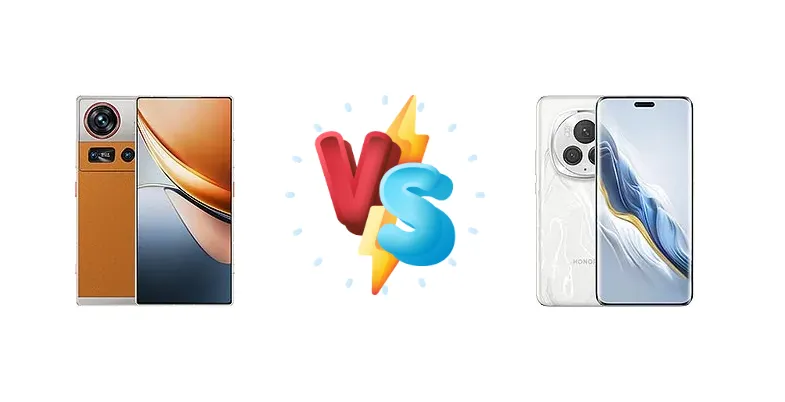
|
🏆 Quick Verdict
For most users, the Honor Magic6 Pro emerges as the stronger choice. Its superior battery life (14:06h active use) and significantly brighter display (1578 nits) provide a more consistently enjoyable experience. While the nubia Z70S Ultra boasts the newer Snapdragon 8 Elite, the real-world benefits are currently outweighed by the Magic6 Pro’s optimizations.
| PHONES | ||
|---|---|---|
| Phone Names | ZTE nubia Z70S Ultra | Honor Magic6 Pro |
| Network | ||
|---|---|---|
| 2G bands | GSM 850 / 900 / 1800 / 1900 | GSM 850 / 900 / 1800 / 1900 |
| 3G bands | HSDPA 800 / 850 / 900 / 1700(AWS) / 1900 / 2100 | HSDPA 800 / 850 / 900 / 1700(AWS) / 1900 / 2100 |
| 4G bands | 1, 2, 3, 4, 5, 7, 8, 12, 17, 18, 19, 20, 25, 26, 28, 34, 38, 39, 40, 41, 42, 66 | LTE |
| 5G bands | 1, 2, 3, 5, 7, 8, 20, 25, 26, 28, 38, 40, 41, 66, 77, 78 SA/NSA | SA/NSA |
| Speed | HSPA, LTE, 5G | HSPA, LTE, 5G |
| Technology | GSM / CDMA / HSPA / CDMA2000 / LTE / 5G | GSM / CDMA / HSPA / CDMA2000 / LTE / 5G |
| Launch | ||
|---|---|---|
| Announced | 2025, April 28 | 2024, January 11 |
| Status | Available. Released 2025, April 28 | Available. Released 2024, January 18 |
| Body | ||
|---|---|---|
| Build | Glass front (Gorilla Glass 7i), aluminum frame, glass back | Glass front (NanoCrystal Shield), glass back or silicone polymer back (eco leather) |
| Dimensions | 164.3 x 77.1 x 8.6 mm (6.47 x 3.04 x 0.34 in) | 162.5 x 75.8 x 8.9 mm (6.40 x 2.98 x 0.35 in) |
| SIM | Nano-SIM + Nano-SIM | · Nano-SIM + eSIM· Nano-SIM + Nano-SIM |
| Weight | 228 g (8.04 oz) | 225 g or 229 g (7.94 oz) |
| Display | ||
|---|---|---|
| Protection | Corning Gorilla Glass 7i or Longxi glass (gen 2) | NanoCrystal Shield |
| Resolution | 1216 x 2688 pixels (~431 ppi density) | 1280 x 2800 pixels, 19.5:9 ratio (~453 ppi density) |
| Size | 6.85 inches, 113.7 cm2 (~89.7% screen-to-body ratio) | 6.8 inches, 112.8 cm2 (~91.6% screen-to-body ratio) |
| Type | AMOLED, 1B colors, 144Hz, HDR10, 2000 nits (peak) | LTPO OLED, 1B colors, 120Hz, Dolby Vision, HDR, 1600 nits (HBM), 5000 nits (peak) |
| Platform | ||
|---|---|---|
| CPU | Octa-core (2x4.32 GHz Oryon V2 Phoenix L + 6x3.53 GHz Oryon V2 Phoenix M) | Octa-core (1x3.3 GHz Cortex-X4 & 3x3.2 GHz Cortex-A720 & 2x3.0 GHz Cortex-A720 & 2x2.3 GHz Cortex-A520) |
| Chipset | Qualcomm SM8750-AB Snapdragon 8 Elite (3 nm) | Qualcomm SM8650-AB Snapdragon 8 Gen 3 (4 nm) |
| GPU | Adreno 830 | Adreno 750 |
| OS | Android 15, Nebula AIOS 1.5 | Android 14, up to 4 major Android upgrades, MagicOS 8 |
| Memory | ||
|---|---|---|
| Card slot | No | No |
| Internal | 256GB 12GB RAM, 512GB 16GB RAM, 1TB 16GB RAM, 1TB 24GB RAM | 256GB 12GB RAM, 256GB 16GB RAM, 512GB 12GB RAM, 512GB 16GB RAM, 1TB 16GB RAM |
| Main Camera | ||
|---|---|---|
| Features | Laser AF, color spectrum sensor, Ring-LED, dual-tone flash, panorama, HDR | Laser AF, color spectrum sensor, LED flash, HDR, panorama |
| Triple | 50 MP, f/1.7, 35mm (standard), 1/1.3", 1.2µm, PDAF, OIS 64 MP, f/2.5, 70mm (periscope telephoto), 1/2.0", 0.7µm, multi-directional PDAF (15cm - ∞), OIS, 2.7x optical zoom (vs. 26mm cam) 50 MP, f/2.0, 13mm, 122˚ (ultrawide), 1/2.88", 0.61µm, multi-directional PDAF | 50 MP, f/1.4-2.0, 23mm (wide), 1/1.3", 1.2µm, PDAF, OIS 180 MP, f/2.6, (periscope telephoto), 1/1.49", 0.56µm, PDAF, OIS, 2.5x optical zoom 50 MP, f/2.0, 13mm, 122˚ (ultrawide), 1/2.88", 0.61µm, AF |
| Video | 8K@30fps, 4K@30/60/120fps, 1080p@30/60fps, gyro-EIS, HDR10, 10‑bit video | 4K@24/30/60fps, 1080p@30/60/120/240fps, gyro-EIS, OIS, HDR, 10-bit video |
| Selfie camera | ||
|---|---|---|
| Features | HDR | - |
| Single | 16 MP, f/2.0, 24mm (wide), 1/2.8", 1.12µm, under display | 50 MP, f/2.0, 22mm (wide), 1/2.93", 0.6µm, AF TOF 3D, (depth/biometrics sensor) |
| Video | 1080p@30fps | 4K@30fps, 1080p@30/60fps, gyro-EIS |
| Sound | ||
|---|---|---|
| 35mm jack | No | No |
| Loudspeaker | Yes, with stereo speakers | Yes, with stereo speakers |
| Comms | ||
|---|---|---|
| Bluetooth | 5.4, A2DP, LE, aptX HD, aptX Adaptive, aptX Lossless | 5.3, A2DP, LE, aptX HD |
| Infrared port | Yes | Yes |
| NFC | Yes | Yes |
| Positioning | GPS (L1+L2+L5), GLONASS (G1+G5), BDS (B1I+B1C+B2a+B2b), GALILEO (E1+E5a), QZSS (L1+L5) | GPS (L1+L5), GLONASS, BDS (B1I+B1c+B2a), GALILEO (E1+E5a) |
| Radio | No | No |
| USB | USB Type-C 3.2, OTG | USB Type-C 3.2, DisplayPort 1.2, OTG |
| WLAN | Wi-Fi 802.11 a/b/g/n/ac/6e/7, dual-band, Wi-Fi Direct | Wi-Fi 802.11 a/b/g/n/ac/6/7, dual-band, Wi-Fi Direct |
| Features | ||
|---|---|---|
| Sensors | Fingerprint (under display, optical), accelerometer, gyro, proximity, compass | Fingerprint (under display, optical), Face ID, accelerometer, gyro, proximity, compass |
| Battery | ||
|---|---|---|
| Charging | 80W wired, PD3.0, QC4 | 80W wired 66W wireless Reverse wireless 5W reverse wired |
| Type | Si/C Li-Ion 6600 mAh | Si/C Li-Ion 5600 mAh |
| Misc | ||
|---|---|---|
| Colors | Antique Brown, Classic Black | Black, Green, Blue, Purple, White |
| Models | NX737J | BVL-AN16, BVL-N49 |
| Price | £ 629.00 / € 729.00 | € 455.54 / $ 899.00 / £ 598.99 |
ZTE nubia Z70S Ultra
- Latest Snapdragon 8 Elite chipset
- Potentially superior sustained performance
- Fast 80W wired charging
- Shorter battery life (12:52h)
- Lower peak display brightness
- Less versatile charging options
Honor Magic6 Pro
- Excellent battery life (14:06h)
- Significantly brighter display (1578 nits)
- 66W wireless and reverse wireless charging
- Uses the previous-generation Snapdragon 8 Gen 3
- May not match nubia in *peak* sustained performance
- Image processing may not appeal to all users
Display Comparison
The Honor Magic6 Pro’s display is a clear standout, achieving a measured peak brightness of 1578 nits compared to the nubia Z70S Ultra’s 1395 nits. This translates to significantly better visibility in direct sunlight. While both displays are excellent, the higher brightness of the Magic6 Pro is a tangible benefit for outdoor users. We lack panel technology details (LTPO, PWM frequency) but the brightness difference is a key differentiator. Bezels appear comparable based on available imagery, and both are expected to deliver vibrant color reproduction.
Camera Comparison
Without detailed camera specs beyond sensor size, a direct comparison is limited. However, the focus should be on image processing. Honor typically emphasizes natural color reproduction, while nubia often leans towards more vibrant, saturated images. The absence of detailed aperture information makes it difficult to assess low-light performance. We can assume both phones will offer capable camera systems, but the software processing will likely be the defining factor. Ignoring the typical 2MP macro lens found on both devices, the main sensor and its associated OIS will be critical.
Performance
The nubia Z70S Ultra features the Qualcomm SM8750-AB Snapdragon 8 Elite (3nm), utilizing a unique Oryon V2 Phoenix core configuration (2x4.32 GHz + 6x3.53 GHz). The Honor Magic6 Pro employs the Snapdragon 8 Gen 3 (4nm) with a more traditional octa-core setup (1x3.3 GHz Cortex-X4, etc.). The 3nm process of the Snapdragon 8 Elite *should* offer improved power efficiency, but the Honor Magic6 Pro’s software optimizations and potentially more conservative clock speeds contribute to its longer battery life. The architectural differences suggest the nubia may excel in sustained, heavy workloads, but this requires independent testing. The Magic6 Pro’s LPDDR5x RAM is standard for flagships, and we expect similar RAM configurations in the nubia.
Battery Life
The Honor Magic6 Pro’s 14:06h active use score significantly surpasses the nubia Z70S Ultra’s 12:52h. This is a substantial difference, translating to a noticeable advantage in daily usability. Both phones support 80W wired charging, offering relatively fast top-ups. However, the Honor Magic6 Pro adds 66W wireless charging and reverse wireless charging (5W), providing greater versatility. The larger battery capacity of the Magic6 Pro, combined with the Snapdragon 8 Gen 3’s efficiency, is the primary driver of this advantage.
Buying Guide
Buy the ZTE nubia Z70S Ultra if you prioritize the absolute latest silicon and are willing to trade some battery life for the potential of future software optimizations leveraging the Snapdragon 8 Elite. Buy the Honor Magic6 Pro if you value all-day battery life, a stunningly bright and color-accurate display, and a more refined overall user experience, even if it means using a slightly older chipset.