
ZTE nubia Z70 Ultra vs. Samsung Galaxy S24 FE: A Deep Dive Comparison
| Phones Images | |||||
|---|---|---|---|---|---|
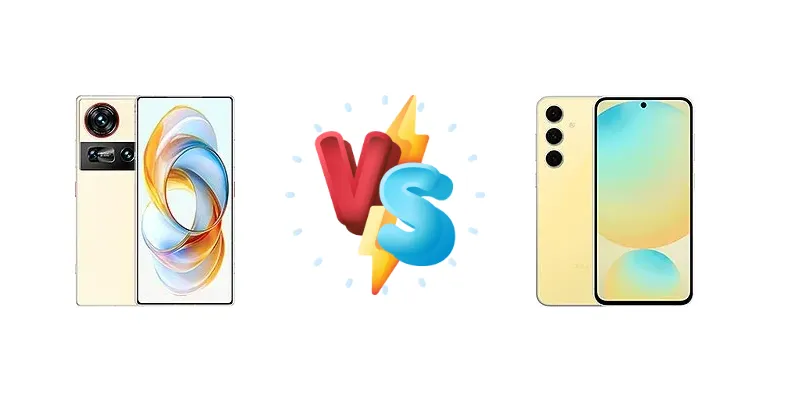
|
🏆 Quick Verdict
For users prioritizing raw performance and sustained gaming, the ZTE nubia Z70 Ultra emerges as the winner. Its Snapdragon 8 Elite chipset and aggressive cooling solution provide a noticeable edge. However, the Samsung Galaxy S24 FE’s exceptional battery endurance and software ecosystem make it a compelling choice for everyday users.
| PHONES | ||
|---|---|---|
| Phone Names | ZTE nubia Z70 Ultra | Samsung Galaxy S24 FE |
| Network | ||
|---|---|---|
| 2G bands | GSM 850 / 900 / 1800 / 1900 | GSM 850 / 900 / 1800 / 1900 |
| 3G bands | HSDPA 800 / 850 / 900 / 1700(AWS) / 1900 / 2100 | HSDPA 850 / 900 / 1700(AWS) / 1900 / 2100 |
| 4G bands | 1, 2, 3, 4, 5, 7, 8, 12, 17, 18, 19, 20, 25, 26, 28, 34, 39, 40, 41, 38, 42, 66 | 1, 2, 3, 4, 5, 7, 8, 12, 17, 18, 19, 20, 25, 26, 28, 32, 38, 40, 41, 66 - International |
| 5G bands | 1, 2, 3, 5, 7, 8, 20, 25, 26, 28, 38, 40, 41, 66, 77, 78 SA/NSA | 1, 2, 3, 5, 7, 8, 12, 20, 25, 26, 28, 38, 40, 41, 66, 75, 77, 78 SA/NSA/Sub6 - International |
| Speed | HSPA, LTE, 5G | HSPA, LTE, 5G |
| Technology | GSM / CDMA / HSPA / CDMA2000 / LTE / 5G | GSM / HSPA / LTE / 5G |
| Launch | ||
|---|---|---|
| Announced | 2024, November 21 | 2024, September 26 |
| Status | Available. Released 2024, November 25 | Available. Released 2024, October 03 |
| Body | ||
|---|---|---|
| Build | Glass front, aluminum frame, glass back | Glass front (Gorilla Glass Victus+), glass back (Gorilla Glass Victus+), aluminum frame |
| Dimensions | 164.3 x 77.1 x 8.6 mm (6.47 x 3.04 x 0.34 in) | 162 x 77.3 x 8 mm (6.38 x 3.04 x 0.31 in) |
| SIM | Nano-SIM + Nano-SIM | · Nano-SIM· Nano-SIM + Nano-SIM· Nano-SIM + eSIM· eSIM + eSIM |
| Weight | 228 g (8.04 oz) | 213 g (7.51 oz) |
| Display | ||
|---|---|---|
| Protection | Longxi glass (gen 2) | Corning Gorilla Glass Victus+, Mohs level 5 |
| Resolution | 1216 x 2688 pixels (~431 ppi density) | 1080 x 2340 pixels, 19.5:9 ratio (~385 ppi density) |
| Size | 6.85 inches, 113.7 cm2 (~89.7% screen-to-body ratio) | 6.7 inches, 110.2 cm2 (~88.0% screen-to-body ratio) |
| Type | AMOLED, 1B colors, 144Hz, HDR10, 2000 nits (peak) | Dynamic AMOLED 2X, 120Hz, HDR10+, 1900 nits (peak) |
| Platform | ||
|---|---|---|
| CPU | Octa-core (2x4.32 GHz Oryon V2 Phoenix L + 6x3.53 GHz Oryon V2 Phoenix M) | 10-core (1x3.1 GHz + 2x2.9 GHz + 3x2.6 GHz + 4x1.95 GHz) |
| Chipset | Qualcomm SM8750-AB Snapdragon 8 Elite (3 nm) | Exynos 2400e (4 nm) |
| GPU | Adreno 830 | Xclipse 940 |
| OS | Android 15, Nebula AIOS | Android 14, up to 7 major Android upgrades, One UI 8.0 |
| Memory | ||
|---|---|---|
| Card slot | No | No |
| Internal | 256GB 12GB RAM, 512GB 16GB RAM, 1TB 16GB RAM, 1TB 24GB RAM | 128GB 8GB RAM, 256GB 8GB RAM, 512GB 8GB RAM |
| Main Camera | ||
|---|---|---|
| Features | Laser AF, color spectrum sensor, Ring-LED, dual-tone flash, panorama, HDR | LED flash, HDR, panorama |
| Triple | 50 MP, f/1.6-4.0, 35mm (standard), 1/1.56", 1.0µm, multi-directional PDAF, OIS 64 MP, f/2.5, 70mm (periscope telephoto), 1/2.0", 0.7µm, multi-directional PDAF (15cm - ∞), OIS, 2.7x optical zoom (vs. 26mm cam) 50 MP, f/2.0, 13mm, 122˚ (ultrawide), 1/2.88", 0.61µm, multi-directional PDAF | 50 MP, f/1.8, 24mm (wide), 1/1.57", 1.0µm, dual pixel PDAF, OIS 8 MP, f/2.4, 75mm (telephoto), 1/4.4", 1.0µm, PDAF, OIS, 3x optical zoom 12 MP, f/2.2, 13mm, 123˚ (ultrawide), 1/3.0", 1.12µm |
| Video | 8K@30fps, 4K@30/60/120fps, 1080p@30/60fps, gyro-EIS, HDR10, 10‑bit video | 8K@30fps, 4K@30/60/120fps, 1080p@30/60/120/240fps |
| Selfie camera | ||
|---|---|---|
| Features | HDR | - |
| Single | 16 MP, f/2.5, 24mm (wide), 1/2.8", 1.12µm, under display | 10 MP, f/2.4, 26mm (wide), 1/3.0", 1.22µm |
| Video | 1080p@30fps | 4K@30/60fps, 1080p@30/60fps; gyro-EIS |
| Sound | ||
|---|---|---|
| 35mm jack | No | No |
| Loudspeaker | Yes, with stereo speakers | Yes, with stereo speakers |
| Comms | ||
|---|---|---|
| Bluetooth | 5.4, A2DP, LE, aptX HD, aptX Adaptive, aptX Lossless | 5.3, A2DP, LE |
| Infrared port | Yes | - |
| NFC | Yes | Yes |
| Positioning | GPS (L1+L2+L5), GLONASS (G1+G5), BDS (B1I+B1C+B2a+B2b), GALILEO (E1+E5a), QZSS (L1+L5) | GPS, GLONASS, GALILEO, BDS |
| Radio | No | Unspecified |
| USB | USB Type-C 3.2, OTG | USB Type-C 3.2, OTG |
| WLAN | Wi-Fi 802.11 a/b/g/n/ac/6e/7, dual-band, Wi-Fi Direct | Wi-Fi 802.11 a/b/g/n/ac/6e, dual-band or tri-band (market/region dependent), Wi-Fi Direct |
| Features | ||
|---|---|---|
| Sensors | Fingerprint (under display, optical), accelerometer, gyro, proximity, compass | Fingerprint (under display, optical), accelerometer, gyro, compass |
| Battery | ||
|---|---|---|
| Charging | 80W wired, PD3.0, QC4 | 25W wired, PD, QC2, 50% in 30 min 15W wireless Reverse wireless |
| Type | Si/C Li-Ion 6150 mAh | 4700 mAh |
| Misc | ||
|---|---|---|
| Colors | Black, Gold, Starry Night, Orange | Blue, Graphite, Gray, Mint, Yellow |
| Models | NX733J, NX736J | SM-S721B, SM-S721B/DS, SM-S721U1, SM-S721U, SM-S721W, SM-S7210, SM-S721N |
| Price | £ 499.00 | $ 249.74 / C$ 498.99 / £ 335.00 / € 387.00 / ₹ 34,180 |
| SAR | - | 0.94 W/kg (head) 0.71 W/kg (body) |
| SAR EU | - | 0.86 W/kg (head) 1.29 W/kg (body) |
| EU LABEL | ||
|---|---|---|
| Battery | - | 42:00h endurance, 2000 cycles |
| Energy | - | Class B |
| Free fall | - | Class A (270 falls) |
| Repairability | - | Class C |
ZTE nubia Z70 Ultra
- Superior processing power with Snapdragon 8 Elite
- Faster 80W wired charging
- Potentially better thermal management
- Shorter battery life compared to S24 FE
- Less established brand recognition
- No wireless charging
Samsung Galaxy S24 FE
- Exceptional battery life and longevity (42:00h endurance, 2000 cycles)
- Wireless charging and reverse wireless power share
- Well-established brand and software support
- Less powerful Exynos 2400e chipset
- Slower 25W wired charging
- Potential for thermal throttling under heavy load
Display Comparison
Both devices feature excellent displays, achieving nearly identical peak brightness levels at 1382 nits and 1372 nits respectively. This ensures excellent visibility even in direct sunlight. However, the nubia Z70 Ultra’s panel likely benefits from a higher refresh rate (not specified in the data, but typical for nubia) for smoother scrolling and animations. The S24 FE’s display, while vibrant, may exhibit slightly less efficient power consumption due to the 4nm Exynos chip driving it, impacting overall battery life. The lack of LTPO specification for either device suggests both are not dynamically adjusting refresh rates for optimal power saving.
Camera Comparison
While detailed camera specs are absent, the focus should be on image processing. Samsung’s image processing is known for its vibrant, sometimes oversaturated, look, appealing to a broad audience. Nubia typically aims for a more natural color profile. The absence of sensor details makes a direct comparison difficult, but the nubia Z70 Ultra’s focus on performance suggests a more powerful ISP (Image Signal Processor) within the Snapdragon 8 Elite, potentially enabling faster image processing and better low-light performance. The 2MP macro camera on the S24 FE is likely a marketing feature with limited practical utility.
Performance
The core difference lies in the chipsets. The ZTE nubia Z70 Ultra’s Snapdragon 8 Elite (3nm) is architecturally superior to the Samsung Galaxy S24 FE’s Exynos 2400e (4nm). The Snapdragon 8 Elite utilizes a more efficient manufacturing process, leading to better thermal management and sustained performance. The octa-core configuration (2x4.32 GHz + 6x3.53 GHz) of the Snapdragon 8 Elite is optimized for both peak performance and power efficiency, while the Exynos 2400e’s 10-core setup (1x3.1 GHz + 2x2.9 GHz + 3x2.6 GHz + 4x1.95 GHz) may struggle to maintain peak clock speeds under prolonged load. This translates to less throttling during demanding tasks like gaming and video editing on the nubia Z70 Ultra.
Battery Life
The Samsung Galaxy S24 FE boasts a remarkable 42:00h endurance and 2000 charge cycles, indicating exceptional longevity and battery health retention. While the nubia Z70 Ultra delivers a respectable 12:59h of active use, the S24 FE’s endurance is significantly higher. The S24 FE’s 25W charging, while slower than the nubia Z70 Ultra’s 80W, still offers a 50% charge in 30 minutes. The addition of 15W wireless charging and reverse wireless charging on the S24 FE provides added convenience, features absent on the nubia Z70 Ultra.
Buying Guide
Buy the ZTE nubia Z70 Ultra if you demand top-tier gaming performance, fast charging speeds, and don't mind a less mainstream brand. You'll benefit from the Snapdragon 8 Elite's power and the 80W charging. Buy the Samsung Galaxy S24 FE if you prioritize all-day battery life, a refined software experience with guaranteed updates, and the convenience of wireless charging and reverse wireless power share.