
ZTE nubia Z70 Ultra vs. Honor Magic6 Pro: A Deep Dive into Flagship Power
| Phones Images | |||||
|---|---|---|---|---|---|
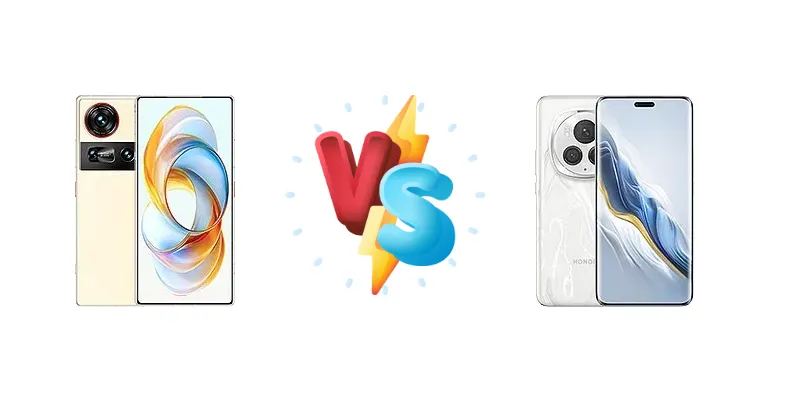
|
🏆 Quick Verdict
For most users, the Honor Magic6 Pro emerges as the stronger all-rounder. Its superior battery life (14:06h active use) and significantly brighter display (1578 nits) provide tangible benefits in everyday use. While the nubia Z70 Ultra’s Snapdragon 8 Elite offers impressive raw power, the Magic6 Pro’s efficiency and feature set make it the more practical choice.
| PHONES | ||
|---|---|---|
| Phone Names | ZTE nubia Z70 Ultra | Honor Magic6 Pro |
| Network | ||
|---|---|---|
| 2G bands | GSM 850 / 900 / 1800 / 1900 | GSM 850 / 900 / 1800 / 1900 |
| 3G bands | HSDPA 800 / 850 / 900 / 1700(AWS) / 1900 / 2100 | HSDPA 800 / 850 / 900 / 1700(AWS) / 1900 / 2100 |
| 4G bands | 1, 2, 3, 4, 5, 7, 8, 12, 17, 18, 19, 20, 25, 26, 28, 34, 39, 40, 41, 38, 42, 66 | LTE |
| 5G bands | 1, 2, 3, 5, 7, 8, 20, 25, 26, 28, 38, 40, 41, 66, 77, 78 SA/NSA | SA/NSA |
| Speed | HSPA, LTE, 5G | HSPA, LTE, 5G |
| Technology | GSM / CDMA / HSPA / CDMA2000 / LTE / 5G | GSM / CDMA / HSPA / CDMA2000 / LTE / 5G |
| Launch | ||
|---|---|---|
| Announced | 2024, November 21 | 2024, January 11 |
| Status | Available. Released 2024, November 25 | Available. Released 2024, January 18 |
| Body | ||
|---|---|---|
| Build | Glass front, aluminum frame, glass back | Glass front (NanoCrystal Shield), glass back or silicone polymer back (eco leather) |
| Dimensions | 164.3 x 77.1 x 8.6 mm (6.47 x 3.04 x 0.34 in) | 162.5 x 75.8 x 8.9 mm (6.40 x 2.98 x 0.35 in) |
| SIM | Nano-SIM + Nano-SIM | · Nano-SIM + eSIM· Nano-SIM + Nano-SIM |
| Weight | 228 g (8.04 oz) | 225 g or 229 g (7.94 oz) |
| Display | ||
|---|---|---|
| Protection | Longxi glass (gen 2) | NanoCrystal Shield |
| Resolution | 1216 x 2688 pixels (~431 ppi density) | 1280 x 2800 pixels, 19.5:9 ratio (~453 ppi density) |
| Size | 6.85 inches, 113.7 cm2 (~89.7% screen-to-body ratio) | 6.8 inches, 112.8 cm2 (~91.6% screen-to-body ratio) |
| Type | AMOLED, 1B colors, 144Hz, HDR10, 2000 nits (peak) | LTPO OLED, 1B colors, 120Hz, Dolby Vision, HDR, 1600 nits (HBM), 5000 nits (peak) |
| Platform | ||
|---|---|---|
| CPU | Octa-core (2x4.32 GHz Oryon V2 Phoenix L + 6x3.53 GHz Oryon V2 Phoenix M) | Octa-core (1x3.3 GHz Cortex-X4 & 3x3.2 GHz Cortex-A720 & 2x3.0 GHz Cortex-A720 & 2x2.3 GHz Cortex-A520) |
| Chipset | Qualcomm SM8750-AB Snapdragon 8 Elite (3 nm) | Qualcomm SM8650-AB Snapdragon 8 Gen 3 (4 nm) |
| GPU | Adreno 830 | Adreno 750 |
| OS | Android 15, Nebula AIOS | Android 14, up to 4 major Android upgrades, MagicOS 8 |
| Memory | ||
|---|---|---|
| Card slot | No | No |
| Internal | 256GB 12GB RAM, 512GB 16GB RAM, 1TB 16GB RAM, 1TB 24GB RAM | 256GB 12GB RAM, 256GB 16GB RAM, 512GB 12GB RAM, 512GB 16GB RAM, 1TB 16GB RAM |
| Main Camera | ||
|---|---|---|
| Features | Laser AF, color spectrum sensor, Ring-LED, dual-tone flash, panorama, HDR | Laser AF, color spectrum sensor, LED flash, HDR, panorama |
| Triple | 50 MP, f/1.6-4.0, 35mm (standard), 1/1.56", 1.0µm, multi-directional PDAF, OIS 64 MP, f/2.5, 70mm (periscope telephoto), 1/2.0", 0.7µm, multi-directional PDAF (15cm - ∞), OIS, 2.7x optical zoom (vs. 26mm cam) 50 MP, f/2.0, 13mm, 122˚ (ultrawide), 1/2.88", 0.61µm, multi-directional PDAF | 50 MP, f/1.4-2.0, 23mm (wide), 1/1.3", 1.2µm, PDAF, OIS 180 MP, f/2.6, (periscope telephoto), 1/1.49", 0.56µm, PDAF, OIS, 2.5x optical zoom 50 MP, f/2.0, 13mm, 122˚ (ultrawide), 1/2.88", 0.61µm, AF |
| Video | 8K@30fps, 4K@30/60/120fps, 1080p@30/60fps, gyro-EIS, HDR10, 10‑bit video | 4K@24/30/60fps, 1080p@30/60/120/240fps, gyro-EIS, OIS, HDR, 10-bit video |
| Selfie camera | ||
|---|---|---|
| Features | HDR | - |
| Single | 16 MP, f/2.5, 24mm (wide), 1/2.8", 1.12µm, under display | 50 MP, f/2.0, 22mm (wide), 1/2.93", 0.6µm, AF TOF 3D, (depth/biometrics sensor) |
| Video | 1080p@30fps | 4K@30fps, 1080p@30/60fps, gyro-EIS |
| Sound | ||
|---|---|---|
| 35mm jack | No | No |
| Loudspeaker | Yes, with stereo speakers | Yes, with stereo speakers |
| Comms | ||
|---|---|---|
| Bluetooth | 5.4, A2DP, LE, aptX HD, aptX Adaptive, aptX Lossless | 5.3, A2DP, LE, aptX HD |
| Infrared port | Yes | Yes |
| NFC | Yes | Yes |
| Positioning | GPS (L1+L2+L5), GLONASS (G1+G5), BDS (B1I+B1C+B2a+B2b), GALILEO (E1+E5a), QZSS (L1+L5) | GPS (L1+L5), GLONASS, BDS (B1I+B1c+B2a), GALILEO (E1+E5a) |
| Radio | No | No |
| USB | USB Type-C 3.2, OTG | USB Type-C 3.2, DisplayPort 1.2, OTG |
| WLAN | Wi-Fi 802.11 a/b/g/n/ac/6e/7, dual-band, Wi-Fi Direct | Wi-Fi 802.11 a/b/g/n/ac/6/7, dual-band, Wi-Fi Direct |
| Features | ||
|---|---|---|
| Sensors | Fingerprint (under display, optical), accelerometer, gyro, proximity, compass | Fingerprint (under display, optical), Face ID, accelerometer, gyro, proximity, compass |
| Battery | ||
|---|---|---|
| Charging | 80W wired, PD3.0, QC4 | 80W wired 66W wireless Reverse wireless 5W reverse wired |
| Type | Si/C Li-Ion 6150 mAh | Si/C Li-Ion 5600 mAh |
| Misc | ||
|---|---|---|
| Colors | Black, Gold, Starry Night, Orange | Black, Green, Blue, Purple, White |
| Models | NX733J, NX736J | BVL-AN16, BVL-N49 |
| Price | £ 499.00 | € 455.54 / $ 899.00 / £ 598.99 |
ZTE nubia Z70 Ultra
- Potentially higher peak CPU performance with Snapdragon 8 Elite
- Cutting-edge 3nm chipset technology
- Unique Oryon V2 core configuration
- Shorter battery life compared to the Magic6 Pro
- Lacks wireless charging capabilities
- Potential for thermal throttling under sustained load
Honor Magic6 Pro
- Longer battery life (14:06h active use)
- Significantly brighter display (1578 nits)
- Wireless and reverse wireless charging support
- Chipset is a generation older (Snapdragon 8 Gen 3)
- May not match the nubia Z70 Ultra in peak CPU performance
- 4nm process may be less efficient than 3nm (though optimized)
Display Comparison
The Honor Magic6 Pro boasts a significantly brighter display, reaching a measured 1578 nits compared to the nubia Z70 Ultra’s 1382 nits. This translates to superior visibility in direct sunlight. While both likely employ LTPO technology for adaptive refresh rates (not specified in data, but standard for this class), the Honor’s brightness advantage is a clear win. The impact is substantial for outdoor photography and video consumption. We expect both to have excellent color accuracy, but the Honor’s higher peak brightness provides a more immersive viewing experience.
Camera Comparison
Without detailed camera specs, a direct comparison is limited. However, the chipset’s ISP capabilities are relevant. Both Snapdragon chips feature advanced image processing, but the Snapdragon 8 Gen 3 has a proven track record. The nubia Z70 Ultra’s potential advantage lies in the raw processing power of the 8 Elite, allowing for faster image processing and potentially more complex computational photography algorithms. However, without knowing sensor sizes and lens apertures, it’s difficult to definitively declare a winner. We assume both phones will offer excellent image quality, but the Magic6 Pro’s established platform provides a degree of predictability.
Performance
The nubia Z70 Ultra’s Snapdragon 8 Elite (SM8750-AB) utilizes a unique Oryon V2 Phoenix core configuration (2x4.32 GHz + 6x3.53 GHz) built on a 3nm process. This contrasts with the Honor Magic6 Pro’s Snapdragon 8 Gen 3 (SM8650-AB) which uses a more conventional Cortex-X4/A720/A520 setup on a 4nm process. While the 3nm process *should* offer efficiency gains, the Snapdragon 8 Gen 3 is a mature platform with optimized power management. The nubia’s architecture *could* deliver higher peak performance, but the 4nm process of the Gen 3 likely provides better sustained performance and thermal management. The nubia Z70 Ultra will likely excel in short bursts, while the Magic6 Pro will maintain performance longer during extended gaming sessions.
Battery Life
The Honor Magic6 Pro demonstrably outperforms the nubia Z70 Ultra in battery life, achieving 14:06 hours of active use versus 12:59 hours. This difference, while not massive, is significant for all-day usability. Both support 80W wired charging, offering comparable charging speeds (estimated 0-100% in around 30-40 minutes). However, the Honor Magic6 Pro adds 66W wireless charging and reverse wireless charging, providing greater flexibility and convenience. The Magic6 Pro’s superior battery life, coupled with wireless charging options, makes it the clear winner in this category.
Buying Guide
Buy the ZTE nubia Z70 Ultra if you prioritize raw processing power for demanding tasks like video editing or emulation, and are willing to trade some battery life for it. Its Snapdragon 8 Elite chipset offers a potential edge in sustained performance. Buy the Honor Magic6 Pro if you value all-day battery life, a stunningly bright and vibrant display, and the convenience of wireless charging. It’s the better choice for users who prioritize a seamless and long-lasting experience.