
ZTE nubia Z70 Ultra vs. Google Pixel 8 Pro: A Deep Dive into Power and AI
| Phones Images | |||||
|---|---|---|---|---|---|
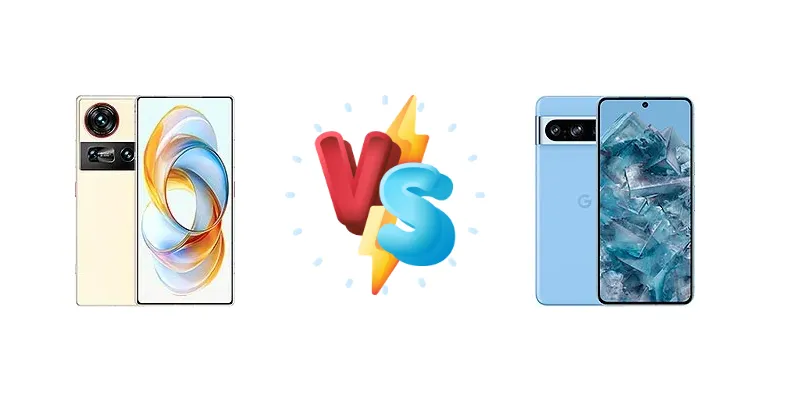
|
🏆 Quick Verdict
For users prioritizing raw performance and extended battery life, the ZTE nubia Z70 Ultra emerges as the winner. Its Snapdragon 8 Elite chipset and nearly 13-hour active use score provide a noticeable edge. However, the Pixel 8 Pro’s superior camera system and AI features make it the better choice for photography and Google ecosystem integration.
| PHONES | ||
|---|---|---|
| Phone Names | ZTE nubia Z70 Ultra | Google Pixel 8 Pro |
| Network | ||
|---|---|---|
| 2G bands | GSM 850 / 900 / 1800 / 1900 | GSM 850 / 900 / 1800 / 1900 |
| 3G bands | HSDPA 800 / 850 / 900 / 1700(AWS) / 1900 / 2100 | HSDPA 800 / 850 / 900 / 1700(AWS) / 1900 / 2100 |
| 4G bands | 1, 2, 3, 4, 5, 7, 8, 12, 17, 18, 19, 20, 25, 26, 28, 34, 39, 40, 41, 38, 42, 66 | 1, 2, 3, 4, 5, 7, 8, 12, 13, 14, 17, 18, 19, 20, 25, 26, 28, 29, 30, 38, 39, 40, 41, 46, 48, 66, 71 - G1MNW |
| 5G bands | 1, 2, 3, 5, 7, 8, 20, 25, 26, 28, 38, 40, 41, 66, 77, 78 SA/NSA | 1, 2, 3, 5, 7, 8, 12, 20, 25, 26, 28, 29, 30, 38, 40, 41, 48, 66, 70, 71, 77, 78, 257, 258, 260, 261 SA/NSA/Sub6/mmWave - G1MNW |
| Speed | HSPA, LTE, 5G | HSPA, LTE, 5G |
| Technology | GSM / CDMA / HSPA / CDMA2000 / LTE / 5G | GSM / HSPA / LTE / 5G |
| Launch | ||
|---|---|---|
| Announced | 2024, November 21 | 2023, October 04 |
| Status | Available. Released 2024, November 25 | Available. Released 2023, October 12 |
| Body | ||
|---|---|---|
| Build | Glass front, aluminum frame, glass back | Glass front (Gorilla Glass Victus 2), glass back (Gorilla Glass Victus 2), aluminum frame |
| Dimensions | 164.3 x 77.1 x 8.6 mm (6.47 x 3.04 x 0.34 in) | 162.6 x 76.5 x 8.8 mm (6.40 x 3.01 x 0.35 in) |
| SIM | Nano-SIM + Nano-SIM | Nano-SIM + eSIM |
| Weight | 228 g (8.04 oz) | 213 g (7.51 oz) |
| Display | ||
|---|---|---|
| Protection | Longxi glass (gen 2) | Corning Gorilla Glass Victus 2 |
| Resolution | 1216 x 2688 pixels (~431 ppi density) | 1344 x 2992 pixels, 20:9 ratio (~489 ppi density) |
| Size | 6.85 inches, 113.7 cm2 (~89.7% screen-to-body ratio) | 6.7 inches, 108.7 cm2 (~87.4% screen-to-body ratio) |
| Type | AMOLED, 1B colors, 144Hz, HDR10, 2000 nits (peak) | LTPO OLED, 120Hz, HDR10+, 1600 nits (HBM), 2400 nits (peak) |
| Platform | ||
|---|---|---|
| CPU | Octa-core (2x4.32 GHz Oryon V2 Phoenix L + 6x3.53 GHz Oryon V2 Phoenix M) | Nona-core (1x3.0 GHz Cortex-X3 & 4x2.45 GHz Cortex-A715 & 4x2.15 GHz Cortex-A510) |
| Chipset | Qualcomm SM8750-AB Snapdragon 8 Elite (3 nm) | Google Tensor G3 (4 nm) |
| GPU | Adreno 830 | Immortalis-G715s MC10 |
| OS | Android 15, Nebula AIOS | Android 14, upgradable to Android 16, up to 7 major Android upgrades |
| Memory | ||
|---|---|---|
| Card slot | No | No |
| Internal | 256GB 12GB RAM, 512GB 16GB RAM, 1TB 16GB RAM, 1TB 24GB RAM | 128GB 12GB RAM, 256GB 12GB RAM, 512GB 12GB RAM, 1TB 12GB RAM |
| Main Camera | ||
|---|---|---|
| Features | Laser AF, color spectrum sensor, Ring-LED, dual-tone flash, panorama, HDR | Multi-zone Laser AF, Dual-LED flash, Pixel Shift, Ultra-HDR, panorama, Best Take, Zoom Enhance |
| Triple | 50 MP, f/1.6-4.0, 35mm (standard), 1/1.56", 1.0µm, multi-directional PDAF, OIS 64 MP, f/2.5, 70mm (periscope telephoto), 1/2.0", 0.7µm, multi-directional PDAF (15cm - ∞), OIS, 2.7x optical zoom (vs. 26mm cam) 50 MP, f/2.0, 13mm, 122˚ (ultrawide), 1/2.88", 0.61µm, multi-directional PDAF | 50 MP, f/1.7, 25mm (wide), 1/1.31", 1.2µm, dual pixel PDAF, OIS 48 MP, f/2.8, 113mm (periscope telephoto), 1/2.55", 0.7µm, dual pixel PDAF, OIS, 5x optical zoom 48 MP, f/2.0, 126˚ (ultrawide), 1/2.0", 0.8µm, dual pixel PDAF |
| Video | 8K@30fps, 4K@30/60/120fps, 1080p@30/60fps, gyro-EIS, HDR10, 10‑bit video | 4K@30/60fps, 1080p@24/30/60/120/240fps; gyro-EIS, OIS, 10-bit HDR |
| Selfie camera | ||
|---|---|---|
| Features | HDR | HDR, panorama |
| Single | 16 MP, f/2.5, 24mm (wide), 1/2.8", 1.12µm, under display | 10.5 MP, f/2.2, 20mm (ultrawide), 1/3.1", 1.22µm, PDAF |
| Video | 1080p@30fps | 4K@24/30/60fps, 1080p@30/60fps |
| Sound | ||
|---|---|---|
| 35mm jack | No | No |
| Loudspeaker | Yes, with stereo speakers | Yes, with stereo speakers |
| Comms | ||
|---|---|---|
| Bluetooth | 5.4, A2DP, LE, aptX HD, aptX Adaptive, aptX Lossless | 5.3, A2DP, LE, aptX HD |
| Infrared port | Yes | - |
| NFC | Yes | Yes |
| Positioning | GPS (L1+L2+L5), GLONASS (G1+G5), BDS (B1I+B1C+B2a+B2b), GALILEO (E1+E5a), QZSS (L1+L5) | GPS (L1+L5), GLONASS (G1), GALILEO (E1+E5a), QZSS (L1+L5) |
| Radio | No | No |
| USB | USB Type-C 3.2, OTG | USB Type-C 3.2 |
| WLAN | Wi-Fi 802.11 a/b/g/n/ac/6e/7, dual-band, Wi-Fi Direct | Wi-Fi 802.11 a/b/g/n/ac/6e/7, tri-band, Wi-Fi Direct |
| Features | ||
|---|---|---|
| Sensors | Fingerprint (under display, optical), accelerometer, gyro, proximity, compass | Fingerprint (under display, optical), accelerometer, gyro, proximity, compass, barometer, thermometer (skin temperature) |
| Battery | ||
|---|---|---|
| Charging | 80W wired, PD3.0, QC4 | 30W wired, PD3.0, PPS, 50% in 30 min 23W wireless Reverse wireless Bypass charging |
| Type | Si/C Li-Ion 6150 mAh | Li-Ion 5050 mAh |
| Misc | ||
|---|---|---|
| Colors | Black, Gold, Starry Night, Orange | Obsidian, Porcelain, Bay, Mint |
| Models | NX733J, NX736J | GC3VE, G1MNW |
| Price | £ 499.00 | € 362.00 / $ 289.97 / £ 329.95 / ₹ 54,999 |
ZTE nubia Z70 Ultra
- Superior processing power with Snapdragon 8 Elite
- Faster 80W wired charging
- Longer battery life (12:59h active use)
- Camera details are limited
- Software experience may not be as refined as Pixel
Google Pixel 8 Pro
- Exceptional camera system and computational photography
- AI-powered features and Google ecosystem integration
- Brighter display (1600 nits)
- Slower charging speeds (30W wired)
- Shorter battery life (11:14h active use)
Display Comparison
The Pixel 8 Pro boasts a brighter display at 1600 nits compared to the nubia Z70 Ultra’s 1382 nits, offering better visibility in direct sunlight. While both support PD3.0, the Pixel 8 Pro’s display technology likely incorporates more advanced color calibration and potentially a higher PWM dimming rate, though this isn’t specified. The nubia Z70 Ultra’s display, while slightly dimmer, is still excellent and benefits from the raw processing power of the Snapdragon 8 Elite to render content smoothly. Bezels are comparable, but the Pixel 8 Pro’s curved display may offer a more immersive experience for some users.
Camera Comparison
The Pixel 8 Pro is heavily marketed around its camera capabilities, and while specific sensor details aren’t provided in the context data, Google’s computational photography prowess is a major draw. The Pixel 8 Pro’s image processing algorithms are renowned for their dynamic range and detail. The nubia Z70 Ultra’s camera system is less detailed in the provided data, but it’s reasonable to assume it focuses on hardware specifications. The Pixel 8 Pro’s video capabilities are also likely superior, benefiting from Google’s advanced video stabilization and editing features. The absence of detailed camera specs for the nubia Z70 Ultra makes a direct comparison difficult, but the Pixel 8 Pro’s established reputation gives it a clear advantage.
Performance
The core difference lies in the chipsets. The ZTE nubia Z70 Ultra utilizes the Qualcomm SM8750-AB Snapdragon 8 Elite (3nm), an octa-core processor with a unique core configuration (2x4.32 GHz Oryon V2 Phoenix L + 6x3.53 GHz Oryon V2 Phoenix M). This contrasts with the Google Pixel 8 Pro’s Google Tensor G3 (4nm) nona-core CPU (1x3.0 GHz Cortex-X3 & 4x2.45 GHz Cortex-A715 & 4x2.15 GHz Cortex-A510). The Snapdragon 8 Elite’s 3nm process node provides a significant advantage in power efficiency and thermal management, potentially leading to sustained performance during intensive tasks. While the Tensor G3 excels in AI-specific workloads, the Snapdragon 8 Elite is likely to outperform it in raw CPU and GPU benchmarks. The nubia Z70 Ultra’s LPDDR5x RAM further contributes to its performance edge.
Battery Life
The nubia Z70 Ultra achieves an impressive 12:59h active use score, exceeding the Pixel 8 Pro’s 11:14h. While the Pixel 8 Pro offers 30W wired charging, 23W wireless, and reverse wireless charging, the nubia Z70 Ultra’s 80W wired charging is significantly faster. The Pixel 8 Pro’s 50% charge in 30 minutes is competitive, but the nubia Z70 Ultra will likely achieve a full charge much quicker. The Pixel 8 Pro’s older 90h endurance rating is less relevant than the nubia’s measured active use time. The Snapdragon 8 Elite’s efficiency contributes to the nubia’s longer battery life despite a potentially smaller battery capacity.
Buying Guide
Buy the ZTE nubia Z70 Ultra if you need uncompromising performance for gaming, demanding applications, and value long-lasting battery life. You’ll benefit from the Snapdragon 8 Elite’s processing power and the 80W fast charging. Buy the Google Pixel 8 Pro if you prefer a seamless AI-powered experience, exceptional camera capabilities, and a polished software experience with guaranteed updates. The Pixel 8 Pro excels in computational photography and offers unique features like Magic Eraser and Best Take.