
ZTE nubia Z60S Pro vs. vivo iQOO 12 Pro: A Deep Dive into Flagship Performance
| Phones Images | |||||
|---|---|---|---|---|---|
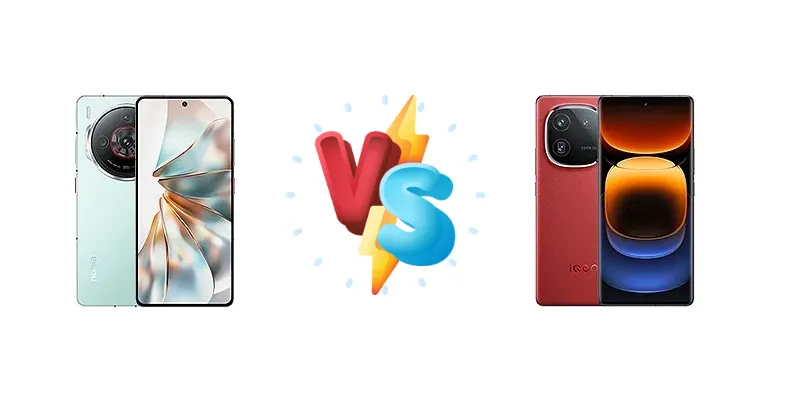
|
🏆 Quick Verdict
For the average user prioritizing future-proofing and the fastest charging speeds, the vivo iQOO 12 Pro is the clear winner. Its Snapdragon 8 Gen 3 chipset delivers a noticeable performance uplift, and the 120W wired and 50W wireless charging are unmatched. However, the nubia Z60S Pro remains a compelling option for those seeking excellent battery life and a potentially lower price point.
| PHONES | ||
|---|---|---|
| Phone Names | ZTE nubia Z60S Pro | vivo iQOO 12 Pro |
| Network | ||
|---|---|---|
| 2G bands | GSM 850 / 900 / 1800 / 1900 | GSM 850 / 900 / 1800 / 1900 |
| 3G bands | HSDPA 800 / 850 / 900 / 1700(AWS) / 1900 / 2100 | HSDPA 800 / 850 / 900 / 1700(AWS) / 1900 / 2100 |
| 4G bands | 1, 2, 3, 4, 5, 7, 8, 12, 17, 18, 19, 20, 25, 26, 28, 34, 38, 39, 40, 41, 42, 66 | 1, 2, 3, 4, 5, 7, 8, 12, 17, 18, 19, 20, 25, 26, 28, 34, 38, 39, 40, 41, 42, 66 |
| 5G bands | 1, 2, 3, 5, 7, 8, 20, 25, 26, 28, 38, 40, 41, 66, 77, 78 SA/NSA | 1, 2, 3, 5, 7, 8, 12, 20, 25, 26, 28, 66, 38, 40, 41, 77, 78 SA/NSA |
| Speed | HSPA, LTE, 5G | HSPA, LTE, 5G |
| Technology | GSM / CDMA / HSPA / CDMA2000 / LTE / 5G | GSM / CDMA / HSPA / CDMA2000 / LTE / 5G |
| Launch | ||
|---|---|---|
| Announced | 2024, July 23 | 2023, November 07 |
| Status | Available. Released 2024, August 12 | Available. Released 2023, November 14 |
| Body | ||
|---|---|---|
| Build | Glass front, aluminum frame | - |
| Dimensions | 163.6 x 76 x 8.7 mm (6.44 x 2.99 x 0.34 in) | 164.6 x 75.4 x 8.6 mm or 8.8 mm |
| SIM | Nano-SIM + Nano-SIM | Nano-SIM + Nano-SIM |
| Weight | 220 g (7.76 oz) | 205 g or 210 g (7.23 oz) |
| Display | ||
|---|---|---|
| Protection | Longxi glass | - |
| Resolution | 1260 x 2800 pixels, 20:9 ratio (~452 ppi density) | 1440 x 3200 pixels, 20:9 ratio (~518 ppi density) |
| Size | 6.78 inches, 111.5 cm2 (~89.7% screen-to-body ratio) | 6.78 inches, 111.0 cm2 (~89.4% screen-to-body ratio) |
| Type | AMOLED, 1B colors, 120Hz, 1200 nits (peak) | LTPO AMOLED, 1B colors, 144Hz, HDR10+, 1600 nits (HBM), 3000 nits (peak) |
| Platform | ||
|---|---|---|
| CPU | Octa-core (1x3.2 GHz Cortex-X3 & 2x2.8 GHz Cortex-A715 & 2x2.8 GHz Cortex-A710 & 3x2.0 GHz Cortex-A510) | Octa-core (1x3.3 GHz Cortex-X4 & 3x3.2 GHz Cortex-A720 & 2x3.0 GHz Cortex-A720 & 2x2.3 GHz Cortex-A520) |
| Chipset | Qualcomm SM8550-AB Snapdragon 8 Gen 2 (4 nm) | Qualcomm SM8650-AB Snapdragon 8 Gen 3 (4 nm) |
| GPU | Adreno 740 | Adreno 750 |
| OS | Android 14, MyOS 14 (International), MyOS 14.5 (China) | Android 14, up to 2 major Android upgrades, Funtouch 14 (International), OriginOS 4 (China) |
| Memory | ||
|---|---|---|
| Card slot | No | No |
| Internal | 256GB 8GB RAM, 256GB 12GB RAM, 512GB 16GB RAM, 1TB 16GB RAM, 1TB 24GB RAM | 256GB 16GB RAM, 512GB 16GB RAM, 1TB 16GB RAM |
| Main Camera | ||
|---|---|---|
| Dual | 50 MP, f/1.6, 35mm (standard), 1/1.56", 1.0µm, PDAF, OIS 8 MP, f/2.4, 80mm (telephoto), 1/4.4", 1.0µm, PDAF, optical zoom 50 MP, f/2.0, 13mm, 125˚ (ultrawide), 1/2.88", 0.61µm, AF | - |
| Features | Dual-LED dual-tone flash, HDR, panorama | Color spectrum sensor, Dual-LED flash, HDR, panorama |
| Triple | - | 50 MP, f/1.7, 23mm (wide), 1/1.3", 1.2µm, ulti-directional PDAF, OIS 64 MP, f/2.6, 70mm (periscope telephoto), 1/2.0", PDAF, OIS, 3x optical zoom 50 MP, f/2.0, 15mm, 119˚ (ultrawide), AF |
| Video | 8K@30fps, 4K@30/60/120fps, 1080p, gyro-EIS, 10-bit | 8K@30fps, 4K@24/30/60fps, 1080p@30/60/120/240fps, gyro-EIS |
| Selfie camera | ||
|---|---|---|
| Features | - | HDR |
| Single | 16 MP, f/2.5, 26mm (wide), 1/3.06", 1.0µm | 16 MP, f/2.5, (wide) |
| Video | 1080p@30fps | 1080p@30fps, gyro-EIS |
| Sound | ||
|---|---|---|
| 35mm jack | No | No |
| Loudspeaker | Yes, with stereo speakers | Yes, with stereo speakers |
| Comms | ||
|---|---|---|
| Bluetooth | 5.3, A2DP, LE, aptX HD, aptX Adaptive, aptX Lossless | 5.4, A2DP, LE, aptX HD, aptX Adaptive, aptX Lossless |
| Infrared port | Yes | Yes |
| NFC | Yes (market/region dependent) | Yes |
| Positioning | GPS (L1+L2+L5), GLONASS (G1+G5), BDS (B1I+B1C+B2a+B2b), GALILEO (E1+E5a), QZSS (L1+L5) | GPS (L1+L5), GLONASS (G1), BDS (B1I+B1c+B2a), GALILEO (E1+E5a), QZSS (L1+L5) |
| Radio | No | No |
| USB | USB Type-C 3.1, OTG | USB Type-C 2.0, OTG |
| WLAN | Wi-Fi 802.11 a/b/g/n/ac/6e, dual-band, Wi-Fi Direct | Wi-Fi 802.11 a/b/g/n/ac/6/7, tri-band, Wi-Fi Direct |
| Features | ||
|---|---|---|
| Sensors | Fingerprint (under display, optical), accelerometer, gyro, proximity, compass | Fingerprint (under display, ultrasonic), accelerometer, gyro, proximity, compass |
| Battery | ||
|---|---|---|
| Charging | 80W wired | 120W wired 50W wireless 10W reverse wireless |
| Type | Li-Po 5100 mAh | 5100 mAh |
| Misc | ||
|---|---|---|
| Colors | Black, Aqua, White | Black, Red, White (BMW M branding) |
| Models | - | V2329A |
| Price | About 670 EUR | About 650 EUR |
ZTE nubia Z60S Pro
- Excellent battery life (12:12h active use)
- Competitive price point (likely)
- Efficient Snapdragon 8 Gen 2 chipset
- Slower charging speeds (80W wired)
- Older chipset compared to iQOO 12 Pro
vivo iQOO 12 Pro
- Latest Snapdragon 8 Gen 3 chipset for peak performance
- Blazing-fast 120W wired charging
- 50W wireless and 10W reverse wireless charging
- Potentially higher price
- Battery life may be slightly less than nubia Z60S Pro
Display Comparison
While specific display details are absent, both phones likely feature high refresh rate AMOLED panels. The iQOO 12 Pro, being a newer device, may benefit from advancements in panel technology, potentially offering higher peak brightness and improved color accuracy. However, without detailed specifications, it's difficult to definitively state a display advantage. Both brands are known for vibrant displays, so user preference will likely play a larger role.
Camera Comparison
Without detailed camera specifications, a direct comparison is limited. However, iQOO phones often prioritize camera performance, and the newer chipset in the iQOO 12 Pro likely enables more advanced image processing capabilities. The absence of information regarding sensor sizes and lens apertures makes it difficult to assess image quality, but the iQOO 12 Pro’s newer image signal processor (ISP) within the Snapdragon 8 Gen 3 should provide improvements in dynamic range and low-light performance. We can assume both phones will offer a versatile camera system, but the iQOO 12 Pro likely has an edge in computational photography.
Performance
The iQOO 12 Pro’s Snapdragon 8 Gen 3 (4nm) represents a significant leap over the nubia Z60S Pro’s Snapdragon 8 Gen 2 (4nm). The Gen 3 features a new CPU architecture with the Cortex-X4 prime core clocked at 3.3 GHz, compared to the Z60S Pro’s 3.2 GHz Cortex-X3. This, combined with the newer Adreno GPU, translates to faster processing speeds and improved graphics performance, particularly noticeable in demanding games. The iQOO 12 Pro’s CPU configuration (1x3.3 GHz Cortex-X4, 3x3.2 GHz Cortex-A720, 2x3.0 GHz Cortex-A720, 2x2.3 GHz Cortex-A520) also offers a more balanced core distribution than the Z60S Pro’s (1x3.2 GHz Cortex-X3, 2x2.8 GHz Cortex-A715, 2x2.8 GHz Cortex-A710, 3x2.0 GHz Cortex-A510).
Battery Life
The nubia Z60S Pro boasts an impressive 12:12h active use battery score, indicating excellent power efficiency. While the iQOO 12 Pro’s battery capacity is unknown, its Snapdragon 8 Gen 3 chipset, despite being more powerful, is also more efficient. However, the iQOO 12 Pro’s charging capabilities are a game-changer: 120W wired charging will deliver a full charge significantly faster than the nubia Z60S Pro’s 80W charging. The addition of 50W wireless and 10W reverse wireless charging further enhances the iQOO 12 Pro’s convenience, offering flexibility in charging options.
Buying Guide
Buy the ZTE nubia Z60S Pro if you need exceptional battery endurance for all-day use and value a balanced flagship experience without the absolute highest price tag. Buy the vivo iQOO 12 Pro if you prioritize peak performance for demanding games and applications, and if rapid charging – both wired and wireless – is a critical feature for your lifestyle.