
ZTE nubia Z60S Pro vs Asus Zenfone 10: A Deep Dive into Two Snapdragon 8 Gen 2 Powerhouses
| Phones Images | |||||
|---|---|---|---|---|---|
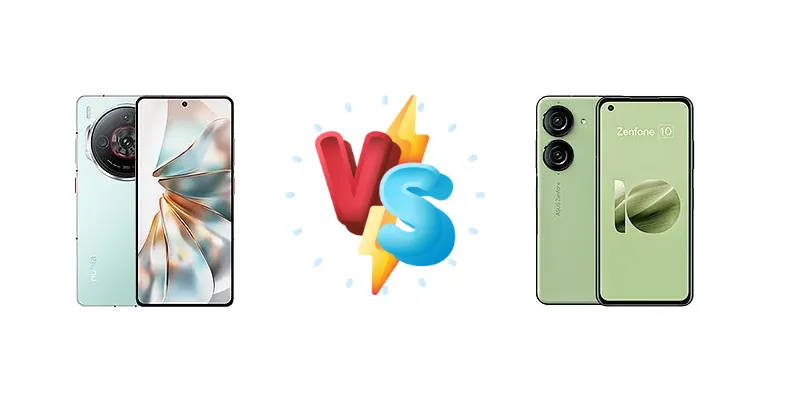
|
🏆 Quick Verdict
For the average user prioritizing all-day battery life and a larger display, the Asus Zenfone 10 edges out the ZTE nubia Z60S Pro. Its slightly superior battery endurance and more refined software experience outweigh the nubia's faster charging, making it the more practical daily driver.
| PHONES | ||
|---|---|---|
| Phone Names | ZTE nubia Z60S Pro | Asus Zenfone 10 |
| Network | ||
|---|---|---|
| 2G bands | GSM 850 / 900 / 1800 / 1900 | GSM 850 / 900 / 1800 / 1900 |
| 3G bands | HSDPA 800 / 850 / 900 / 1700(AWS) / 1900 / 2100 | HSDPA 850 / 900 / 1700(AWS) / 1800 / 1900 / 2100 |
| 4G bands | 1, 2, 3, 4, 5, 7, 8, 12, 17, 18, 19, 20, 25, 26, 28, 34, 38, 39, 40, 41, 42, 66 | 1, 2, 3, 4, 5, 7, 8, 12, 17, 18, 19, 20, 26, 28, 34, 38, 39, 40, 41, 42 |
| 5G bands | 1, 2, 3, 5, 7, 8, 20, 25, 26, 28, 38, 40, 41, 66, 77, 78 SA/NSA | 1, 2, 3, 5, 7, 8, 12, 20, 28, 38, 41, 77, 78 SA/NSA |
| Speed | HSPA, LTE, 5G | HSPA, LTE, 5G |
| Technology | GSM / CDMA / HSPA / CDMA2000 / LTE / 5G | GSM / HSPA / LTE / 5G |
| Launch | ||
|---|---|---|
| Announced | 2024, July 23 | 2023, June 29 |
| Status | Available. Released 2024, August 12 | Available. Released 2023, July 10 |
| Body | ||
|---|---|---|
| Build | Glass front, aluminum frame | Glass front, aluminum frame, plastic back |
| Dimensions | 163.6 x 76 x 8.7 mm (6.44 x 2.99 x 0.34 in) | 146.5 x 68.1 x 9.4 mm (5.77 x 2.68 x 0.37 in) |
| SIM | Nano-SIM + Nano-SIM | Nano-SIM + Nano-SIM |
| Weight | 220 g (7.76 oz) | 172 g (6.07 oz) |
| Display | ||
|---|---|---|
| Protection | Longxi glass | Corning Gorilla Glass Victus |
| Resolution | 1260 x 2800 pixels, 20:9 ratio (~452 ppi density) | 1080 x 2400 pixels, 20:9 ratio (~445 ppi density) |
| Size | 6.78 inches, 111.5 cm2 (~89.7% screen-to-body ratio) | 5.92 inches, 84.6 cm2 (~84.8% screen-to-body ratio) |
| Type | AMOLED, 1B colors, 120Hz, 1200 nits (peak) | Super AMOLED, 144Hz, HDR10+, 800 nits (HBM), 1100 nits (peak) |
| Platform | ||
|---|---|---|
| CPU | Octa-core (1x3.2 GHz Cortex-X3 & 2x2.8 GHz Cortex-A715 & 2x2.8 GHz Cortex-A710 & 3x2.0 GHz Cortex-A510) | Octa-core (1x3.2 GHz Cortex-X3 & 2x2.8 GHz Cortex-A715 & 2x2.8 GHz Cortex-A710 & 3x2.0 GHz Cortex-A510) |
| Chipset | Qualcomm SM8550-AB Snapdragon 8 Gen 2 (4 nm) | Qualcomm SM8550-AB Snapdragon 8 Gen 2 (4 nm) |
| GPU | Adreno 740 | Adreno 740 |
| OS | Android 14, MyOS 14 (International), MyOS 14.5 (China) | Android 13, up to 2 major Android upgrades |
| Memory | ||
|---|---|---|
| Card slot | No | No |
| Internal | 256GB 8GB RAM, 256GB 12GB RAM, 512GB 16GB RAM, 1TB 16GB RAM, 1TB 24GB RAM | 128GB 8GB RAM, 256GB 8GB RAM, 256GB 16GB RAM, 512GB 16GB RAM |
| Main Camera | ||
|---|---|---|
| Dual | 50 MP, f/1.6, 35mm (standard), 1/1.56", 1.0µm, PDAF, OIS 8 MP, f/2.4, 80mm (telephoto), 1/4.4", 1.0µm, PDAF, optical zoom 50 MP, f/2.0, 13mm, 125˚ (ultrawide), 1/2.88", 0.61µm, AF | 50 MP, f/1.9, 24mm (wide), 1/1.56", 1.0µm, multi-directional PDAF, gimbal OIS 13 MP, f/2.2, 120° (ultrawide), 1/3.06", 1.12µm |
| Features | Dual-LED dual-tone flash, HDR, panorama | LED flash, HDR, panorama |
| Video | 8K@30fps, 4K@30/60/120fps, 1080p, gyro-EIS, 10-bit | 8K@24fps, 4K@30/60fps, 1080p@30/60fps; gyro-EIS, HDR |
| Selfie camera | ||
|---|---|---|
| Single | 16 MP, f/2.5, 26mm (wide), 1/3.06", 1.0µm | 32 MP, f/2.5, (wide), 1/3.2", 0.7µm |
| Video | 1080p@30fps | 1080p@30fps |
| Sound | ||
|---|---|---|
| 35mm jack | No | Yes |
| Loudspeaker | Yes, with stereo speakers | Yes, with stereo speakers |
| Comms | ||
|---|---|---|
| Bluetooth | 5.3, A2DP, LE, aptX HD, aptX Adaptive, aptX Lossless | 5.3, A2DP, LE, aptX HD, aptX Adaptive, aptX Lossless |
| Infrared port | Yes | - |
| NFC | Yes (market/region dependent) | Yes |
| Positioning | GPS (L1+L2+L5), GLONASS (G1+G5), BDS (B1I+B1C+B2a+B2b), GALILEO (E1+E5a), QZSS (L1+L5) | GPS (L1+L5), GLONASS (L1), BDS (B1I+B2a), GALILEO (E1+E5a), QZSS (L1+L5), NavIC (L5) |
| Radio | No | No |
| USB | USB Type-C 3.1, OTG | USB Type-C 2.0, OTG |
| WLAN | Wi-Fi 802.11 a/b/g/n/ac/6e, dual-band, Wi-Fi Direct | Wi-Fi 802.11 a/b/g/n/ac/6e/7, tri-band, Wi-Fi Direct |
| Features | ||
|---|---|---|
| Sensors | Fingerprint (under display, optical), accelerometer, gyro, proximity, compass | Fingerprint (side-mounted), accelerometer, gyro, proximity, compass |
| Battery | ||
|---|---|---|
| Charging | 80W wired | 30W wired, PD3.0, PPS, QC4 15W wireless 5W reverse wired |
| Type | Li-Po 5100 mAh | Li-Po 4300 mAh |
| Misc | ||
|---|---|---|
| Colors | Black, Aqua, White | Starry Blue, Midnight Black, Aurora Green, Eclipse Red, Comet White |
| Models | - | AI2302 |
| Price | About 670 EUR | About 2300 EUR |
ZTE nubia Z60S Pro
- Faster 80W wired charging
- Potentially better sustained performance due to larger chassis
- Likely larger display for media consumption
- Shorter battery life in active use
- Missing display specifications (brightness, panel type)
- No wireless charging
Asus Zenfone 10
- Superior battery life (13:05h active use)
- Compact and pocketable design
- Wireless and reverse wired charging
- Slower 30W wired charging
- Smaller display size
- Potential for thermal throttling in extended gaming sessions
Display Comparison
The Asus Zenfone 10 boasts a measured peak brightness of 807 nits, a crucial metric for outdoor visibility. While the nubia Z60S Pro’s display specs are not provided, its larger size suggests a potentially more immersive viewing experience. However, without knowing its peak brightness or panel technology (LTPO would be a significant advantage for power saving), the Zenfone 10 holds an edge in usability. The Zenfone 10’s compact size also means a higher pixel density, potentially resulting in a sharper image.
Camera Comparison
Detailed camera specs for the nubia Z60S Pro are missing, making a direct comparison difficult. The Zenfone 10’s camera system is described as 'Photo / Video', indicating a focus on versatility. Without knowing sensor sizes, apertures, or OIS implementation on the nubia, it’s hard to assess its capabilities. The Zenfone 10’s image processing is known for its natural color reproduction, while nubia often leans towards more saturated images. We can assume both phones will deliver good results in ideal conditions, but low-light performance will depend heavily on sensor size and image stabilization.
Performance
Both devices share the Qualcomm SM8550-AB Snapdragon 8 Gen 2 (4nm) chipset and an identical Octa-core CPU configuration (1x3.2 GHz Cortex-X3, 2x2.8 GHz Cortex-A715, 2x2.8 GHz Cortex-A710, 3x2.0 GHz Cortex-A510). This ensures comparable raw processing power. However, thermal management will be key. The Zenfone 10’s smaller chassis may present greater cooling challenges, potentially leading to more aggressive throttling under sustained load. The nubia Z60S Pro, with more internal space, *could* maintain peak performance for longer, but this requires further testing. Both utilize LPDDR5x RAM, ensuring fast memory access.
Battery Life
The Asus Zenfone 10 achieves an active use battery score of 13:05h, surpassing the ZTE nubia Z60S Pro’s 12:12h. While the nubia Z60S Pro offers significantly faster 80W wired charging compared to the Zenfone 10’s 30W, the Zenfone 10’s superior endurance means you’ll need to charge it less frequently. The Zenfone 10 also adds the convenience of 15W wireless charging and 5W reverse wired charging, features absent on the nubia. The Zenfone 10’s older endurance rating of 109h further supports its battery efficiency.
Buying Guide
Buy the ZTE nubia Z60S Pro if you need a larger screen for media consumption and appreciate the fastest possible wired charging speeds. Buy the Asus Zenfone 10 if you prefer a truly pocketable flagship experience, value one-handed usability, and prioritize battery optimization for all-day performance.