
Nubia Z60 Ultra vs Xiaomi 14 Pro: A Deep Dive into Flagship Performance and Battery Life
| Phones Images | |||||
|---|---|---|---|---|---|
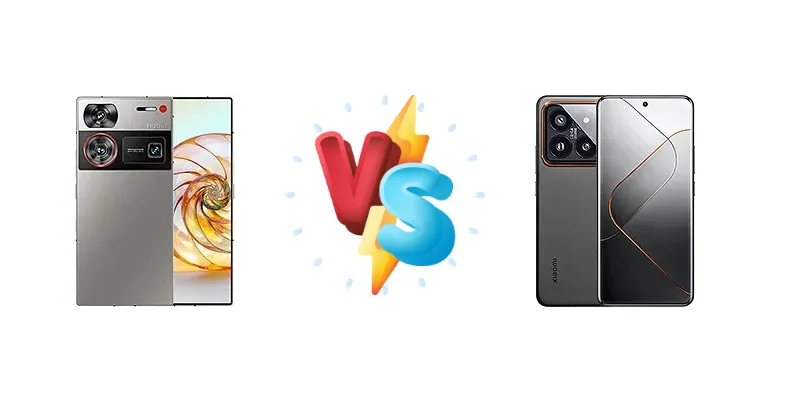
|
🏆 Quick Verdict
For the average user, the Xiaomi 14 Pro emerges as the more compelling choice. Its significantly faster 120W wired charging and 50W wireless charging capabilities, combined with a comparable Snapdragon 8 Gen 3 performance, outweigh the Nubia Z60 Ultra’s slightly longer active use battery score.
| PHONES | ||
|---|---|---|
| Phone Names | ZTE nubia Z60 Ultra | Xiaomi 14 Pro |
| Network | ||
|---|---|---|
| 2G bands | GSM 850 / 900 / 1800 / 1900 | GSM 850 / 900 / 1800 / 1900 |
| 3G bands | HSDPA 850 / 900 / 1700(AWS) / 1900 / 2100 | HSDPA 800 / 850 / 900 / 1700(AWS) / 1900 / 2100 |
| 4G bands | 1, 2, 3, 4, 5, 7, 8, 12, 17, 18, 19, 20, 26, 28, 34, 38, 39, 40, 41, 66 - International | 1, 3, 4, 5, 7, 8, 18, 19, 26, 28, 34, 38, 39, 40, 41, 42, 48, 66 |
| 5G bands | 1, 2, 3, 5, 7, 8, 28, 38, 40, 41, 66, 77, 78 SA/NSA - International | 1, 3, 5, 7, 8, 28, 38, 40, 41, 48, 66, 77, 78, 79 SA/NSA |
| Speed | HSPA, LTE, 5G | HSPA, LTE, 5G |
| Technology | GSM / CDMA / HSPA / CDMA2000 / LTE / 5G | GSM / CDMA / HSPA / CDMA2000 / LTE / 5G |
| Launch | ||
|---|---|---|
| Announced | 2023, December 19 | 2023, October 26 |
| Status | Available. Released 2023, December 29 | Available. Released 2023, November 01 |
| Body | ||
|---|---|---|
| Build | Glass front, aluminum frame, glass back | Glass front, aluminum frame or titanium frame, glass back |
| Dimensions | 164 x 76.4 x 8.8 mm (6.46 x 3.01 x 0.35 in) | 161.4 x 75.3 x 8.5 mm |
| SIM | Nano-SIM + Nano-SIM | Nano-SIM + Nano-SIM |
| Weight | 246 g (8.68 oz) | 223 g or 230 g (7.87 oz) |
| Display | ||
|---|---|---|
| Protection | - | Shatterproof glass |
| Resolution | 1116 x 2480 pixels, 20:9 ratio (~400 ppi density) | 1440 x 3200 pixels, 20:9 ratio (~522 ppi density) |
| Size | 6.8 inches, 111.6 cm2 (~89.1% screen-to-body ratio) | 6.73 inches, 108.9 cm2 (~89.6% screen-to-body ratio) |
| Type | AMOLED, 1B colors, 120Hz, HDR10, 1500 nits (peak) | LTPO AMOLED, 68B colors, 120Hz, Dolby Vision, HDR10+, 3000 nits (peak) |
| Platform | ||
|---|---|---|
| CPU | Octa-core (1x3.3 GHz Cortex-X4 & 3x3.2 GHz Cortex-A720 & 2x3.0 GHz Cortex-A720 & 2x2.3 GHz Cortex-A520) | Octa-core (1x3.3 GHz Cortex-X4 & 3x3.2 GHz Cortex-A720 & 2x3.0 GHz Cortex-A720 & 2x2.3 GHz Cortex-A520) |
| Chipset | Qualcomm SM8650-AB Snapdragon 8 Gen 3 (4 nm) | Qualcomm SM8650-AB Snapdragon 8 Gen 3 (4 nm) |
| GPU | Adreno 750 | Adreno 750 |
| OS | Android 14, MyOS 14 | Android 14, HyperOS |
| Memory | ||
|---|---|---|
| Card slot | No | No |
| Internal | 256GB 8GB RAM, 256GB 12GB RAM, 512GB 12GB RAM, 512GB 16GB RAM, 1TB 16GB RAM, 1TB 24GB RAM | 256GB 12GB RAM, 512GB 16GB RAM, 1TB 16GB RAM |
| Main Camera | ||
|---|---|---|
| Features | Laser AF, color spectrum sensor, Ring-LED, dual-tone flash, panorama, HDR | Laser AF, color spectrum sensor, Leica lens, Dual-LED dual-tone flash, HDR, panorama |
| Triple | 50 MP, f/1.6, 35mm (standard), 1/1.49", 1.0µm, PDAF, OIS 64 MP, f/3.3, 85mm (periscope telephoto), 1/2.0", PDAF, OIS, 3.3x optical zoom (vs. 26mm cam) 50 MP, f/1.8, 18mm, 100˚ (ultrawide), 1/1.55", PDAF, OIS | 50 MP, f/1.4-f/4.0, 23mm (wide), 1/1.31", 1.2µm, dual pixel PDAF, OIS 50 MP, f/2.0, 75mm (telephoto), PDAF (10cm - ∞), OIS, 3.2x optical zoom 50 MP, f/2.2, 14mm, 115˚ (ultrawide), AF |
| Video | 8K@30fps, 4K@30/60/120fps, 1080p@30/60fps, gyro-EIS, HDR10, 10‑bit video | 8K@24fps (HDR), 4K@24/30/60fps (HDR10+, 10-bit Dolby Vision HDR, 10-bit LOG), 1080p@30/60/120/240/960fps, 720p@1920fps, gyro-EIS |
| Selfie camera | ||
|---|---|---|
| Features | HDR | HDR, panorama |
| Single | 12 MP, under display - International model 16 MP, f/2.0, 26mm (wide), 1/2.8", 1.22µm, under display - China model | 32 MP, f/2.0, 22mm (wide), 0.7µm |
| Video | 1080p@30fps | 4K@30/60fps, 1080p@30/60fps, gyro-EIS |
| Sound | ||
|---|---|---|
| 35mm jack | No | No |
| Loudspeaker | Yes, with stereo speakers | Yes, with stereo speakers |
| Comms | ||
|---|---|---|
| Bluetooth | 5.4, A2DP, LE, aptX HD, aptX Adaptive, aptX Lossless | 5.4, A2DP, LE, aptX HD, aptX Adaptive |
| Infrared port | Yes | Yes |
| NFC | Yes | Yes |
| Positioning | GPS (L1+L5), GLONASS, GALILEO, BDS | GPS (L1+L5), GLONASS (G1), BDS (B1I+B1c+B2a), GALILEO (E1+E5a), QZSS (L1+L5), NavIC (L5) |
| Radio | No | No |
| USB | USB Type-C 3.1, OTG | USB Type-C 3.2 Gen 2, OTG |
| WLAN | Wi-Fi 802.11 a/b/g/n/ac/6e/7, dual-band, Wi-Fi Direct | Wi-Fi 802.11 a/b/g/n/ac/6e/7, dual-band, Wi-Fi Direct |
| Features | ||
|---|---|---|
| Sensors | Fingerprint (under display, optical), accelerometer, gyro, proximity, compass | Fingerprint (under display, optical), accelerometer, proximity, gyro, compass, barometer |
| Battery | ||
|---|---|---|
| Charging | 80W wired, PD3.0, QC4 | 120W wired, PD3.0, QC4, 100% in 18 min 50W wireless, 100% in 40 min 10W reverse wireless |
| Type | Li-Po 6000 mAh | Li-Po 4880 mAh |
| Misc | ||
|---|---|---|
| Colors | Black, Silver, Photographer Edition | Black, Silver, Titanium, Green |
| Models | NX721J | 23116PN5BC |
| Price | $ 459.00 | About 650 EUR |
ZTE nubia Z60 Ultra
- Excellent battery life (14:57h active use)
- Potentially better thermal management due to larger size
- Competitive Snapdragon 8 Gen 3 performance
- Slower charging speeds (80W wired)
- Lacks wireless charging capabilities
- Camera specs currently unknown
Xiaomi 14 Pro
- Ultra-fast 120W wired charging (18 minutes to 100%)
- 50W wireless charging and 10W reverse wireless charging
- Strong Snapdragon 8 Gen 3 performance
- Potentially shorter battery life compared to nubia Z60 Ultra
- Thermal throttling could be a concern with fast charging
- Display specs not fully detailed
Display Comparison
Both devices utilize the Qualcomm SM8650-AB Snapdragon 8 Gen 3, ensuring similar graphical capabilities. However, the nubia Z60 Ultra boasts a measured peak brightness of 1018 nits. While excellent, the Xiaomi 14 Pro is expected to exceed this, based on Xiaomi’s history of display technology. The absence of detailed display specs for the Xiaomi 14 Pro necessitates relying on brand reputation; Xiaomi typically employs LTPO panels for adaptive refresh rates, potentially offering better power efficiency than a standard OLED. Bezels and color accuracy are currently unknown for both, but will be critical factors in the overall user experience.
Camera Comparison
Without camera specifications, a direct comparison is impossible. However, Xiaomi’s flagship phones consistently prioritize camera innovation, often featuring large sensors and advanced image processing algorithms. The nubia Z60 Ultra’s camera system remains an unknown quantity, but ZTE has been improving its camera offerings in recent years. The absence of details regarding sensor size, OIS, and lens apertures prevents a meaningful assessment of image quality.
Performance
The core performance is virtually identical, as both phones are equipped with the Qualcomm SM8650-AB Snapdragon 8 Gen 3 (4nm) chipset and the same CPU configuration: Octa-core (1x3.3 GHz Cortex-X4 & 3x3.2 GHz Cortex-A720 & 2x3.0 GHz Cortex-A720 & 2x2.3 GHz Cortex-A520). The performance difference will likely come down to thermal management and sustained performance. The nubia Z60 Ultra’s larger chassis *could* offer better heat dissipation, but this requires independent testing. RAM speed (LPDDR5x) is also a key factor, but not specified in the provided data.
Battery Life
The nubia Z60 Ultra achieves an active use battery score of 14:57h, a strong result indicating excellent endurance. However, the Xiaomi 14 Pro compensates with significantly faster charging. Its 120W wired charging promises a full charge in just 18 minutes, a substantial advantage over the nubia Z60 Ultra’s 80W charging. Furthermore, the Xiaomi 14 Pro adds 50W wireless charging and 10W reverse wireless charging, features absent in the nubia Z60 Ultra. This charging versatility caters to users who prefer wireless convenience or need to top up other devices.
Buying Guide
Buy the ZTE nubia Z60 Ultra if you prioritize maximizing screen-on time and value a phone that can comfortably last a full day with heavy usage. Buy the Xiaomi 14 Pro if you demand the fastest possible charging speeds, both wired and wireless, and appreciate the convenience of a quick power boost, even if it means slightly more frequent charging cycles.