
Nubia Z60 Ultra vs. iQOO 12 Pro: A Deep Dive into Battery, Charging, and Performance
| Phones Images | |||||
|---|---|---|---|---|---|
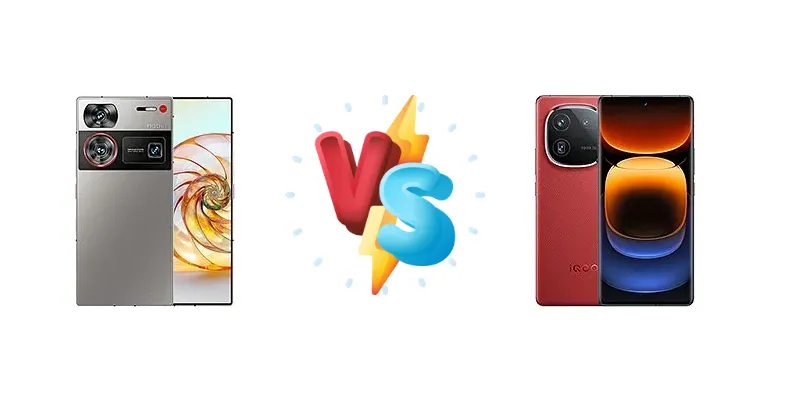
|
🏆 Quick Verdict
For the average user prioritizing longevity and a balanced experience, the ZTE nubia Z60 Ultra emerges as the winner. Its impressive 14:57-hour active use battery score, combined with a respectable 80W charging speed, offers a compelling package. The iQOO 12 Pro’s 120W charging is faster, but doesn’t compensate for a potentially shorter runtime.
| PHONES | ||
|---|---|---|
| Phone Names | ZTE nubia Z60 Ultra | vivo iQOO 12 Pro |
| Network | ||
|---|---|---|
| 2G bands | GSM 850 / 900 / 1800 / 1900 | GSM 850 / 900 / 1800 / 1900 |
| 3G bands | HSDPA 850 / 900 / 1700(AWS) / 1900 / 2100 | HSDPA 800 / 850 / 900 / 1700(AWS) / 1900 / 2100 |
| 4G bands | 1, 2, 3, 4, 5, 7, 8, 12, 17, 18, 19, 20, 26, 28, 34, 38, 39, 40, 41, 66 - International | 1, 2, 3, 4, 5, 7, 8, 12, 17, 18, 19, 20, 25, 26, 28, 34, 38, 39, 40, 41, 42, 66 |
| 5G bands | 1, 2, 3, 5, 7, 8, 28, 38, 40, 41, 66, 77, 78 SA/NSA - International | 1, 2, 3, 5, 7, 8, 12, 20, 25, 26, 28, 66, 38, 40, 41, 77, 78 SA/NSA |
| Speed | HSPA, LTE, 5G | HSPA, LTE, 5G |
| Technology | GSM / CDMA / HSPA / CDMA2000 / LTE / 5G | GSM / CDMA / HSPA / CDMA2000 / LTE / 5G |
| Launch | ||
|---|---|---|
| Announced | 2023, December 19 | 2023, November 07 |
| Status | Available. Released 2023, December 29 | Available. Released 2023, November 14 |
| Body | ||
|---|---|---|
| Build | Glass front, aluminum frame, glass back | - |
| Dimensions | 164 x 76.4 x 8.8 mm (6.46 x 3.01 x 0.35 in) | 164.6 x 75.4 x 8.6 mm or 8.8 mm |
| SIM | Nano-SIM + Nano-SIM | Nano-SIM + Nano-SIM |
| Weight | 246 g (8.68 oz) | 205 g or 210 g (7.23 oz) |
| Display | ||
|---|---|---|
| Resolution | 1116 x 2480 pixels, 20:9 ratio (~400 ppi density) | 1440 x 3200 pixels, 20:9 ratio (~518 ppi density) |
| Size | 6.8 inches, 111.6 cm2 (~89.1% screen-to-body ratio) | 6.78 inches, 111.0 cm2 (~89.4% screen-to-body ratio) |
| Type | AMOLED, 1B colors, 120Hz, HDR10, 1500 nits (peak) | LTPO AMOLED, 1B colors, 144Hz, HDR10+, 1600 nits (HBM), 3000 nits (peak) |
| Platform | ||
|---|---|---|
| CPU | Octa-core (1x3.3 GHz Cortex-X4 & 3x3.2 GHz Cortex-A720 & 2x3.0 GHz Cortex-A720 & 2x2.3 GHz Cortex-A520) | Octa-core (1x3.3 GHz Cortex-X4 & 3x3.2 GHz Cortex-A720 & 2x3.0 GHz Cortex-A720 & 2x2.3 GHz Cortex-A520) |
| Chipset | Qualcomm SM8650-AB Snapdragon 8 Gen 3 (4 nm) | Qualcomm SM8650-AB Snapdragon 8 Gen 3 (4 nm) |
| GPU | Adreno 750 | Adreno 750 |
| OS | Android 14, MyOS 14 | Android 14, up to 2 major Android upgrades, Funtouch 14 (International), OriginOS 4 (China) |
| Memory | ||
|---|---|---|
| Card slot | No | No |
| Internal | 256GB 8GB RAM, 256GB 12GB RAM, 512GB 12GB RAM, 512GB 16GB RAM, 1TB 16GB RAM, 1TB 24GB RAM | 256GB 16GB RAM, 512GB 16GB RAM, 1TB 16GB RAM |
| Main Camera | ||
|---|---|---|
| Features | Laser AF, color spectrum sensor, Ring-LED, dual-tone flash, panorama, HDR | Color spectrum sensor, Dual-LED flash, HDR, panorama |
| Triple | 50 MP, f/1.6, 35mm (standard), 1/1.49", 1.0µm, PDAF, OIS 64 MP, f/3.3, 85mm (periscope telephoto), 1/2.0", PDAF, OIS, 3.3x optical zoom (vs. 26mm cam) 50 MP, f/1.8, 18mm, 100˚ (ultrawide), 1/1.55", PDAF, OIS | 50 MP, f/1.7, 23mm (wide), 1/1.3", 1.2µm, ulti-directional PDAF, OIS 64 MP, f/2.6, 70mm (periscope telephoto), 1/2.0", PDAF, OIS, 3x optical zoom 50 MP, f/2.0, 15mm, 119˚ (ultrawide), AF |
| Video | 8K@30fps, 4K@30/60/120fps, 1080p@30/60fps, gyro-EIS, HDR10, 10‑bit video | 8K@30fps, 4K@24/30/60fps, 1080p@30/60/120/240fps, gyro-EIS |
| Selfie camera | ||
|---|---|---|
| Features | HDR | HDR |
| Single | 12 MP, under display - International model 16 MP, f/2.0, 26mm (wide), 1/2.8", 1.22µm, under display - China model | 16 MP, f/2.5, (wide) |
| Video | 1080p@30fps | 1080p@30fps, gyro-EIS |
| Sound | ||
|---|---|---|
| 35mm jack | No | No |
| Loudspeaker | Yes, with stereo speakers | Yes, with stereo speakers |
| Comms | ||
|---|---|---|
| Bluetooth | 5.4, A2DP, LE, aptX HD, aptX Adaptive, aptX Lossless | 5.4, A2DP, LE, aptX HD, aptX Adaptive, aptX Lossless |
| Infrared port | Yes | Yes |
| NFC | Yes | Yes |
| Positioning | GPS (L1+L5), GLONASS, GALILEO, BDS | GPS (L1+L5), GLONASS (G1), BDS (B1I+B1c+B2a), GALILEO (E1+E5a), QZSS (L1+L5) |
| Radio | No | No |
| USB | USB Type-C 3.1, OTG | USB Type-C 2.0, OTG |
| WLAN | Wi-Fi 802.11 a/b/g/n/ac/6e/7, dual-band, Wi-Fi Direct | Wi-Fi 802.11 a/b/g/n/ac/6/7, tri-band, Wi-Fi Direct |
| Features | ||
|---|---|---|
| Sensors | Fingerprint (under display, optical), accelerometer, gyro, proximity, compass | Fingerprint (under display, ultrasonic), accelerometer, gyro, proximity, compass |
| Battery | ||
|---|---|---|
| Charging | 80W wired, PD3.0, QC4 | 120W wired 50W wireless 10W reverse wireless |
| Type | Li-Po 6000 mAh | 5100 mAh |
| Misc | ||
|---|---|---|
| Colors | Black, Silver, Photographer Edition | Black, Red, White (BMW M branding) |
| Models | NX721J | V2329A |
| Price | $ 459.00 | About 650 EUR |
ZTE nubia Z60 Ultra
- Exceptional battery life (14:57h active use)
- Respectable 80W wired charging
- High peak brightness (1018 nits)
- Lacks wireless charging
- Charging speed slower than iQOO 12 Pro
vivo iQOO 12 Pro
- Ultra-fast 120W wired charging
- Convenient 50W wireless charging
- Potential for optimized gaming performance
- Likely shorter battery life than nubia Z60 Ultra
- Battery capacity currently unknown
Display Comparison
While both devices likely feature high-quality AMOLED panels, the nubia Z60 Ultra’s measured 1018 nits of peak brightness suggests a superior outdoor visibility experience. The iQOO 12 Pro’s display specifications are currently unavailable, making a direct comparison difficult. However, both are expected to utilize adaptive refresh rate technology (LTPO) to optimize power consumption, though the specific implementation and efficiency will vary. Bezels are likely comparable given the flagship positioning of both devices.
Camera Comparison
Camera specifications are currently limited. Both devices will undoubtedly feature multi-camera systems, but the nubia Z60 Ultra’s potential focus on image quality and detail, given ZTE’s recent camera advancements, is a possibility. The iQOO 12 Pro may lean towards a more versatile camera setup optimized for social media and quick sharing. Without sensor size, aperture, and image processing details, a definitive camera comparison is impossible. The inclusion of a 2MP macro camera on either device is unlikely to significantly impact overall image quality.
Performance
Both the ZTE nubia Z60 Ultra and the vivo iQOO 12 Pro are equipped with the Qualcomm SM8650-AB Snapdragon 8 Gen 3 (4 nm) chipset, featuring the same octa-core CPU configuration (1x3.3 GHz Cortex-X4, 3x3.2 GHz Cortex-A720, 2x3.0 GHz Cortex-A720, 2x2.3 GHz Cortex-A520). This means raw processing power will be virtually identical. Performance differences will likely stem from thermal management and RAM optimization. The iQOO series historically focuses on gaming performance, suggesting potentially more aggressive cooling solutions and software tweaks to maintain peak clock speeds for longer durations. However, without detailed thermal testing, this remains speculative.
Battery Life
The nubia Z60 Ultra’s active use battery score of 14:57 hours is a significant advantage. While the iQOO 12 Pro’s battery capacity is unknown, the nubia’s runtime demonstrates excellent power efficiency. The iQOO 12 Pro compensates with significantly faster charging – 120W wired, 50W wireless, and 10W reverse wireless – compared to the nubia Z60 Ultra’s 80W wired charging. This means the iQOO 12 Pro can replenish its battery much quicker, potentially mitigating concerns about shorter runtime. The addition of wireless and reverse wireless charging on the iQOO 12 Pro provides added convenience.
Buying Guide
Buy the ZTE nubia Z60 Ultra if you need exceptional battery life for all-day use and value a consistently reliable experience. This phone is ideal for professionals, travelers, or anyone who dislikes frequent charging. Buy the vivo iQOO 12 Pro if you prioritize the absolute fastest charging speeds and frequently top up your phone throughout the day, and are willing to potentially sacrifice some overall runtime.