
Honor Magic6 Pro vs. ZTE nubia Z60 Ultra: A Deep Dive into Flagship Features
| Phones Images | |||||
|---|---|---|---|---|---|
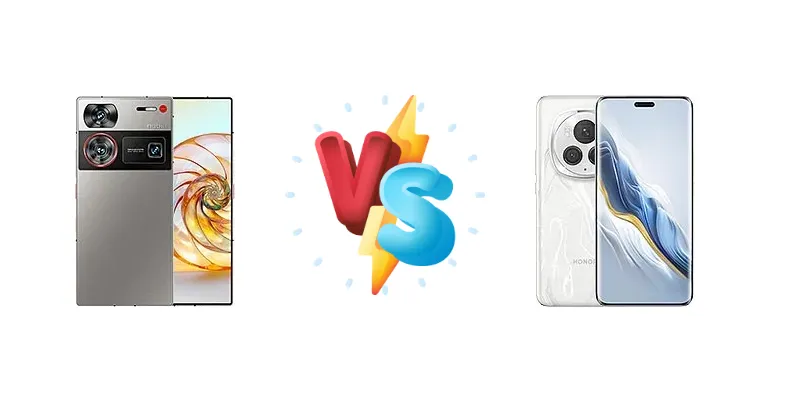
|
🏆 Quick Verdict
For most users, the Honor Magic6 Pro emerges as the slightly stronger choice. Its significantly brighter display (1578 nits vs 1018 nits) offers superior visibility outdoors, and the addition of 66W wireless charging provides convenient power-up options. While the nubia Z60 Ultra boasts excellent battery life, the Magic6 Pro’s overall package is more compelling.
| PHONES | ||
|---|---|---|
| Phone Names | ZTE nubia Z60 Ultra | Honor Magic6 Pro |
| Network | ||
|---|---|---|
| 2G bands | GSM 850 / 900 / 1800 / 1900 | GSM 850 / 900 / 1800 / 1900 |
| 3G bands | HSDPA 850 / 900 / 1700(AWS) / 1900 / 2100 | HSDPA 800 / 850 / 900 / 1700(AWS) / 1900 / 2100 |
| 4G bands | 1, 2, 3, 4, 5, 7, 8, 12, 17, 18, 19, 20, 26, 28, 34, 38, 39, 40, 41, 66 - International | LTE |
| 5G bands | 1, 2, 3, 5, 7, 8, 28, 38, 40, 41, 66, 77, 78 SA/NSA - International | SA/NSA |
| Speed | HSPA, LTE, 5G | HSPA, LTE, 5G |
| Technology | GSM / CDMA / HSPA / CDMA2000 / LTE / 5G | GSM / CDMA / HSPA / CDMA2000 / LTE / 5G |
| Launch | ||
|---|---|---|
| Announced | 2023, December 19 | 2024, January 11 |
| Status | Available. Released 2023, December 29 | Available. Released 2024, January 18 |
| Body | ||
|---|---|---|
| Build | Glass front, aluminum frame, glass back | Glass front (NanoCrystal Shield), glass back or silicone polymer back (eco leather) |
| Dimensions | 164 x 76.4 x 8.8 mm (6.46 x 3.01 x 0.35 in) | 162.5 x 75.8 x 8.9 mm (6.40 x 2.98 x 0.35 in) |
| SIM | Nano-SIM + Nano-SIM | · Nano-SIM + eSIM· Nano-SIM + Nano-SIM |
| Weight | 246 g (8.68 oz) | 225 g or 229 g (7.94 oz) |
| Display | ||
|---|---|---|
| Protection | - | NanoCrystal Shield |
| Resolution | 1116 x 2480 pixels, 20:9 ratio (~400 ppi density) | 1280 x 2800 pixels, 19.5:9 ratio (~453 ppi density) |
| Size | 6.8 inches, 111.6 cm2 (~89.1% screen-to-body ratio) | 6.8 inches, 112.8 cm2 (~91.6% screen-to-body ratio) |
| Type | AMOLED, 1B colors, 120Hz, HDR10, 1500 nits (peak) | LTPO OLED, 1B colors, 120Hz, Dolby Vision, HDR, 1600 nits (HBM), 5000 nits (peak) |
| Platform | ||
|---|---|---|
| CPU | Octa-core (1x3.3 GHz Cortex-X4 & 3x3.2 GHz Cortex-A720 & 2x3.0 GHz Cortex-A720 & 2x2.3 GHz Cortex-A520) | Octa-core (1x3.3 GHz Cortex-X4 & 3x3.2 GHz Cortex-A720 & 2x3.0 GHz Cortex-A720 & 2x2.3 GHz Cortex-A520) |
| Chipset | Qualcomm SM8650-AB Snapdragon 8 Gen 3 (4 nm) | Qualcomm SM8650-AB Snapdragon 8 Gen 3 (4 nm) |
| GPU | Adreno 750 | Adreno 750 |
| OS | Android 14, MyOS 14 | Android 14, up to 4 major Android upgrades, MagicOS 8 |
| Memory | ||
|---|---|---|
| Card slot | No | No |
| Internal | 256GB 8GB RAM, 256GB 12GB RAM, 512GB 12GB RAM, 512GB 16GB RAM, 1TB 16GB RAM, 1TB 24GB RAM | 256GB 12GB RAM, 256GB 16GB RAM, 512GB 12GB RAM, 512GB 16GB RAM, 1TB 16GB RAM |
| Main Camera | ||
|---|---|---|
| Features | Laser AF, color spectrum sensor, Ring-LED, dual-tone flash, panorama, HDR | Laser AF, color spectrum sensor, LED flash, HDR, panorama |
| Triple | 50 MP, f/1.6, 35mm (standard), 1/1.49", 1.0µm, PDAF, OIS 64 MP, f/3.3, 85mm (periscope telephoto), 1/2.0", PDAF, OIS, 3.3x optical zoom (vs. 26mm cam) 50 MP, f/1.8, 18mm, 100˚ (ultrawide), 1/1.55", PDAF, OIS | 50 MP, f/1.4-2.0, 23mm (wide), 1/1.3", 1.2µm, PDAF, OIS 180 MP, f/2.6, (periscope telephoto), 1/1.49", 0.56µm, PDAF, OIS, 2.5x optical zoom 50 MP, f/2.0, 13mm, 122˚ (ultrawide), 1/2.88", 0.61µm, AF |
| Video | 8K@30fps, 4K@30/60/120fps, 1080p@30/60fps, gyro-EIS, HDR10, 10‑bit video | 4K@24/30/60fps, 1080p@30/60/120/240fps, gyro-EIS, OIS, HDR, 10-bit video |
| Selfie camera | ||
|---|---|---|
| Features | HDR | - |
| Single | 12 MP, under display - International model 16 MP, f/2.0, 26mm (wide), 1/2.8", 1.22µm, under display - China model | 50 MP, f/2.0, 22mm (wide), 1/2.93", 0.6µm, AF TOF 3D, (depth/biometrics sensor) |
| Video | 1080p@30fps | 4K@30fps, 1080p@30/60fps, gyro-EIS |
| Sound | ||
|---|---|---|
| 35mm jack | No | No |
| Loudspeaker | Yes, with stereo speakers | Yes, with stereo speakers |
| Comms | ||
|---|---|---|
| Bluetooth | 5.4, A2DP, LE, aptX HD, aptX Adaptive, aptX Lossless | 5.3, A2DP, LE, aptX HD |
| Infrared port | Yes | Yes |
| NFC | Yes | Yes |
| Positioning | GPS (L1+L5), GLONASS, GALILEO, BDS | GPS (L1+L5), GLONASS, BDS (B1I+B1c+B2a), GALILEO (E1+E5a) |
| Radio | No | No |
| USB | USB Type-C 3.1, OTG | USB Type-C 3.2, DisplayPort 1.2, OTG |
| WLAN | Wi-Fi 802.11 a/b/g/n/ac/6e/7, dual-band, Wi-Fi Direct | Wi-Fi 802.11 a/b/g/n/ac/6/7, dual-band, Wi-Fi Direct |
| Features | ||
|---|---|---|
| Sensors | Fingerprint (under display, optical), accelerometer, gyro, proximity, compass | Fingerprint (under display, optical), Face ID, accelerometer, gyro, proximity, compass |
| Battery | ||
|---|---|---|
| Charging | 80W wired, PD3.0, QC4 | 80W wired 66W wireless Reverse wireless 5W reverse wired |
| Type | Li-Po 6000 mAh | Si/C Li-Ion 5600 mAh |
| Misc | ||
|---|---|---|
| Colors | Black, Silver, Photographer Edition | Black, Green, Blue, Purple, White |
| Models | NX721J | BVL-AN16, BVL-N49 |
| Price | $ 459.00 | € 455.54 / $ 899.00 / £ 598.99 |
ZTE nubia Z60 Ultra
- Longer battery life in active use tests.
- Clean, near-stock Android experience.
- Competitive price point (likely).
- Significantly dimmer display compared to the Magic6 Pro.
- Lacks wireless charging capabilities.
Honor Magic6 Pro
- Much brighter display for superior outdoor visibility.
- 66W wireless charging for added convenience.
- Reverse wireless charging for accessories.
- Slightly shorter battery life in active use tests.
- MagicOS may not appeal to all users.
Display Comparison
The Honor Magic6 Pro’s display is the clear standout, achieving a measured peak brightness of 1578 nits compared to the nubia Z60 Ultra’s 1018 nits. This substantial difference translates to significantly better visibility under direct sunlight. While both utilize high-refresh-rate panels, the Magic6 Pro’s higher brightness is a tangible benefit for outdoor photographers and users who frequently consume content on the go. Details regarding panel technology (LTPO or not) are missing, but the brightness difference is a key differentiator. Bezels appear comparable based on available imagery, and color accuracy is likely similar given both target the flagship segment.
Camera Comparison
Without detailed camera specifications, a direct comparison is limited. However, the market positioning suggests both will feature multi-camera systems with a primary focus on image quality. The absence of sensor size information prevents a definitive assessment. The nubia Z60 Ultra’s brand history leans towards photography, while Honor often emphasizes computational photography. Lens apertures and OIS implementation will be crucial factors, but are currently unknown. It’s safe to assume both will offer capable camera systems, but the Magic6 Pro’s software processing may lean towards more vibrant, social-media-ready images.
Performance
Both devices are equipped with the Qualcomm SM8650-AB Snapdragon 8 Gen 3 (4 nm) chipset, featuring an identical CPU configuration: 1x3.3 GHz Cortex-X4, 3x3.2 GHz Cortex-A720, 2x3.0 GHz Cortex-A720, and 2x2.3 GHz Cortex-A520. This means raw processing power will be nearly indistinguishable between the two. Performance will largely depend on thermal management and RAM optimization, data for which is currently unavailable. Both likely utilize LPDDR5x RAM, further minimizing performance gaps. The real-world impact of any thermal differences will be most noticeable during extended gaming sessions.
Battery Life
The nubia Z60 Ultra delivers a commendable 14:57h active use score, slightly exceeding the Honor Magic6 Pro’s 14:06h. This suggests the nubia offers superior battery endurance under similar usage conditions. However, the Magic6 Pro compensates with significantly faster charging options: 80W wired, 66W wireless, and even 5W reverse wired charging. The nubia Z60 Ultra is limited to 80W wired charging. While the difference in active use time isn’t massive, the Magic6 Pro’s wireless charging and reverse charging capabilities add considerable convenience.
Buying Guide
Buy the ZTE nubia Z60 Ultra if you prioritize maximizing battery life and value a clean, near-stock Android experience. Its 14:57 active use score is impressive. Buy the Honor Magic6 Pro if you demand the brightest possible display for outdoor use, appreciate the convenience of wireless charging, and prefer a more feature-rich software experience with Honor’s MagicOS.