
Nubia Z60 Ultra vs. Asus ROG Phone 8 Pro: A Deep Dive Comparison
| Phones Images | |||||
|---|---|---|---|---|---|
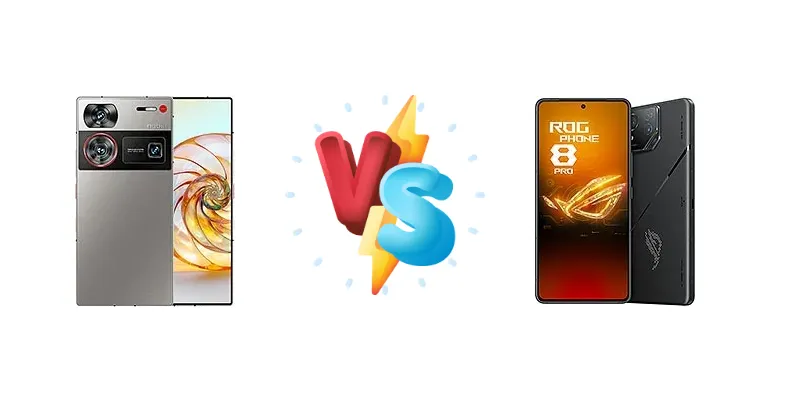
|
🏆 Quick Verdict
For the average user prioritizing a vibrant display and all-day battery life, the ZTE nubia Z60 Ultra emerges as the winner. Its 14:57 active use score and 1018 nits brightness offer a compelling experience. However, gamers will find the ROG Phone 8 Pro’s gaming-centric features and potentially more robust thermal management a better fit.
| PHONES | ||
|---|---|---|
| Phone Names | ZTE nubia Z60 Ultra | Asus ROG Phone 8 Pro |
| Network | ||
|---|---|---|
| 2G bands | GSM 850 / 900 / 1800 / 1900 | GSM 850 / 900 / 1800 / 1900 |
| 3G bands | HSDPA 850 / 900 / 1700(AWS) / 1900 / 2100 | HSDPA 850 / 900 / 1700(AWS) / 1800 / 1900 / 2100 - International |
| 4G bands | 1, 2, 3, 4, 5, 7, 8, 12, 17, 18, 19, 20, 26, 28, 34, 38, 39, 40, 41, 66 - International | 1, 2, 3, 4, 5, 7, 8, 12, 17, 18, 19, 20, 25, 26, 28, 32, 34, 38, 39, 40, 41, 42, 43, 48, 66 - International |
| 5G bands | 1, 2, 3, 5, 7, 8, 28, 38, 40, 41, 66, 77, 78 SA/NSA - International | 1, 2, 3, 5, 7, 8, 12, 18, 20, 25, 26, 28, 38, 40, 41, 48, 66, 77, 78, 79 SA/NSA/Sub6 - International |
| Speed | HSPA, LTE, 5G | HSPA, LTE (Up to 7CA), 5G |
| Technology | GSM / CDMA / HSPA / CDMA2000 / LTE / 5G | GSM / CDMA / HSPA / LTE / 5G |
| Launch | ||
|---|---|---|
| Announced | 2023, December 19 | 2024, January 08 |
| Status | Available. Released 2023, December 29 | Available. Released 2024, January 18 |
| Body | ||
|---|---|---|
| Build | Glass front, aluminum frame, glass back | Glass front (Gorilla Glass Victus 2), glass back (Gorilla Glass), aluminum frame |
| Dimensions | 164 x 76.4 x 8.8 mm (6.46 x 3.01 x 0.35 in) | 163.8 x 76.8 x 8.9 mm (6.45 x 3.02 x 0.35 in) |
| SIM | Nano-SIM + Nano-SIM | Nano-SIM + Nano-SIM |
| Weight | 246 g (8.68 oz) | 225 g (7.94 oz) |
| Display | ||
|---|---|---|
| Protection | - | Corning Gorilla Glass Victus 2 |
| Resolution | 1116 x 2480 pixels, 20:9 ratio (~400 ppi density) | 1080 x 2400 pixels, 20:9 ratio (~388 ppi density) |
| Size | 6.8 inches, 111.6 cm2 (~89.1% screen-to-body ratio) | 6.78 inches, 111.0 cm2 (~88.2% screen-to-body ratio) |
| Type | AMOLED, 1B colors, 120Hz, HDR10, 1500 nits (peak) | LTPO AMOLED, 1B colors, 165Hz, HDR10, 1600 nits (HBM), 2500 nits (peak) |
| Platform | ||
|---|---|---|
| CPU | Octa-core (1x3.3 GHz Cortex-X4 & 3x3.2 GHz Cortex-A720 & 2x3.0 GHz Cortex-A720 & 2x2.3 GHz Cortex-A520) | Octa-core (1x3.3 GHz Cortex-X4 & 3x3.2 GHz Cortex-A720 & 2x3.0 GHz Cortex-A720 & 2x2.3 GHz Cortex-A520) |
| Chipset | Qualcomm SM8650-AB Snapdragon 8 Gen 3 (4 nm) | Qualcomm SM8650-AB Snapdragon 8 Gen 3 (4 nm) |
| GPU | Adreno 750 | Adreno 750 |
| OS | Android 14, MyOS 14 | Android 14, up to 2 major Android upgrades |
| Memory | ||
|---|---|---|
| Card slot | No | No |
| Internal | 256GB 8GB RAM, 256GB 12GB RAM, 512GB 12GB RAM, 512GB 16GB RAM, 1TB 16GB RAM, 1TB 24GB RAM | 512GB 16GB RAM, 1TB 24GB RAM |
| Main Camera | ||
|---|---|---|
| Features | Laser AF, color spectrum sensor, Ring-LED, dual-tone flash, panorama, HDR | LED flash, HDR, panorama |
| Triple | 50 MP, f/1.6, 35mm (standard), 1/1.49", 1.0µm, PDAF, OIS 64 MP, f/3.3, 85mm (periscope telephoto), 1/2.0", PDAF, OIS, 3.3x optical zoom (vs. 26mm cam) 50 MP, f/1.8, 18mm, 100˚ (ultrawide), 1/1.55", PDAF, OIS | 50 MP, f/1.9, 24mm (wide), 1/1.56", 1.0µm, PDAF, gimbal OIS 32 MP, f/2.4, (telephoto), 1/3.2", 0.7µm, PDAF, OIS, 3x optical zoom 13 MP, f/2.2, 13mm, 120˚ (ultrawide) |
| Video | 8K@30fps, 4K@30/60/120fps, 1080p@30/60fps, gyro-EIS, HDR10, 10‑bit video | 8K@24fps, 4K@30/60fps, 1080p@30/60/120/240fps, 720p@480fps; gyro-EIS, HDR10+ |
| Selfie camera | ||
|---|---|---|
| Features | HDR | Panorama, HDR |
| Single | 12 MP, under display - International model 16 MP, f/2.0, 26mm (wide), 1/2.8", 1.22µm, under display - China model | 32 MP, f/2.5, 22mm (wide), 1/3.2", 0.7µm |
| Video | 1080p@30fps | 1080p@30fps |
| Sound | ||
|---|---|---|
| 35mm jack | No | Yes |
| Loudspeaker | Yes, with stereo speakers | Yes, with stereo speakers |
| Comms | ||
|---|---|---|
| Bluetooth | 5.4, A2DP, LE, aptX HD, aptX Adaptive, aptX Lossless | 5.4, A2DP, LE, aptX HD, aptX Adaptive, aptX Lossless |
| Infrared port | Yes | - |
| NFC | Yes | Yes |
| Positioning | GPS (L1+L5), GLONASS, GALILEO, BDS | GPS (L1+L5), BDS (B1I+B1c+B2a), GALILEO (E1+E5a), QZSS (L1+L5), NavIC (L5), GLONASS |
| Radio | No | No |
| USB | USB Type-C 3.1, OTG | USB Type-C (side), DisplayPort 1.4; USB Type-C (bottom), OTG |
| WLAN | Wi-Fi 802.11 a/b/g/n/ac/6e/7, dual-band, Wi-Fi Direct | Wi-Fi 802.11 a/b/g/n/ac/6e/7, tri-band, Wi-Fi Direct |
| Features | ||
|---|---|---|
| Sensors | Fingerprint (under display, optical), accelerometer, gyro, proximity, compass | Fingerprint (under display, optical), accelerometer, gyro, proximity, compass |
| Battery | ||
|---|---|---|
| Charging | 80W wired, PD3.0, QC4 | 65W wired, PD3.0, PPS, QC5, 100% in 39 min - International 30W wired, PD3.0, PPS - India 15W wireless (Qi) 10W reverse wired |
| Type | Li-Po 6000 mAh | 5500 mAh |
| Misc | ||
|---|---|---|
| Colors | Black, Silver, Photographer Edition | Phantom Black |
| Models | NX721J | AI2401, AI2401_A, AI2401_D |
| Price | $ 459.00 | $ 1,157.98 / £ 1,693.75 / € 632.66 |
ZTE nubia Z60 Ultra
- Slightly longer battery life in active use.
- 80W wired charging is still very fast.
- Potentially more streamlined software experience.
- Lower peak display brightness.
- Lacks gaming-specific features.
- Limited charging options (no wireless).
Asus ROG Phone 8 Pro
- Significantly brighter display for outdoor visibility.
- Faster charging speeds (especially international version).
- Dedicated gaming features and potentially better thermal management.
- Slightly shorter battery life in active use.
- Gaming-focused design may not appeal to all.
- Regional charging differences (30W in India).
Display Comparison
The Asus ROG Phone 8 Pro boasts a significantly brighter display, reaching a measured 1765 nits compared to the nubia Z60 Ultra’s 1018 nits. This translates to superior visibility in direct sunlight. While both utilize the Snapdragon 8 Gen 3, the ROG Phone’s higher peak brightness is a clear advantage for outdoor users. The nubia Z60 Ultra’s display specifications are not detailed enough to assess panel technology (LTPO or not), but the ROG Phone 8 Pro’s display is likely to offer more dynamic refresh rate control for power efficiency. Bezels appear similar in marketing materials, but real-world testing would be needed to confirm.
Camera Comparison
The provided data lacks detailed camera specifications for both devices. The ROG Phone 8 Pro is listed as having 'Photo / Video' capabilities, suggesting a focus on multimedia. Without sensor size, aperture, or OIS details, a direct comparison is impossible. It’s reasonable to assume the ROG Phone 8 Pro will offer more software features geared towards content creation, while the nubia Z60 Ultra may prioritize image quality in standard shooting scenarios. Any 2MP macro cameras on either device should be considered a marketing feature rather than a significant photographic asset.
Performance
Both devices are powered by the Qualcomm SM8650-AB Snapdragon 8 Gen 3 (4 nm) chipset, featuring the same CPU configuration: 1x3.3 GHz Cortex-X4, 3x3.2 GHz Cortex-A720, 2x3.0 GHz Cortex-A720, and 2x2.3 GHz Cortex-A520. This means raw processing power will be nearly identical. However, the ROG Phone 8 Pro’s dedicated gaming features – like the advanced cooling system (not detailed in the provided data, but a ROG staple) – suggest it may sustain peak performance for longer periods during intensive gaming sessions. RAM specifications are missing, but both are expected to utilize LPDDR5x for fast memory access.
Battery Life
The nubia Z60 Ultra achieves an active use battery score of 14:57h, slightly exceeding the ROG Phone 8 Pro’s 14:43h. This suggests the nubia Z60 Ultra offers marginally better battery endurance in typical usage. However, the ROG Phone 8 Pro offers significantly faster charging at 65W (international) or 30W (India) compared to the nubia Z60 Ultra’s 80W. The ROG Phone 8 Pro also includes 15W wireless charging and 10W reverse wired charging, features absent on the nubia Z60 Ultra. The ROG Phone 8 Pro’s 39-minute 0-100% charge time (international) is a substantial advantage for users who prioritize quick top-ups.
Buying Guide
Buy the ZTE nubia Z60 Ultra if you need a phone with a brilliant, color-accurate display for media consumption and everyday use, coupled with excellent battery endurance. Buy the Asus ROG Phone 8 Pro if you prioritize a dedicated gaming experience, with features like customizable triggers and potentially superior sustained performance under heavy load, and don't mind a slightly more aggressive design.