
ZTE nubia Z50S Pro vs. vivo X90 Pro+: A Deep Dive into Flagship Performance
| Phones Images | |||||
|---|---|---|---|---|---|
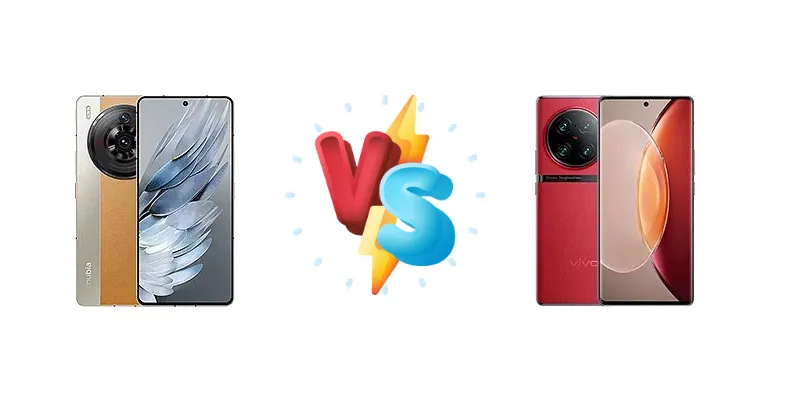
|
🏆 Quick Verdict
For most users, the vivo X90 Pro+ emerges as the stronger overall package. While the nubia Z50S Pro delivers excellent battery life with its 12:29h active use score, the X90 Pro+'s superior camera system, coupled with 50W wireless charging and a slightly refined chipset, justifies the price premium.
| PHONES | ||
|---|---|---|
| Phone Names | ZTE nubia Z50S Pro | vivo X90 Pro+ |
| Network | ||
|---|---|---|
| 2G bands | GSM 850 / 900 / 1800 / 1900 | GSM 850 / 900 / 1800 / 1900 - SIM 1 & SIM 2 |
| 3G bands | HSDPA 800 / 850 / 900 / 1700(AWS) / 1900 / 2100 | HSDPA 800 / 850 / 900 / 1700(AWS) / 1900 / 2100 |
| 4G bands | 1, 2, 3, 4, 5, 7, 8, 12, 17, 18, 19, 20, 26, 28, 34, 38, 39, 40, 41, 66 | 1, 2, 3, 4, 5, 7, 8, 12, 17, 18, 19, 20, 25, 26, 28, 34, 38, 39, 40, 41, 42, 66 |
| 5G bands | 1, 3, 5, 7, 8, 20, 28, 38, 41, 77, 78 SA/NSA | 1, 2, 3, 5, 7, 8, 12, 20, 28, 38, 40, 41, 66, 77, 78, 79 SA/NSA |
| Speed | HSPA, LTE, 5G | HSPA, LTE-A, 5G |
| Technology | GSM / CDMA / HSPA / EVDO / LTE / 5G | GSM / CDMA / HSPA / EVDO / LTE / 5G |
| - | CDMA2000 1xEV-DO | |
| Launch | ||
|---|---|---|
| Announced | 2023, July 20 | 2022, November 22 |
| Status | Available. Released 2023, July 27 | Available. Released 2022, December 06 |
| Body | ||
|---|---|---|
| Build | Glass front, silicone polymer back (eco leather), aluminum frame | Glass front, aluminum frame, eco leather back |
| Dimensions | 163.9 x 76.3 x 8.3 mm (6.45 x 3.00 x 0.33 in) | 164.4 x 75.3 x 9.7 mm (6.47 x 2.96 x 0.38 in) |
| SIM | Nano-SIM + Nano-SIM | Dual SIM (Nano-SIM, dual stand-by) |
| Weight | 228 g (8.04 oz) | 221 g (7.80 oz) |
| - | IP68 dust/water resistant (up to 1.5m for 30 min) | |
| Display | ||
|---|---|---|
| Resolution | 1260 x 2800 pixels, 20:9 ratio (~452 ppi density) | 1440 x 3200 pixels, 20:9 ratio (~517 ppi density) |
| Size | 6.8 inches, 111.6 cm2 (~89.3% screen-to-body ratio) | 6.78 inches, 111.4 cm2 (~90.0% screen-to-body ratio) |
| Type | AMOLED, 1B colors, 120Hz, 1200 nits (peak) | LTPO4 AMOLED, 1B colors, 120Hz, Dolby Vision, HDR10+, 1800 nits (peak) |
| Platform | ||
|---|---|---|
| CPU | Octa-core (1x3.36 GHz Cortex-X3 & 2x2.8 GHz Cortex-A715 & 2x2.8 GHz Cortex-A710 & 3x2.0 GHz Cortex-A510) | Octa-core (1x3.2 GHz Cortex-X3 & 2x2.8 GHz Cortex-A715 & 2x2.8 GHz Cortex-A710 & 3x2.0 GHz Cortex-A510) |
| Chipset | Qualcomm SM8550-AC Snapdragon 8+ Gen 2 (4 nm) | Qualcomm SM8550-AB Snapdragon 8 Gen 2 (4 nm) |
| GPU | Adreno 740 (719 MHz) | Adreno 740 |
| OS | Android 13, MyOS 13, no planned android upgrades | Android 13, Funtouch (Global), Origin OS 3 (China) |
| Memory | ||
|---|---|---|
| Card slot | No | No |
| Internal | 256GB 12GB RAM, 1TB 12GB RAM, 1TB 16GB RAM | 256GB 12GB RAM, 512GB 12GB RAM |
| - | UFS 4.0 | |
| Main Camera | ||
|---|---|---|
| Dual | 50 MP, f/1.6, 35mm (standard), 1/1.49", 1.0µm, PDAF, OIS 8 MP, f/2.4, 80mm (telephoto), 1/4.4", PDAF, OIS, optical zoom 50 MP, f/2.0, 13mm, 125˚ (ultrawide), 1/2.88", 0.61µm, AF | - |
| Features | Dual-LED dual-tone flash, HDR, panorama | Zeiss optics, Zeiss T* lens coating, Pixel Shift, dual-LED dual-tone flash, HDR, panorama |
| Quad | - | 50.3 MP, f/1.8, 23mm (wide), 1.0"-type, 1.6µm, Dual Pixel PDAF, Laser AF, OIS 64 MP, f/3.5, 90mm (periscope telephoto), 1/2.0", 0.7µm, PDAF, OIS, 3.5x optical zoom 50 MP, f/1.6, 50mm (telephoto), 1/2.4", 0.7µm, AF, 2x optical zoom, OIS 48 MP, f/2.2, 14mm, 114˚ (ultrawide), 1/2.0", 0.8µm, AF |
| Single | - | 32 MP, f/2.5, 24mm (wide), 1/2.8", 0.8µm |
| Video | 8K@30fps, 4K@30/60/120fps, 1080p, gyro-EIS, 10-bit | 8K@30fps, 4K@30/60fps, 1080p@30/60fps, gyro-EIS, 14-bit RAW video |
| Selfie camera | ||
|---|---|---|
| Features | - | HDR |
| Single | 16 MP, f/2.5, 26mm (wide), 1/3.06", 1.0µm | 32 MP, f/2.5, 24mm (wide), 1/2.8", 0.8µm |
| Video | 1080p@30fps | 1080p@30/60fps |
| Sound | ||
|---|---|---|
| 3.5mm jack | - | No |
| 35mm jack | No | - |
| Loudspeaker | Yes, with stereo speakers | Yes, with stereo speakers |
| - | 32-bit/192kHz audio | |
| Comms | ||
|---|---|---|
| Bluetooth | 5.3, A2DP, LE, aptX HD, aptX Adaptive, aptX Lossless | 5.3, A2DP, LE, aptX HD |
| Infrared port | Yes | Yes |
| NFC | Yes | Yes |
| Positioning | GPS (L1+L5), GLONASS, BDS, GALILEO, QZSS | GPS (L1+L5), GLONASS, BDS, GALILEO, QZSS |
| Radio | No | No |
| USB | USB Type-C 3.1 | USB Type-C 3.2, OTG |
| WLAN | Wi-Fi 802.11 a/b/g/n/ac/6e, dual-band or tri-band (market/region dependent), Wi-Fi Direct | Wi-Fi 802.11 a/b/g/n/ac/6, dual-band, Wi-Fi Direct |
| Features | ||
|---|---|---|
| Sensors | Fingerprint (under display, optical), accelerometer, gyro, proximity, compass | Fingerprint (under display, ultrasonic), accelerometer, gyro, proximity, compass, color spectrum |
| Battery | ||
|---|---|---|
| Charging | 80W wired | 80W wired, 100% in 33 min (advertised) 50W wireless Reverse wired |
| Type | Li-Po 5100 mAh | Li-Po 4700 mAh, non-removable |
| Misc | ||
|---|---|---|
| Colors | Black, Khaki, Silver/White | Black, Red |
| Models | NX713J | V2227A |
| Price | About 800 EUR | About 1030 EUR |
ZTE nubia Z50S Pro
- Exceptional battery life (12:29h active use)
- Powerful Snapdragon 8+ Gen 2 processor
- Competitive 80W wired charging
- Missing camera details raise concerns
- No wireless charging support
vivo X90 Pro+
- Latest Snapdragon 8 Gen 2 chipset
- Superior camera system (expected)
- 50W wireless charging and reverse wired charging
- Battery life may be slightly lower than nubia Z50S Pro
- Higher price point
Display Comparison
Both devices feature high-quality displays, but the nubia Z50S Pro boasts a measured peak brightness of 1029 nits. While the X90 Pro+ likely achieves similar or higher brightness levels (data unavailable), the nubia's confirmed figure is impressive. The absence of LTPO information for either device means we can't assess adaptive refresh rate efficiency. Bezels are likely comparable given both phones target a premium aesthetic. Color accuracy is expected to be excellent on both, typical of flagship panels.
Camera Comparison
The vivo X90 Pro+ is expected to significantly outperform the nubia Z50S Pro in camera capabilities, though detailed sensor information for the nubia is missing. The X90 Pro+ is known for its exceptional image processing and high-quality sensors. While both phones likely offer versatile camera systems, the X90 Pro+'s focus on camera technology positions it as the superior choice for photography enthusiasts. The absence of details on the nubia's camera system makes a precise comparison difficult, but it's unlikely to match the X90 Pro+'s reputation.
Performance
The core difference lies in the chipsets: the nubia Z50S Pro utilizes the Snapdragon 8+ Gen 2 (SM8550-AC), while the X90 Pro+ features the Snapdragon 8 Gen 2 (SM8550-AB). Both are 4nm chips with identical CPU core configurations – 1x Cortex-X3, 2x Cortex-A715, 2x Cortex-A710, and 3x Cortex-A510. However, the Snapdragon 8 Gen 2 in the X90 Pro+ has a slightly higher peak CPU clock speed (3.2 GHz vs 3.36 GHz on the nubia), and benefits from architectural improvements in the GPU and NPU, leading to marginally better sustained performance and efficiency. The X90 Pro+ also benefits from potentially faster LPDDR5x RAM, though specifics are unavailable.
Battery Life
The nubia Z50S Pro shines with its impressive 12:29h active use battery score, indicating excellent real-world endurance. The X90 Pro+’s battery capacity is unknown, but its Snapdragon 8 Gen 2 chipset is more power-efficient. Both support 80W wired charging, with the X90 Pro+ advertising a full charge in 33 minutes. Crucially, the X90 Pro+ adds 50W wireless charging and reverse wired charging, offering greater convenience and versatility – features absent on the nubia Z50S Pro.
Buying Guide
Buy the ZTE nubia Z50S Pro if you prioritize maximizing battery life and value for money. Its Snapdragon 8+ Gen 2 provides ample performance for demanding tasks, and the 80W charging is respectable. Buy the vivo X90 Pro+ if you demand the best possible camera experience, appreciate the convenience of wireless charging, and are willing to pay a premium for the latest Snapdragon chipset and its associated refinements.