
ZTE nubia Z50S Pro vs Oppo Find X6 Pro: A Deep Dive into Flagship Performance
| Phones Images | |||||
|---|---|---|---|---|---|
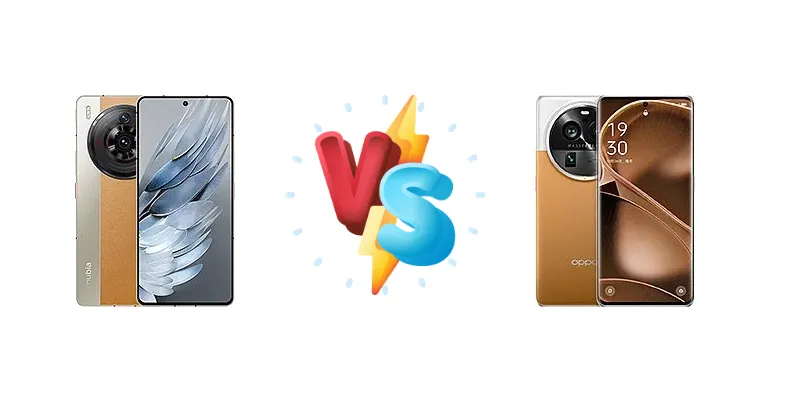
|
🏆 Quick Verdict
For the average user prioritizing camera quality and fast charging, the Oppo Find X6 Pro emerges as the winner. Its 100W charging and superior display brightness offer tangible benefits. However, gamers and those seeking maximum sustained performance may find the nubia Z50S Pro's Snapdragon 8+ Gen 2 a compelling alternative.
| PHONES | ||
|---|---|---|
| Phone Names | ZTE nubia Z50S Pro | Oppo Find X6 Pro |
| Network | ||
|---|---|---|
| 2G bands | GSM 850 / 900 / 1800 / 1900 | GSM 850 / 900 / 1800 / 1900 |
| 3G bands | HSDPA 800 / 850 / 900 / 1700(AWS) / 1900 / 2100 | HSDPA 800 / 850 / 900 / 1700(AWS) / 1900 / 2100 |
| 4G bands | 1, 2, 3, 4, 5, 7, 8, 12, 17, 18, 19, 20, 26, 28, 34, 38, 39, 40, 41, 66 | 1, 2, 3, 4, 5, 7, 8, 12, 17, 18, 19, 20, 26, 28, 34, 38, 39, 40, 41, 66 |
| 5G bands | 1, 3, 5, 7, 8, 20, 28, 38, 41, 77, 78 SA/NSA | 1, 3, 5, 7, 8, 20, 28, 38, 40, 41, 66, 77, 78, 79 SA/NSA |
| Speed | HSPA, LTE, 5G | HSPA, LTE, 5G |
| Technology | GSM / CDMA / HSPA / EVDO / LTE / 5G | GSM / CDMA / HSPA / CDMA2000 / LTE / 5G |
| - | CDMA2000 1x | |
| Launch | ||
|---|---|---|
| Announced | 2023, July 20 | 2023, March 21 |
| Status | Available. Released 2023, July 27 | Available. Released 2023, March 24 |
| Body | ||
|---|---|---|
| Build | Glass front, silicone polymer back (eco leather), aluminum frame | Glass front (Gorilla Glass Victus 2), glass back (Gorilla Glass 5) or eco leather back, aluminum frame |
| Dimensions | 163.9 x 76.3 x 8.3 mm (6.45 x 3.00 x 0.33 in) | 164.8 x 76.2 x 9.1 mm or 9.5 mm |
| SIM | Nano-SIM + Nano-SIM | Nano-SIM + Nano-SIM |
| Weight | 228 g (8.04 oz) | 216 g or 218 g (7.62 oz) |
| - | IP68 dust/water resistant (up to 1.5m for 30 min) | |
| Display | ||
|---|---|---|
| Protection | - | Corning Gorilla Glass Victus 2 |
| Resolution | 1260 x 2800 pixels, 20:9 ratio (~452 ppi density) | 1440 x 3168 pixels (~510 ppi density) |
| Size | 6.8 inches, 111.6 cm2 (~89.3% screen-to-body ratio) | 6.82 inches, 113.0 cm2 (~90.0% screen-to-body ratio) |
| Type | AMOLED, 1B colors, 120Hz, 1200 nits (peak) | LTPO3 AMOLED, 1B colors, 120Hz, Dolby Vision, HDR10+, 800 nits (typ), 1500 nits (HBM), 2500 nits (peak) |
| Platform | ||
|---|---|---|
| CPU | Octa-core (1x3.36 GHz Cortex-X3 & 2x2.8 GHz Cortex-A715 & 2x2.8 GHz Cortex-A710 & 3x2.0 GHz Cortex-A510) | Octa-core (1x3.2 GHz Cortex-X3 & 2x2.8 GHz Cortex-A715 & 2x2.8 GHz Cortex-A710 & 3x2.0 GHz Cortex-A510) |
| Chipset | Qualcomm SM8550-AC Snapdragon 8+ Gen 2 (4 nm) | Qualcomm SM8550-AB Snapdragon 8 Gen 2 (4 nm) |
| GPU | Adreno 740 (719 MHz) | Adreno 740 |
| OS | Android 13, MyOS 13, no planned android upgrades | Android 13, up to 4 major Android upgrades, ColorOS 14 |
| Memory | ||
|---|---|---|
| Card slot | No | No |
| Internal | 256GB 12GB RAM, 1TB 12GB RAM, 1TB 16GB RAM | 256GB 12GB RAM, 256GB 16GB RAM, 512GB 16GB RAM |
| - | UFS 4.0 | |
| Main Camera | ||
|---|---|---|
| Dual | 50 MP, f/1.6, 35mm (standard), 1/1.49", 1.0µm, PDAF, OIS 8 MP, f/2.4, 80mm (telephoto), 1/4.4", PDAF, OIS, optical zoom 50 MP, f/2.0, 13mm, 125˚ (ultrawide), 1/2.88", 0.61µm, AF | - |
| Features | Dual-LED dual-tone flash, HDR, panorama | Laser AF, color spectrum sensor, Hasselblad Color Calibration, LED flash, HDR, panorama |
| Triple | - | 50 MP, f/1.8, 23mm (wide), 1.0"-type, 1.6µm, dual pixel PDAF, OIS 50 MP, f/2.6, 65mm (periscope telephoto), 1/1.56", 1.0µm, 2.8x optical zoom, multi-directional PDAF, OIS 50 MP, f/2.2, 15mm, 110˚ (ultrawide), 1/1.56", 1.0µm, multi-directional PDAF |
| Video | 8K@30fps, 4K@30/60/120fps, 1080p, gyro-EIS, 10-bit | 4K@30/60fps, 1080p@30/60/240fps; gyro-EIS; HDR, 10‑bit video, Dolby Vision |
| Selfie camera | ||
|---|---|---|
| Features | - | Panorama |
| Single | 16 MP, f/2.5, 26mm (wide), 1/3.06", 1.0µm | 32 MP, f/2.4, 21mm (wide), 1/2.74", 0.8µm, PDAF |
| Video | 1080p@30fps | 4K@30fps, gyro-EIS |
| Sound | ||
|---|---|---|
| 3.5mm jack | - | No |
| 35mm jack | No | No |
| Loudspeaker | Yes, with stereo speakers | Yes, with stereo speakers |
| Comms | ||
|---|---|---|
| Bluetooth | 5.3, A2DP, LE, aptX HD, aptX Adaptive, aptX Lossless | 5.3, A2DP, LE, aptX HD |
| Infrared port | Yes | Yes |
| NFC | Yes | Yes |
| Positioning | GPS (L1+L5), GLONASS, BDS, GALILEO, QZSS | GPS (L1+L5), GLONASS (G1), BDS (B1I+B1c+B2a), GALILEO (E1+E5a), QZSS (L1+L5) |
| Radio | No | No |
| USB | USB Type-C 3.1 | USB Type-C 3.1, OTG |
| WLAN | Wi-Fi 802.11 a/b/g/n/ac/6e, dual-band or tri-band (market/region dependent), Wi-Fi Direct | Wi-Fi 802.11 a/b/g/n/ac/6e/7, tri-band, Wi-Fi Direct |
| Features | ||
|---|---|---|
| Sensors | Fingerprint (under display, optical), accelerometer, gyro, proximity, compass | Fingerprint (under display, optical), accelerometer, gyro, proximity, compass |
| Battery | ||
|---|---|---|
| Charging | 80W wired | 100W wired, PD, 45% in 10 min, 100% in 30 min 50W wireless, 50% in 22 min, 100% in 51 min 10W reverse wireless |
| Type | Li-Po 5100 mAh | Li-Po 5000 mAh |
| Misc | ||
|---|---|---|
| Colors | Black, Khaki, Silver/White | Black, Green, Brown |
| Models | NX713J | PGEM110, PGEM10 |
| Price | About 800 EUR | About 820 EUR |
| Tests | ||
|---|---|---|
| Battery life | - | Endurance rating 114h |
| Camera | - | Photo / Video |
| Display | - | Contrast ratio: Infinite (nominal) |
| Loudspeaker | - | -25.1 LUFS (Very good) |
| Performance | - | AnTuTu: 1294797 (v9) GeekBench: 4791 (v5.1), 5226 (v6) GFXBench: 60fps (ES 3.1 onscreen) |
ZTE nubia Z50S Pro
- Superior sustained performance due to Snapdragon 8+ Gen 2
- Excellent battery life (12:29h active use)
- Potentially more affordable price point
- Lower peak display brightness
- Slower charging speeds (80W wired)
Oppo Find X6 Pro
- Brighter display (1318 nits)
- Significantly faster charging (100W wired, 50W wireless)
- Likely superior camera image processing
- Snapdragon 8 Gen 2 may throttle under sustained load
- Potentially higher price
Display Comparison
The Oppo Find X6 Pro boasts a significantly brighter display, reaching 1318 nits compared to the nubia Z50S Pro’s 1029 nits. This translates to better visibility under direct sunlight. While both utilize high-quality panels, the Oppo’s higher peak brightness and infinite contrast ratio provide a more vibrant and engaging viewing experience. The nubia Z50S Pro’s display, while still excellent, is less impactful in bright outdoor conditions. We lack PWM frequency data, but both are expected to be high-quality panels.
Camera Comparison
Both devices are equipped with advanced camera systems, but detailed sensor information is missing. However, given Oppo’s reputation, the Find X6 Pro likely prioritizes image processing and computational photography for consistently high-quality results. The lack of specific sensor details prevents a definitive comparison, but Oppo’s history suggests a focus on dynamic range and low-light performance. Both phones support video recording, but the Find X6 Pro’s advanced image signal processor (ISP) likely offers superior video stabilization and dynamic range. The nubia Z50S Pro may lean towards a more natural image processing style, appealing to users who prefer less post-processing.
Performance
Both phones are powered by Qualcomm’s flagship silicon, but with a key difference: the nubia Z50S Pro features the Snapdragon 8+ Gen 2, while the Find X6 Pro uses the Snapdragon 8 Gen 2. While the 8 Gen 2 offers incremental improvements in CPU and GPU performance, the 8+ Gen 2 is known for its superior thermal management. The 4nm process node of both chips contributes to efficiency, but the 8+ Gen 2’s refined architecture allows for sustained peak performance for longer durations, benefiting demanding games. Both devices utilize Octa-core CPUs with the same core configuration, but the nubia’s slightly higher clock speed (3.36 GHz vs 3.2 GHz) on the Cortex-X3 prime core provides a marginal edge in single-core tasks.
Battery Life
The nubia Z50S Pro delivers an impressive 12:29h of active use, showcasing excellent battery optimization. The Oppo Find X6 Pro, with an endurance rating of 114 hours, suggests comparable longevity. However, the Oppo significantly excels in charging speed, offering 100W wired charging (0-100% in 30 minutes, 45% in 10 minutes), 50W wireless charging (100% in 51 minutes), and even 10W reverse wireless charging. The nubia Z50S Pro’s 80W wired charging is fast, but noticeably slower. This charging disparity is a major advantage for the Oppo, especially for users who frequently need to top up their battery quickly.
Buying Guide
Buy the ZTE nubia Z50S Pro if you need a phone optimized for extended gaming sessions, value sustained performance over peak camera capabilities, and appreciate a more aggressive price point. Buy the Oppo Find X6 Pro if you prefer a top-tier camera system, lightning-fast 100W charging (including wireless), and a brighter, more visually immersive display experience.