
ZTE nubia Z50S Pro vs Huawei P60 Pro: A Deep Dive into Flagship Performance
| Phones Images | |||||
|---|---|---|---|---|---|
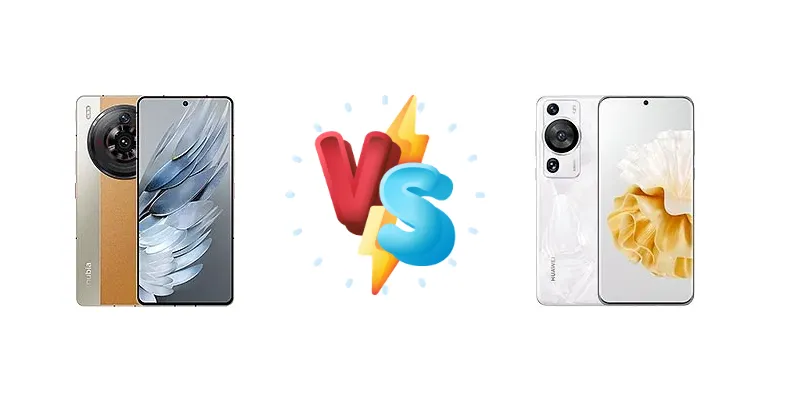
|
🏆 Quick Verdict
For most users, the ZTE nubia Z50S Pro emerges as the stronger choice. Its Snapdragon 8+ Gen 2 chipset provides a noticeable performance advantage, particularly in demanding tasks, and its active use battery life of 12:29h is impressive. While the P60 Pro offers wireless charging and a slightly brighter display, the nubia’s superior processing power and potentially lower price make it the more compelling option.
| PHONES | ||
|---|---|---|
| Phone Names | ZTE nubia Z50S Pro | Huawei P60 Pro |
| Network | ||
|---|---|---|
| 2G bands | GSM 850 / 900 / 1800 / 1900 | GSM 850 / 900 / 1800 / 1900 |
| 3G bands | HSDPA 800 / 850 / 900 / 1700(AWS) / 1900 / 2100 | HSDPA 800 / 850 / 900 / 1700(AWS) / 1900 / 2100 |
| 4G bands | 1, 2, 3, 4, 5, 7, 8, 12, 17, 18, 19, 20, 26, 28, 34, 38, 39, 40, 41, 66 | 1, 2, 3, 4, 5, 7, 8, 12, 13, 17, 18, 19, 20, 26, 28, 32, 34, 38, 39, 40, 41, 66 - International |
| 5G bands | 1, 3, 5, 7, 8, 20, 28, 38, 41, 77, 78 SA/NSA | - |
| Speed | HSPA, LTE, 5G | HSPA, LTE |
| Technology | GSM / CDMA / HSPA / EVDO / LTE / 5G | GSM / CDMA / HSPA / CDMA2000 / LTE |
| - | 1, 2, 3, 4, 5, 7, 8, 12, 17, 18, 19, 20, 26, 28, 34, 38, 39, 40, 41 - China | |
| Launch | ||
|---|---|---|
| Announced | 2023, July 20 | 2023, March 23 |
| Status | Available. Released 2023, July 27 | Available. Released 2023, March 31 |
| Body | ||
|---|---|---|
| Build | Glass front, silicone polymer back (eco leather), aluminum frame | - |
| Dimensions | 163.9 x 76.3 x 8.3 mm (6.45 x 3.00 x 0.33 in) | 161 x 74.5 x 8.3 mm (6.34 x 2.93 x 0.33 in) |
| SIM | Nano-SIM + Nano-SIM | · Nano-SIM· Nano-SIM + Nano-SIM |
| Weight | 228 g (8.04 oz) | 200 g (7.05 oz) |
| - | IP68 dust/water resistant (up to 1.5m for 30 min) | |
| Display | ||
|---|---|---|
| Protection | - | Kunlun Glass |
| Resolution | 1260 x 2800 pixels, 20:9 ratio (~452 ppi density) | 1220 x 2700 pixels (~444 ppi density) |
| Size | 6.8 inches, 111.6 cm2 (~89.3% screen-to-body ratio) | 6.67 inches, 107.7 cm2 (~89.8% screen-to-body ratio) |
| Type | AMOLED, 1B colors, 120Hz, 1200 nits (peak) | LTPO OLED, 1B colors, 120Hz |
| Platform | ||
|---|---|---|
| CPU | Octa-core (1x3.36 GHz Cortex-X3 & 2x2.8 GHz Cortex-A715 & 2x2.8 GHz Cortex-A710 & 3x2.0 GHz Cortex-A510) | Octa-core (1x3.19 GHz Cortex-X2 & 3x2.75 GHz Cortex-A710 & 4x2.0 GHz Cortex-A510) |
| Chipset | Qualcomm SM8550-AC Snapdragon 8+ Gen 2 (4 nm) | Qualcomm SM8475 Snapdragon 8+ Gen 1 4G (4 nm) |
| GPU | Adreno 740 (719 MHz) | Adreno 730 |
| OS | Android 13, MyOS 13, no planned android upgrades | HarmonyOS 3.1 (China), EMUI 13.1 (Europe), no Google Play Services |
| Memory | ||
|---|---|---|
| Card slot | No | Nano Memory (uses shared SIM slot) |
| Internal | 256GB 12GB RAM, 1TB 12GB RAM, 1TB 16GB RAM | 256GB 8GB RAM, 256GB 12GB RAM, 512GB 12GB RAM |
| - | UFS | |
| Main Camera | ||
|---|---|---|
| Dual | 50 MP, f/1.6, 35mm (standard), 1/1.49", 1.0µm, PDAF, OIS 8 MP, f/2.4, 80mm (telephoto), 1/4.4", PDAF, OIS, optical zoom 50 MP, f/2.0, 13mm, 125˚ (ultrawide), 1/2.88", 0.61µm, AF | - |
| Features | Dual-LED dual-tone flash, HDR, panorama | Laser AF, color spectrum sensor, LED flash, HDR, panorama |
| Triple | - | 48 MP, f/1.4-f/4.0, 25mm (wide), PDAF, OIS 48 MP, f/2.1, 90mm (telephoto), PDAF, sensor-shift OIS, 3.5x optical zoom 13 MP, f/2.2, 13mm (ultrawide), AF |
| Video | 8K@30fps, 4K@30/60/120fps, 1080p, gyro-EIS, 10-bit | 4K@30/60fps, 1080p@30/60fps, 1080p@960fps; gyro-EIS, HDR Vivid |
| Selfie camera | ||
|---|---|---|
| Features | - | Panorama, HDR |
| Single | 16 MP, f/2.5, 26mm (wide), 1/3.06", 1.0µm | 13 MP, f/2.4, (ultrawide) |
| Video | 1080p@30fps | 4K@30/60fps, 1080p@30fps, HDR Vivid |
| Sound | ||
|---|---|---|
| 3.5mm jack | - | No |
| 35mm jack | No | No |
| Loudspeaker | Yes, with stereo speakers | Yes, with stereo speakers |
| Comms | ||
|---|---|---|
| Bluetooth | 5.3, A2DP, LE, aptX HD, aptX Adaptive, aptX Lossless | 5.2, A2DP, LE |
| Infrared port | Yes | Yes |
| NFC | Yes | Yes |
| Positioning | GPS (L1+L5), GLONASS, BDS, GALILEO, QZSS | GPS (L1+L5), GLONASS (B1I+B1c+B2a), BDS (B1I+B1c+B2a), GALILEO (E1+E5a), QZSS (L1+L5), NavIC |
| Radio | No | No |
| USB | USB Type-C 3.1 | USB Type-C 3.1, OTG |
| WLAN | Wi-Fi 802.11 a/b/g/n/ac/6e, dual-band or tri-band (market/region dependent), Wi-Fi Direct | Wi-Fi 802.11 a/b/g/n/ac/6, dual-band, Wi-Fi Direct |
| Features | ||
|---|---|---|
| Sensors | Fingerprint (under display, optical), accelerometer, gyro, proximity, compass | Fingerprint (under display, optical), accelerometer, gyro, proximity, compass |
| - | BDS Satellite Message | |
| Battery | ||
|---|---|---|
| Charging | 80W wired | 88W wired 50W wireless Reverse wireless |
| Type | Li-Po 5100 mAh | Li-Po 4815 mAh |
| Misc | ||
|---|---|---|
| Colors | Black, Khaki, Silver/White | Black, Green, Violet, Rococo Pearl |
| Models | NX713J | MNA-AL00, MNA-LX9 |
| Price | About 800 EUR | € 738.50 |
| Tests | ||
|---|---|---|
| Battery life | - | Endurance rating 96h |
| Camera | - | Photo / Video |
| Display | - | Contrast ratio: Infinite (nominal) |
| Loudspeaker | - | -27.3 LUFS (Good) |
| Performance | - | AnTuTu: 1030473 (v9) GeekBench: 4422 (v6) GFXBench: 65fps (ES 3.1 onscreen) |
ZTE nubia Z50S Pro
- More powerful Snapdragon 8+ Gen 2 chipset
- Potentially better thermal management due to newer process node
- Faster processing speeds for gaming and demanding apps
- Lower peak display brightness compared to P60 Pro
- Limited display specifications available
Huawei P60 Pro
- Higher peak display brightness for better outdoor visibility
- Wireless charging and reverse wireless charging capabilities
- Reputation for strong camera image processing
- Older Snapdragon 8+ Gen 1 4G chipset with 4G connectivity limitation
- Potentially lower performance in demanding tasks
- Endurance rating is less informative than active use testing
Display Comparison
Both devices feature high-quality displays, but the Huawei P60 Pro edges out the nubia Z50S Pro in peak brightness, achieving 1135 nits compared to the nubia’s 1029 nits. This difference is noticeable in direct sunlight. However, the lack of detailed display specifications like refresh rate and panel type for the nubia Z50S Pro makes a complete assessment difficult. The P60 Pro’s ‘Infinite’ contrast ratio (nominal) suggests a strong OLED panel, while the nubia’s display performance relies heavily on its calibration and color accuracy, which are currently unknown.
Camera Comparison
Both phones are marketed as camera-centric, but detailed sensor information is missing. Both support photo and video recording, but without specifics on megapixel counts, sensor sizes, or aperture values, a direct comparison is challenging. The P60 Pro’s reputation for strong image processing and color science suggests a focus on producing visually appealing images, while the nubia Z50S Pro’s camera performance remains largely unknown. The absence of details on optical image stabilization (OIS) on either device further complicates the assessment. We can assume both will offer a range of shooting modes, but the quality will depend heavily on the underlying hardware and software algorithms.
Performance
The core difference lies in the chipsets. The ZTE nubia Z50S Pro’s Snapdragon 8+ Gen 2 (4nm) represents a significant upgrade over the Huawei P60 Pro’s Snapdragon 8+ Gen 1 4G (4nm). The Gen 2 features a newer CPU architecture – Cortex-X3 vs Cortex-X2 – and improved efficiency. The nubia’s CPU configuration (1x3.36 GHz Cortex-X3, 2x2.8 GHz Cortex-A715, 2x2.8 GHz Cortex-A710, 3x2.0 GHz Cortex-A510) offers a performance boost over the P60 Pro’s (1x3.19 GHz Cortex-X2, 3x2.75 GHz Cortex-A710, 4x2.0 GHz Cortex-A510). Crucially, the P60 Pro is limited to 4G connectivity, a significant drawback for users requiring fast mobile data speeds. The nubia Z50S Pro will benefit from faster app loading, smoother multitasking, and superior gaming performance.
Battery Life
The Huawei P60 Pro boasts an ‘Endurance rating’ of 96 hours, a metric that requires further context. The nubia Z50S Pro, however, provides a concrete ‘active use’ score of 12:29h. While the P60 Pro offers both 88W wired and 50W wireless charging, along with reverse wireless charging, the nubia Z50S Pro’s 80W wired charging is still very competitive. The P60 Pro’s wireless charging is a clear advantage for convenience, but the nubia’s potentially more efficient chipset could offset the slightly slower wired charging speed in real-world usage.
Buying Guide
Buy the ZTE nubia Z50S Pro if you prioritize gaming, demanding applications, and future-proofing with a more powerful processor. It’s ideal for users who frequently edit videos, play graphically intensive games, or simply want the fastest possible Android experience. Buy the Huawei P60 Pro if you value camera versatility, wireless charging, and a slightly brighter display, and are willing to accept the limitations of the older Snapdragon 8+ Gen 1 4G chipset and potential software restrictions.