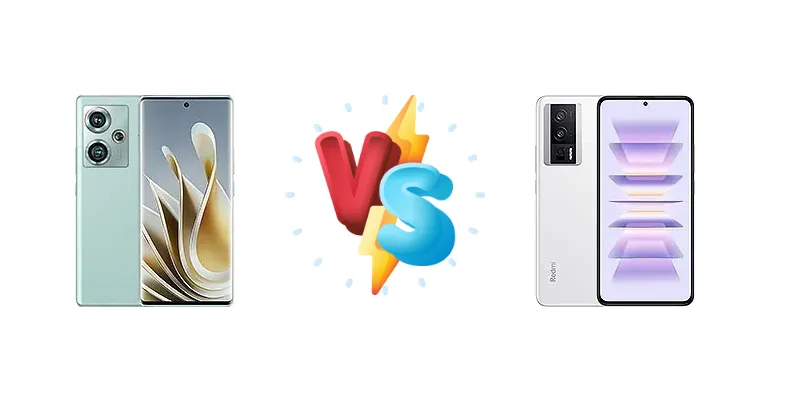
The Snapdragon 8 Gen 2 chipset is the hottest ticket in Android, and both the ZTE Nubia Z50 and Xiaomi Redmi K60 Pro are vying for your attention. These phones offer flagship performance at competitive prices, but which one delivers the best overall experience? Let's dive into a detailed comparison.
🏆 Quick Verdict
The Redmi K60 Pro takes the crown thanks to its significantly faster 120W charging, wireless charging capabilities, and potentially superior camera system (based on Xiaomi's track record). While the Nubia Z50 is a strong contender, the K60 Pro offers a more compelling package for most users.
| Network |
|---|
| 2G bands | GSM 850 / 900 / 1800 / 1900 | GSM 850 / 900 / 1800 / 1900 |
| 3G bands | HSDPA 850 / 900 / 1700(AWS) / 1900 / 2100 | HSDPA 800 / 850 / 900 / 1700(AWS) / 2100 |
| 4G bands | LTE | 1, 3, 4, 5, 8, 18, 19, 26, 34, 38, 39, 40, 41, 42 |
| 5G bands | SA/NSA | 1, 3, 5, 8, 28, 38, 41, 77, 78 SA/NSA |
| Speed | HSPA, LTE, 5G | HSPA, LTE, 5G |
| Technology | GSM / CDMA / HSPA / LTE / 5G | GSM / CDMA / HSPA / CDMA2000 / LTE / 5G |
| | CDMA 800 | CDMA2000 1x |
| Launch |
|---|
| Announced | 2022, December 19 | 2022, December 27 |
| Status | Available. Released 2022, December 26 | Available. Released 2023, January 01 |
| Body |
|---|
| Build | Glass front, aluminum frame, glass back or eco leather back | - |
| Dimensions | 162.9 x 72.9 x 8.5 mm or 8.7 mm | 162.8 x 75.4 x 8.6 mm or 8.9 mm |
| SIM | Nano-SIM + Nano-SIM | Nano-SIM + Nano-SIM |
| Weight | 197 g or 199 g (6.95 oz) | 201 g or 205 g (7.09 oz) |
| Display |
|---|
| Resolution | 1080 x 2400 pixels, 20:9 ratio (~395 ppi density) | 1440 x 3200 pixels, 20:9 ratio (~526 ppi density) |
| Size | 6.67 inches, 107.4 cm2 (~90.4% screen-to-body ratio) | 6.67 inches, 107.4 cm2 (~87.5% screen-to-body ratio) |
| Type | AMOLED, 1B colors, 144Hz, HDR10+, 1000 nits | OLED, 68B colors, 120Hz, Dolby Vision, HDR10+, 1400 nits (peak) |
| Platform |
|---|
| CPU | Octa-core (1x3.2 GHz Cortex-X3 & 2x2.8 GHz Cortex-A715 & 2x2.8 GHz Cortex-A710 & 3x2.0 GHz Cortex-A510) | Octa-core (1x3.2 GHz Cortex-X3 & 2x2.8 GHz Cortex-A715 & 2x2.8 GHz Cortex-A710 & 3x2.0 GHz Cortex-A510) |
| Chipset | Qualcomm SM8550-AB Snapdragon 8 Gen 2 (4 nm) | Qualcomm SM8550-AB Snapdragon 8 Gen 2 (4 nm) |
| GPU | Adreno 740 | Adreno 740 |
| OS | Android 13, MyOS 13 | Android 13, MIUI 14 |
| Memory |
|---|
| Card slot | No | No |
| Internal | 128GB 8GB RAM, 256GB 8GB RAM, 256GB 12GB RAM, 512GB 12GB RAM, 1TB 16GB RAM | 128GB 8GB RAM, 256GB 8GB RAM, 256GB 12GB RAM, 512GB 12GB RAM, 512GB 16GB RAM |
| | UFS 4.0
UFS 3.1 (128GB only) | UFS 4.0
UFS 3.1 - 128GB only |
| Main Camera |
|---|
| Dual | 64 MP, f/1.6, 35mm (standard), 1/1.7", PDAF, OIS
50 MP, f/2.2, 14mm, 116˚ (ultrawide), AF | - |
| Features | Ring-LED flash (4 LEDs), panorama, HDR | Color spectrum sensor, Dual-LED dual-tone flash, HDR, panorama |
| Single | 16 MP, (wide) | - |
| Triple | - | 54 MP, f/1.9, (wide), 1/1.49", 1.0µm, PDAF, OIS
8 MP, 118˚ (ultrawide), 1/4.0", 1.12µm
2 MP (macro) |
| Video | 8K, 4K | 8K@24fps, 4K@30/60fps, 1080p@30/60/120/240/960fps, 720p@1920fps, gyro-EIS |
| Selfie camera |
|---|
| Features | HDR | HDR |
| Single | 16 MP, (wide) | 16 MP, (wide), 1/3.06", 1.0µm |
| Video | 1080p@30fps | 1080p@30/60/120fps |
| Sound |
|---|
| 3.5mm jack | No | No |
| 35mm jack | No | No |
| Loudspeaker | Yes, with stereo speakers | Yes, with stereo speakers |
| | 24-bit/192kHz audio | 24-bit/192kHz audio |
| Comms |
|---|
| Bluetooth | 5.3, A2DP, LE | 5.3, A2DP, LE |
| Infrared port | - | Yes |
| NFC | Yes | Yes |
| Positioning | GPS (L1+L5), GLONASS, BDS, GALILEO, QZSS | GPS (L1+L5), GLONASS (G1), BDS (B1I+B2a+Bc), GALILEO (E1+E5a), QZSS (L1+L5), NavIC |
| Radio | No | Unspecified |
| USB | USB Type-C 3.1, OTG | USB Type-C 2.0, OTG |
| WLAN | Wi-Fi 802.11 a/b/g/n/ac/6e, dual-band, Wi-Fi Direct | Wi-Fi 802.11 a/b/g/n/ac/6e, dual-band, Wi-Fi Direct |
| Features |
|---|
| Sensors | Fingerprint (under display, optical), accelerometer, gyro, proximity, compass | Fingerprint (under display, optical), accelerometer, gyro, proximity, compass |
| Battery |
|---|
| Charging | 80W wired | 120W wired, PD3.0, QC3+, 100% in 19 min
30W wireless |
| Type | Li-Po 5000 mAh | Li-Po 5000 mAh |
| Misc |
|---|
| Colors | Black, Silver, Mint, Rabit red | Black, White, Mint, Champion Black |
| Models | NX711J | 22127RK46C |
| Price | About 400 EUR | About 460 EUR |
ZTE nubia Z50
- Potentially more affordable
- Clean software experience
- Sleek design (rumored)
- Slower charging (80W)
- No wireless charging
- Camera performance potentially less refined
Xiaomi Redmi K60 Pro
- Blazing-fast 120W charging
- 30W wireless charging
- Potentially superior camera system
- Strong software support
- Xiaomi's MIUI software can be polarizing
- May be slightly more expensive
Display Comparison
Both phones likely feature high-quality AMOLED displays with 120Hz refresh rates. The Nubia Z50 is rumored to have a slightly curved display, while the Redmi K60 Pro may opt for a flatter panel. Screen brightness and color accuracy will be key differentiators to look for in reviews.
Camera Comparison
While both phones have capable camera systems, Xiaomi generally excels in camera processing. The Redmi K60 Pro is expected to have a more versatile camera setup, potentially including a higher-resolution main sensor and improved image stabilization. The Nubia Z50's camera performance will depend on ZTE's software tuning.
Performance
Powered by the same Snapdragon 8 Gen 2 chipset, both phones should offer exceptional performance. Real-world differences will likely come down to software optimization and thermal management. Expect smooth multitasking, demanding gaming, and snappy app launches on both devices.
Battery Life
The Redmi K60 Pro's 120W wired charging is a massive advantage, allowing for incredibly quick top-ups. The Nubia Z50's 80W charging is still fast, but not as impressive. The Redmi K60 Pro also boasts 30W wireless charging, a feature absent on the Nubia Z50. Battery capacity is likely similar, around 5000mAh.
Buying Guide
The ZTE Nubia Z50 is ideal for users prioritizing a clean software experience and potentially a slightly more affordable price point. The Xiaomi Redmi K60 Pro is the better choice for those who value blazing-fast charging, wireless charging, and a potentially more refined camera experience.
Frequently Asked Questions
❓ What is the difference in software between the Nubia Z50 and Redmi K60 Pro?
The Nubia Z50 is expected to offer a cleaner, more stock-like Android experience, while the Redmi K60 Pro runs Xiaomi's MIUI, which is feature-rich but can be more cluttered.
❓ Which phone is better for gaming?
Both phones should handle gaming exceptionally well thanks to the Snapdragon 8 Gen 2. The Redmi K60 Pro's potentially better thermal management could give it a slight edge in sustained performance during long gaming sessions.