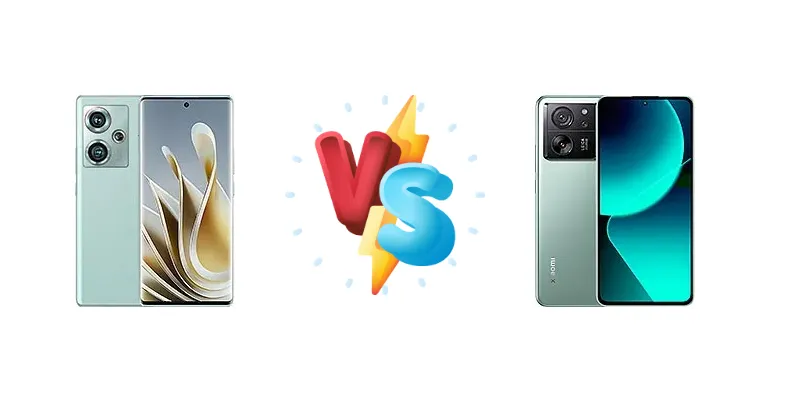
The ZTE nubia Z50 and Xiaomi 13T represent compelling options in the increasingly competitive flagship smartphone space. The nubia Z50, powered by the Snapdragon 8 Gen 2, aims for raw performance, while the Xiaomi 13T leverages the Dimensity 8200 Ultra, prioritizing a balance of power and efficiency. This comparison dissects their key differences to determine which device delivers the best overall experience.
🏆 Quick Verdict
For users prioritizing peak performance and sustained gaming, the ZTE nubia Z50 with its Snapdragon 8 Gen 2 is the clear winner. However, the Xiaomi 13T offers exceptional battery life (12:23h active use) and faster charging (42min to 100%) making it ideal for power users who value longevity and convenience.
| Network |
|---|
| 2G bands | GSM 850 / 900 / 1800 / 1900 | GSM 850 / 900 / 1800 / 1900 |
| 3G bands | HSDPA 850 / 900 / 1700(AWS) / 1900 / 2100 | HSDPA 800 / 850 / 900 / 1700(AWS) / 1900 / 2100 |
| 4G bands | LTE | 1, 2, 3, 4, 5, 7, 8, 12, 13, 17, 18, 19, 20, 26, 28, 32, 38, 40, 41, 66 |
| 5G bands | SA/NSA | 1, 3, 5, 7, 8, 20, 28, 38, 40, 41, 66, 77, 78 SA/NSA |
| Speed | HSPA, LTE, 5G | HSPA, LTE, 5G |
| Technology | GSM / CDMA / HSPA / LTE / 5G | GSM / HSPA / LTE / 5G |
| | CDMA 800 | - |
| Launch |
|---|
| Announced | 2022, December 19 | 2023, September 26 |
| Status | Available. Released 2022, December 26 | Available. Released 2023, September 26 |
| Body |
|---|
| Build | Glass front, aluminum frame, glass back or eco leather back | Glass front (Gorilla Glass 5), glass back or silicone polymer back, plastic frame |
| Dimensions | 162.9 x 72.9 x 8.5 mm or 8.7 mm | 162.2 x 75.7 x 8.5 mm (6.39 x 2.98 x 0.33 in) |
| SIM | Nano-SIM + Nano-SIM | · Nano-SIM + eSIM· Nano-SIM + Nano-SIM |
| Weight | 197 g or 199 g (6.95 oz) | 193 g or 197 g (6.81 oz) |
| Display |
|---|
| Protection | - | Corning Gorilla Glass 5 |
| Resolution | 1080 x 2400 pixels, 20:9 ratio (~395 ppi density) | 1220 x 2712 pixels, 20:9 ratio (~446 ppi density) |
| Size | 6.67 inches, 107.4 cm2 (~90.4% screen-to-body ratio) | 6.67 inches, 107.4 cm2 (~87.5% screen-to-body ratio) |
| Type | AMOLED, 1B colors, 144Hz, HDR10+, 1000 nits | AMOLED, 68B colors, 144Hz, Dolby Vision, HDR10+, 1200 nits (HBM), 2600 nits (peak) |
| Platform |
|---|
| CPU | Octa-core (1x3.2 GHz Cortex-X3 & 2x2.8 GHz Cortex-A715 & 2x2.8 GHz Cortex-A710 & 3x2.0 GHz Cortex-A510) | Octa-core (1x3.1 GHz Cortex-A78 & 3x3.0 GHz Cortex-A78 & 4x2.0 GHz Cortex-A55) |
| Chipset | Qualcomm SM8550-AB Snapdragon 8 Gen 2 (4 nm) | Mediatek Dimensity 8200 Ultra (4 nm) |
| GPU | Adreno 740 | Mali-G610 MC6 |
| OS | Android 13, MyOS 13 | Android 13, up to 4 major Android upgrades, HyperOS |
| Memory |
|---|
| Card slot | No | No |
| Internal | 128GB 8GB RAM, 256GB 8GB RAM, 256GB 12GB RAM, 512GB 12GB RAM, 1TB 16GB RAM | 256GB 8GB RAM, 256GB 12GB RAM |
| | UFS 4.0
UFS 3.1 (128GB only) | - |
| Main Camera |
|---|
| Dual | 64 MP, f/1.6, 35mm (standard), 1/1.7", PDAF, OIS
50 MP, f/2.2, 14mm, 116˚ (ultrawide), AF | - |
| Features | Ring-LED flash (4 LEDs), panorama, HDR | Leica lens, color spectrum sensor, LED flash, HDR, panorama |
| Single | 16 MP, (wide) | - |
| Triple | - | 50 MP, f/1.9, 24mm (wide), 1/1.28", 1.22µm, PDAF, OIS
50 MP, f/1.9, 50mm (telephoto), 1/2.88", 0.61µm, PDAF, 2x optical zoom
12 MP, f/2.2, 15mm (ultrawide), 1/3.06", 1.12µm |
| Video | 8K, 4K | 4K@30fps (HDR10+), 1080p@30/60/120fps, gyro-EIS |
| Selfie camera |
|---|
| Features | HDR | HDR |
| Single | 16 MP, (wide) | 20 MP, f/2.2, (wide), 0.8µm |
| Video | 1080p@30fps | 1080p@30fps, HDR10+ |
| Sound |
|---|
| 3.5mm jack | No | - |
| 35mm jack | No | No |
| Loudspeaker | Yes, with stereo speakers | Yes, with stereo speakers |
| | 24-bit/192kHz audio | - |
| Comms |
|---|
| Bluetooth | 5.3, A2DP, LE | 5.4, A2DP, LE |
| Infrared port | - | Yes |
| NFC | Yes | Yes (market/region dependent) |
| Positioning | GPS (L1+L5), GLONASS, BDS, GALILEO, QZSS | GPS (L1+L5), GLONASS (G1), GALILEO (E1+E5a), QZSS (L1+L5), NavIC (L5), BDS |
| Radio | No | No |
| USB | USB Type-C 3.1, OTG | USB Type-C 2.0, OTG |
| WLAN | Wi-Fi 802.11 a/b/g/n/ac/6e, dual-band, Wi-Fi Direct | Wi-Fi 802.11 a/b/g/n/ac/6, dual-band |
| Features |
|---|
| Sensors | Fingerprint (under display, optical), accelerometer, gyro, proximity, compass | Fingerprint (under display, optical), accelerometer, gyro, proximity, compass |
| Battery |
|---|
| Charging | 80W wired | 67W wired, PD3.0, QC4, 100% in 42 min |
| Type | Li-Po 5000 mAh | Li-Po 5000 mAh |
| Misc |
|---|
| Colors | Black, Silver, Mint, Rabit red | Alpine Blue, Meadow Green, Black |
| Models | NX711J | 2306EPN60G |
| Price | About 400 EUR | $ 255.96 / £ 326.27 / € 204.18 |
| SAR EU | - | 0.99 W/kg (head) 0.99 W/kg (body) |
ZTE nubia Z50
- Superior processing power with Snapdragon 8 Gen 2
- Potentially better sustained gaming performance
- Faster charging speed (80W)
- Likely shorter battery life compared to Xiaomi 13T
- Display brightness potentially lower than Xiaomi 13T
Xiaomi 13T
- Exceptional battery life (12:23h active use)
- Fast charging with PD3.0 and QC4 (42min to 100%)
- Brighter display (1264 nits)
- Less powerful processor than Snapdragon 8 Gen 2
- May exhibit more throttling under sustained load
Display Comparison
The Xiaomi 13T boasts a significantly brighter display, reaching a measured peak of 1264 nits, which translates to superior visibility in direct sunlight. While the nubia Z50’s display specifications are not provided, Xiaomi’s brightness advantage is substantial. The 13T’s panel likely benefits from advancements in display technology, offering a more vibrant and readable experience outdoors. Without knowing the nubia Z50’s panel type (e.g., LTPO), it’s difficult to assess its power efficiency compared to the 13T.
Camera Comparison
Without detailed camera specifications for the nubia Z50, a direct comparison is limited. However, the Xiaomi 13T’s camera system is likely to focus on versatile photo and video capabilities. The absence of information regarding the nubia Z50’s sensor size and optical image stabilization (OIS) makes it difficult to assess its low-light performance and video stabilization. The Xiaomi 13T’s image processing is known for its vibrant colors and detailed images, catering to social media sharing. We can assume the nubia Z50 will also offer a competitive camera experience, but its strengths remain unknown without further data.
Performance
The ZTE nubia Z50’s Snapdragon 8 Gen 2 (4nm) represents a significant leap in performance over the Xiaomi 13T’s Dimensity 8200 Ultra (4nm). The Snapdragon 8 Gen 2’s CPU configuration – a 1x3.2 GHz Cortex-X3 prime core – is architecturally superior to the 1x3.1 GHz Cortex-A78 in the Dimensity 8200 Ultra, promising faster single-core performance. The Snapdragon’s more modern Cortex-A715 and A710 cores also offer improvements over the Dimensity’s A78 cores. This translates to snappier app launches, smoother multitasking, and higher frame rates in demanding games. While both chips are fabricated on a 4nm process, Qualcomm’s optimizations generally lead to better sustained performance and thermal management.
Battery Life
The Xiaomi 13T clearly excels in battery performance, achieving an impressive 12:23h of active use and an endurance rating of 101 hours. This is a significant advantage over any potential battery life the nubia Z50 might offer, given its focus on power-hungry performance. The 13T’s 67W wired charging, complete with PD3.0 and QC4 support, allows for a full charge in just 42 minutes, providing exceptional convenience. The nubia Z50’s 80W charging is faster, but the Xiaomi 13T’s superior battery endurance mitigates the charging speed difference for most users.
Buying Guide
Buy the ZTE nubia Z50 if you need uncompromising processing power for demanding games, video editing, or multitasking. Its Snapdragon 8 Gen 2 chipset provides a noticeable edge in performance-intensive tasks. Buy the Xiaomi 13T if you prefer a phone that lasts all day and charges incredibly quickly. The Dimensity 8200 Ultra offers excellent performance, but the 13T’s battery endurance and 67W charging are its standout features.
Frequently Asked Questions
❓ Does the Dimensity 8200 Ultra in the Xiaomi 13T get noticeably hot during extended gaming sessions?
While the Dimensity 8200 Ultra is a capable chip, it's not as thermally efficient as the Snapdragon 8 Gen 2. Expect some heat buildup during prolonged gaming, potentially leading to slight performance throttling. However, Xiaomi's cooling solutions typically mitigate this effectively, preventing overheating.
❓ How does the 80W charging on the nubia Z50 compare to the 67W charging on the Xiaomi 13T in real-world usage?
Although the nubia Z50 charges at a higher wattage, the difference in charging time isn't massive. The Xiaomi 13T’s 67W charging still achieves a full charge in 42 minutes, and the larger battery capacity of the 13T means the faster charging of the Z50 doesn't necessarily translate to significantly more uptime.
❓ Is the Xiaomi 13T a good choice for mobile gamers who prioritize high frame rates?
The Xiaomi 13T is capable of running most mobile games at high settings, but the Snapdragon 8 Gen 2 in the nubia Z50 will deliver consistently higher and more stable frame rates, especially in graphically demanding titles. The 13T is still a good gaming phone, but not the absolute best.