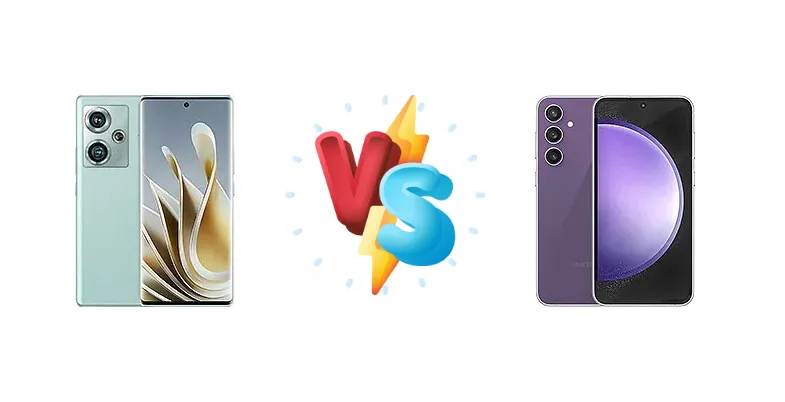
The ZTE nubia Z50 and Samsung Galaxy S23 FE occupy interesting spaces in the Android landscape. The nubia Z50 aggressively targets performance with the latest Snapdragon silicon, while the S23 FE aims for a more refined, all-around flagship experience at a potentially lower price point. This comparison dissects their key differences to determine which phone best suits your needs.
🏆 Quick Verdict
For users prioritizing raw performance and fast charging, the ZTE nubia Z50 is the clear winner. Its Snapdragon 8 Gen 2 chipset delivers a significant edge in demanding tasks. However, the Samsung Galaxy S23 FE offers a more polished software experience and longer battery life in typical use, making it a better choice for the average user.
| Network |
|---|
| 2G bands | GSM 850 / 900 / 1800 / 1900 | GSM 850 / 900 / 1800 / 1900 |
| 3G bands | HSDPA 850 / 900 / 1700(AWS) / 1900 / 2100 | HSDPA 850 / 900 / 1700(AWS) / 1900 / 2100 |
| 4G bands | LTE | 1, 2, 3, 4, 5, 7, 8, 12, 13, 17, 20, 26, 28, 38, 40, 41, 66 - International |
| 5G bands | SA/NSA | 1, 2, 3, 5, 7, 8, 20, 28, 38, 40, 41, 66, 77, 78 SA/NSA/Sub6 - International |
| Speed | HSPA, LTE, 5G | HSPA, LTE, 5G |
| Technology | GSM / CDMA / HSPA / LTE / 5G | GSM / HSPA / LTE / 5G |
| | CDMA 800 | - |
| Launch |
|---|
| Announced | 2022, December 19 | 2023, October 04 |
| Status | Available. Released 2022, December 26 | Available. Released 2023, October 05 |
| Body |
|---|
| Build | Glass front, aluminum frame, glass back or eco leather back | Glass front (Gorilla Glass 5), glass back (Gorilla Glass 5), aluminum frame |
| Dimensions | 162.9 x 72.9 x 8.5 mm or 8.7 mm | 158 x 76.5 x 8.2 mm (6.22 x 3.01 x 0.32 in) |
| SIM | Nano-SIM + Nano-SIM | · Nano-SIM· Nano-SIM + Nano-SIM· Nano-SIM + Nano-SIM + eSIM (max 2 at a time) |
| Weight | 197 g or 199 g (6.95 oz) | 209 g (7.37 oz) |
| Display |
|---|
| Protection | - | Corning Gorilla Glass 5 |
| Resolution | 1080 x 2400 pixels, 20:9 ratio (~395 ppi density) | 1080 x 2340 pixels, 19.5:9 ratio (~403 ppi density) |
| Size | 6.67 inches, 107.4 cm2 (~90.4% screen-to-body ratio) | 6.4 inches, 100.5 cm2 (~83.2% screen-to-body ratio) |
| Type | AMOLED, 1B colors, 144Hz, HDR10+, 1000 nits | Dynamic AMOLED 2X, 120Hz, HDR10+, 1450 nits (peak) |
| Platform |
|---|
| CPU | Octa-core (1x3.2 GHz Cortex-X3 & 2x2.8 GHz Cortex-A715 & 2x2.8 GHz Cortex-A710 & 3x2.0 GHz Cortex-A510) | Octa-core (1x2.8 GHz Cortex-X2 & 3x2.50 GHz Cortex-A710 & 4x1.8 GHz Cortex-A510) - InternationalOcta-core (1x3.00 GHz Cortex-X2 & 3x2.50 GHz Cortex-A710 & 4x1.80 GHz Cortex-A510) - USA |
| Chipset | Qualcomm SM8550-AB Snapdragon 8 Gen 2 (4 nm) | Exynos 2200 (4 nm) - InternationalQualcomm SM8450 Snapdragon 8 Gen 1 (4 nm) - USA |
| GPU | Adreno 740 | Xclipse 920 - InternationalAdreno 730 - USA |
| OS | Android 13, MyOS 13 | Android 13, up to 4 major Android upgrades, One UI 8 |
| Memory |
|---|
| Card slot | No | No |
| Internal | 128GB 8GB RAM, 256GB 8GB RAM, 256GB 12GB RAM, 512GB 12GB RAM, 1TB 16GB RAM | 128GB 8GB RAM, 256GB 8GB RAM |
| | UFS 4.0
UFS 3.1 (128GB only) | - |
| Main Camera |
|---|
| Dual | 64 MP, f/1.6, 35mm (standard), 1/1.7", PDAF, OIS
50 MP, f/2.2, 14mm, 116˚ (ultrawide), AF | - |
| Features | Ring-LED flash (4 LEDs), panorama, HDR | LED flash, HDR, panorama |
| Single | 16 MP, (wide) | - |
| Triple | - | 50 MP, f/1.8, 23mm (wide), 1/1.57", 1.0µm, dual pixel PDAF, OIS
8 MP, f/2.4, 76mm (telephoto), 1/4.5", 1.0µm, PDAF, OIS, 3x optical zoom
12 MP, f/2.2, 13mm, 123˚ (ultrawide), 1/3.0", 1.12µm |
| Video | 8K, 4K | 8K@24fps, 4K@30/60fps, 1080p@30/60/120/240fps |
| Selfie camera |
|---|
| Features | HDR | - |
| Single | 16 MP, (wide) | 10 MP, f/2.4, 25mm (wide), 1/3.0", 1.22µm |
| Video | 1080p@30fps | 4K@30/60fps, 1080p@30/60fps; gyro-EIS |
| Sound |
|---|
| 3.5mm jack | No | - |
| 35mm jack | No | No |
| Loudspeaker | Yes, with stereo speakers | Yes, with stereo speakers |
| | 24-bit/192kHz audio | - |
| Comms |
|---|
| Bluetooth | 5.3, A2DP, LE | 5.3, A2DP, LE |
| NFC | Yes | Yes |
| Positioning | GPS (L1+L5), GLONASS, BDS, GALILEO, QZSS | GPS, GLONASS, GALILEO, BDS |
| Radio | No | Unspecified |
| USB | USB Type-C 3.1, OTG | USB Type-C, OTG |
| WLAN | Wi-Fi 802.11 a/b/g/n/ac/6e, dual-band, Wi-Fi Direct | Wi-Fi 802.11 a/b/g/n/ac/6e, dual-band, Wi-Fi Direct |
| Features |
|---|
| Sensors | Fingerprint (under display, optical), accelerometer, gyro, proximity, compass | Fingerprint (under display, optical), accelerometer, gyro, compass |
| Battery |
|---|
| Charging | 80W wired | 25W wired, PD3.0, 50% in 30 min
15W wireless
Reverse wireless |
| Type | Li-Po 5000 mAh | Li-Ion 4500 mAh |
| Misc |
|---|
| Colors | Black, Silver, Mint, Rabit red | Mint, Cream, Graphite, Purple, Indigo, Tangerine |
| Models | NX711J | SM-S711B, SM-S711B/DS, SM-S711U1, SM-S711U, SM-S711W, SM-S7110, SM-S711N |
| Price | About 400 EUR | $ 219.95 / C$ 327.90 / £ 248.99 / € 272.00 / ₹ 34,999 |
| SAR | - | 0.80 W/kg (head) 0.72 W/kg (body) |
| SAR EU | - | 0.76 W/kg (head) 1.04 W/kg (body) |
ZTE nubia Z50
- Significantly faster processor (Snapdragon 8 Gen 2)
- Ultra-fast 80W wired charging
- Potentially lower price point
- Software experience may be less refined
- Battery life potentially shorter than S23 FE
Samsung Galaxy S23 FE
- Excellent battery life (8:28h active use)
- Polished software experience (One UI)
- Versatile camera system
- Slower processor (Exynos 2200/Snapdragon 8 Gen 1)
- Slower 25W wired charging
Display Comparison
The Samsung Galaxy S23 FE boasts a measured peak brightness of 985 nits, providing excellent visibility outdoors. While the nubia Z50’s display specs aren’t provided, nubia typically focuses on high refresh rates. The S23 FE’s panel is likely a more color-accurate and refined experience, benefiting from Samsung’s display expertise. The S23 FE’s display is likely to have better viewing angles and color calibration. The lack of detailed display specs for the nubia Z50 makes a definitive comparison difficult, but Samsung’s track record suggests an advantage here.
Camera Comparison
The context data lacks detailed camera specifications for both devices, making a precise comparison challenging. However, Samsung’s Galaxy S23 FE benefits from its established image processing pipeline and likely features a more versatile camera system. While the nubia Z50 may offer competitive hardware, Samsung’s software optimization and consistent image quality are significant advantages. The S23 FE’s video capabilities are also likely to be superior, given Samsung’s expertise in mobile video recording. Without specific sensor details for the nubia Z50, it’s difficult to assess its low-light performance or dynamic range.
Performance
The nubia Z50’s Qualcomm Snapdragon 8 Gen 2 (4nm) chipset is a generation ahead of the Exynos 2200 (4nm) found in the international S23 FE variant (and Snapdragon 8 Gen 1 in the US). The Snapdragon 8 Gen 2’s Cortex-X3 prime core, clocked at 3.2 GHz, offers a substantial performance uplift over the S23 FE’s Cortex-X2. The 4nm process node on both chips contributes to efficiency, but the newer architecture of the Snapdragon 8 Gen 2 provides superior thermal management, reducing throttling during sustained workloads. The US S23 FE with the Snapdragon 8 Gen 1 closes the gap, but still falls behind the Z50. The nubia Z50 is the clear winner for demanding users.
Battery Life
The Samsung Galaxy S23 FE achieves an impressive 8:28h of active use, demonstrating strong battery life. The nubia Z50’s battery capacity is not specified, but its 80W wired charging significantly outperforms the S23 FE’s 25W charging. The S23 FE offers 15W wireless and reverse wireless charging, adding convenience. While the nubia Z50 prioritizes charging speed, the S23 FE excels in longevity. The faster charging of the Z50 can mitigate a potentially smaller battery capacity, but the S23 FE’s endurance is a key advantage for users who prioritize all-day battery life.
Buying Guide
Buy the ZTE nubia Z50 if you need uncompromising gaming performance, rapid 80W charging, and aren't overly concerned with software refinements. Buy the Samsung Galaxy S23 FE if you prefer a more balanced experience with a well-established ecosystem, a reliable camera system, and all-day battery life, even if it means sacrificing some peak processing power.
Frequently Asked Questions
❓ Does the Exynos 2200 in the international S23 FE overheat during prolonged gaming sessions?
The Exynos 2200 has historically been known to throttle under sustained load. While Samsung has made improvements, the Snapdragon 8 Gen 2 in the nubia Z50 offers significantly better thermal efficiency, resulting in less performance degradation during extended gaming.
❓ Is the 80W charging on the nubia Z50 compatible with Power Delivery (PD) chargers?
While the S23 FE supports PD3.0, the nubia Z50’s 80W charging standard is proprietary. Using a standard PD charger will likely result in slower charging speeds. It’s best to use the charger included with the device or a compatible ZTE charger.
❓ How does the software experience differ between the nubia Z50 and the Samsung Galaxy S23 FE?
The Samsung Galaxy S23 FE runs One UI, a mature and feature-rich Android skin with a large user base and long-term software support. The nubia Z50 likely runs a more stock-Android-like experience with ZTE’s customizations, which may be less polished and have a shorter support lifespan.
❓ Does the nubia Z50 support high refresh rate gaming, like 90fps or 120fps in popular titles?
The Snapdragon 8 Gen 2 is capable of driving high refresh rates in most mobile games. However, specific game support and optimization will vary. The nubia Z50’s display specifications are needed to confirm its maximum refresh rate, but the chipset provides the necessary horsepower.