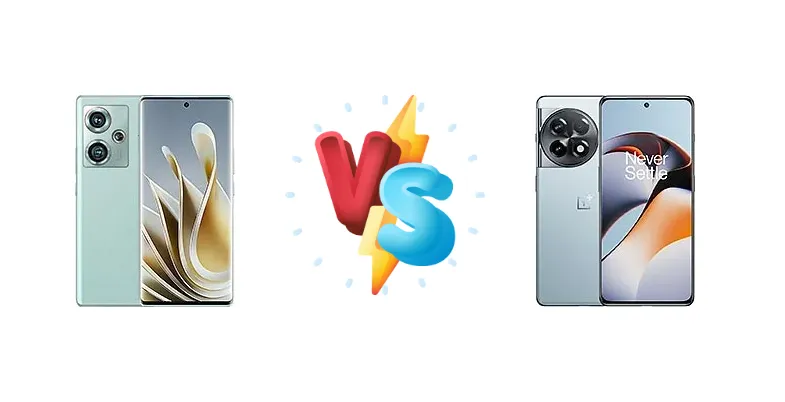
The ZTE nubia Z50 and OnePlus 11R represent compelling options in a crowded smartphone market. The nubia Z50 arrives with the latest Snapdragon 8 Gen 2, while the OnePlus 11R leverages the still-potent Snapdragon 8+ Gen 1. This comparison dissects the key differences, focusing on performance, charging, and overall value to determine which device best suits your needs.
🏆 Quick Verdict
For users prioritizing raw processing power and future-proofing, the ZTE nubia Z50 is the clear winner thanks to its Snapdragon 8 Gen 2. However, the OnePlus 11R delivers excellent performance at a potentially lower price point, coupled with faster 100W charging, making it a strong contender for budget-conscious gamers and power users.
| Network |
|---|
| 2G bands | GSM 850 / 900 / 1800 / 1900 | GSM 850 / 900 / 1800 / 1900 |
| 3G bands | HSDPA 850 / 900 / 1700(AWS) / 1900 / 2100 | HSDPA 850 / 900 / 1700(AWS) / 2100 |
| 4G bands | LTE | 1, 3, 4, 5, 8, 28, 34, 38, 39, 40, 41 |
| 5G bands | SA/NSA | 1, 3, 5, 8, 28, 40, 41, 77, 78 SA/NSA |
| Speed | HSPA, LTE, 5G | HSPA, LTE (3CA), 5G |
| Technology | GSM / CDMA / HSPA / LTE / 5G | GSM / CDMA / HSPA / LTE / 5G |
| | CDMA 800 | CDMA 800 |
| Launch |
|---|
| Announced | 2022, December 19 | 2023, February 07 |
| Status | Available. Released 2022, December 26 | Available. Released 2023, February 21 |
| Body |
|---|
| Build | Glass front, aluminum frame, glass back or eco leather back | Glass front, glass back (Gorilla Glass 5), plastic frame |
| Dimensions | 162.9 x 72.9 x 8.5 mm or 8.7 mm | 163.4 x 74.3 x 8.7 mm (6.43 x 2.93 x 0.34 in) |
| SIM | Nano-SIM + Nano-SIM | Nano-SIM + Nano-SIM |
| Weight | 197 g or 199 g (6.95 oz) | 204 g (7.20 oz) |
| Display |
|---|
| Resolution | 1080 x 2400 pixels, 20:9 ratio (~395 ppi density) | 1240 x 2772 pixels, 20:9 ratio (~451 ppi density) |
| Size | 6.67 inches, 107.4 cm2 (~90.4% screen-to-body ratio) | 6.74 inches, 109.2 cm2 (~90.0% screen-to-body ratio) |
| Type | AMOLED, 1B colors, 144Hz, HDR10+, 1000 nits | Fluid AMOLED, 1B colors, 120Hz, HDR10+, 1450 nits (peak) |
| Platform |
|---|
| CPU | Octa-core (1x3.2 GHz Cortex-X3 & 2x2.8 GHz Cortex-A715 & 2x2.8 GHz Cortex-A710 & 3x2.0 GHz Cortex-A510) | Octa-core (1x3.0 GHz Cortex-X2 & 3x2.5 GHz Cortex-A710 & 4x1.80 GHz Cortex-A510) |
| Chipset | Qualcomm SM8550-AB Snapdragon 8 Gen 2 (4 nm) | Qualcomm SM8475 Snapdragon 8+ Gen 1 (4 nm) |
| GPU | Adreno 740 | Adreno 730 |
| OS | Android 13, MyOS 13 | Android 13, upgradable to Android 15, OxygenOS 15 |
| Memory |
|---|
| Card slot | No | No |
| Internal | 128GB 8GB RAM, 256GB 8GB RAM, 256GB 12GB RAM, 512GB 12GB RAM, 1TB 16GB RAM | 128GB 8GB RAM, 256GB 16GB RAM, 512GB 18GB RAM |
| | UFS 4.0
UFS 3.1 (128GB only) | UFS 3.1 |
| Main Camera |
|---|
| Dual | 64 MP, f/1.6, 35mm (standard), 1/1.7", PDAF, OIS
50 MP, f/2.2, 14mm, 116˚ (ultrawide), AF | - |
| Features | Ring-LED flash (4 LEDs), panorama, HDR | Color spectrum sensor, LED flash, HDR, panorama |
| Single | 16 MP, (wide) | 16 MP, f/2.4, 24mm (wide), 1/3.09", 1.0µm |
| Triple | - | 50 MP, f/1.8, 24mm (wide), 1/1.56", 1.0µm, multi-directional PDAF, OIS
8 MP, f/2.2, 120˚ (ultrawide), 1/4.0", 1.12µm
2 MP (macro) |
| Video | 8K, 4K | 4K@30/60fps, 1080p@30/60/240fps, gyro-EIS |
| Selfie camera |
|---|
| Features | HDR | HDR |
| Single | 16 MP, (wide) | 16 MP, f/2.4, 24mm (wide), 1/3.09", 1.0µm |
| Video | 1080p@30fps | 1080p@30fps |
| Sound |
|---|
| 3.5mm jack | No | No |
| 35mm jack | No | No |
| Loudspeaker | Yes, with stereo speakers | Yes, with stereo speakers |
| | 24-bit/192kHz audio | 24-bit/192kHz audio |
| Comms |
|---|
| Bluetooth | 5.3, A2DP, LE | 5.3, A2DP, LE, aptX HD |
| Infrared port | - | Yes |
| NFC | Yes | Yes |
| Positioning | GPS (L1+L5), GLONASS, BDS, GALILEO, QZSS | GPS (L1+L5), GLONASS (G1), BDS (B1I+B1c+B2a), GALILEO (E1+E5a), QZSS (L1+L5) |
| Radio | No | No |
| USB | USB Type-C 3.1, OTG | USB Type-C 2.0 |
| WLAN | Wi-Fi 802.11 a/b/g/n/ac/6e, dual-band, Wi-Fi Direct | Wi-Fi 802.11 a/b/g/n/ac/6, dual-band |
| Features |
|---|
| Sensors | Fingerprint (under display, optical), accelerometer, gyro, proximity, compass | Fingerprint (under display, optical), accelerometer, gyro, proximity, compass |
| Battery |
|---|
| Charging | 80W wired | 100W wired |
| Type | Li-Po 5000 mAh | Li-Po 5000 mAh |
| Misc |
|---|
| Colors | Black, Silver, Mint, Rabit red | Galactic Silver, Sonic Black, Solar Red |
| Models | NX711J | CPH2487 |
| Price | About 400 EUR | About 600 EUR |
| SAR | - | 1.16 W/kg (head) 0.61 W/kg (body) |
ZTE nubia Z50
- Latest Snapdragon 8 Gen 2 chipset for top-tier performance
- More efficient architecture for better battery life under load
- Likely superior camera system with advanced features
- Slower 80W charging compared to the OnePlus 11R
- Potentially higher price point
OnePlus 11R
- Faster 100W wired charging for quick top-ups
- Excellent performance with the Snapdragon 8+ Gen 1
- Potentially more affordable price
- Older Snapdragon 8+ Gen 1 chipset
- May exhibit more thermal throttling under sustained load
Display Comparison
While display specs aren't provided, both phones likely feature high refresh rate AMOLED panels. The nubia Z50, positioned as a more premium device, may benefit from a slightly higher peak brightness and potentially LTPO technology for adaptive refresh rates, improving power efficiency. The OnePlus 11R, historically, has offered excellent color accuracy, and we'd expect similar performance here. Bezels are likely comparable, with both aiming for an immersive viewing experience.
Camera Comparison
Without detailed camera specs, it's difficult to make a definitive judgment. However, the nubia Z50, being the higher-tier device, likely features a more advanced camera system, potentially with a larger main sensor and improved image processing algorithms. The OnePlus 11R typically delivers solid camera performance for its price, but the nubia Z50 is expected to excel in low-light conditions and offer greater detail in photos. We can assume both will offer capable daylight performance, but the nubia Z50 should have a wider dynamic range.
Performance
The core difference lies in the chipsets. The ZTE nubia Z50’s Snapdragon 8 Gen 2 (4nm) boasts a Cortex-X3 prime core clocked at 3.2 GHz, offering a significant architectural advantage over the OnePlus 11R’s Snapdragon 8+ Gen 1 (4nm) with its Cortex-X2 prime core at 3.0 GHz. The Gen 2 also features updated Cortex-A715 and A510 cores, improving both sustained performance and efficiency. While the 8+ Gen 1 remains powerful, the Gen 2’s superior architecture translates to faster app loading, smoother multitasking, and better gaming performance, especially in demanding titles. The nubia Z50 will likely exhibit less thermal throttling under sustained load. The OnePlus 11R's CPU configuration (1x3.0 GHz Cortex-X2 & 3x2.5 GHz Cortex-A710 & 4x1.80 GHz Cortex-A510) is still very capable, but the nubia Z50 has the edge.
Battery Life
The OnePlus 11R’s 100W wired charging is a significant advantage, allowing for a full charge in a considerably shorter time than the nubia Z50’s 80W charging. While battery capacity isn't specified, the faster charging speed of the 11R mitigates any potential disadvantage from a slightly smaller battery. The Snapdragon 8 Gen 2 in the nubia Z50 is more power-efficient, potentially offsetting the charging speed difference in real-world usage, but the 11R’s convenience is undeniable.
Buying Guide
Buy the ZTE nubia Z50 if you demand the absolute best performance available in this price bracket, need a phone that will remain snappy for years to come, and value the latest chipset technology. Buy the OnePlus 11R if you prioritize fast charging, a balanced feature set, and are looking for a high-performing phone without necessarily needing the bleeding edge of processor technology. It's the smart choice for gamers who value quick top-ups between matches.
Frequently Asked Questions
❓ Will the Snapdragon 8+ Gen 1 in the OnePlus 11R struggle with demanding games like Genshin Impact?
The Snapdragon 8+ Gen 1 is still a very capable chipset and can handle Genshin Impact, but you may need to lower graphics settings for consistently smooth frame rates. The nubia Z50’s Snapdragon 8 Gen 2 will provide a more consistently smooth experience at higher settings.
❓ How much faster is the 100W charging on the OnePlus 11R compared to the 80W charging on the nubia Z50?
While exact times depend on battery capacity, the 100W charging on the OnePlus 11R will likely charge from 0-100% in around 25-30 minutes, while the nubia Z50’s 80W charging will take closer to 35-40 minutes. This difference is most noticeable in the initial stages of charging.
❓ Is the difference in CPU performance between the Snapdragon 8 Gen 2 and 8+ Gen 1 noticeable in everyday tasks?
For basic tasks like browsing, social media, and messaging, the difference will be minimal. However, when multitasking, editing videos, or running demanding applications, the Snapdragon 8 Gen 2 in the nubia Z50 will provide a noticeably smoother and more responsive experience.