
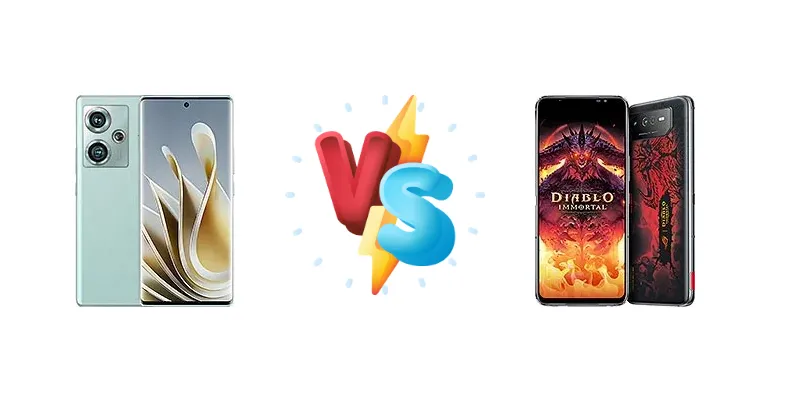
ZTE nubia Z50 vs Asus ROG Phone 6 Diablo Immortal Edition: A Deep Dive Comparison
| Phones Images | |||||
|---|---|---|---|---|---|
|
🏆 Quick Verdict
For the average user prioritizing all-around performance and future-proofing, the ZTE nubia Z50 emerges as the winner. Its Snapdragon 8 Gen 2 offers a performance edge and superior efficiency. However, gamers heavily invested in the ROG ecosystem and demanding gaming-specific features will find the ROG Phone 6 Diablo Immortal Edition more appealing.
| PHONES | ||
|---|---|---|
| Phone Names | ZTE nubia Z50 | Asus ROG Phone 6 Diablo Immortal Edition |
| Network | ||
|---|---|---|
| 2G bands | GSM 850 / 900 / 1800 / 1900 | GSM 850 / 900 / 1800 / 1900 |
| 3G bands | HSDPA 850 / 900 / 1700(AWS) / 1900 / 2100 | HSDPA 800 / 850 / 900 / 1700(AWS) / 1900 / 2100 - A version, C version |
| 4G bands | LTE | 1, 2, 3, 4, 5, 7, 8, 12, 13, 17, 18, 19, 20, 25, 26, 28, 29, 30, 32, 34, 38, 39, 40, 41, 42, 43, 48, 66, 71 - A version |
| 5G bands | SA/NSA | 1, 2, 3, 5, 7, 8, 12, 13, 18, 20, 25, 26, 28, 38, 40, 41, 48, 66, 71, 77, 78, 79 SA/NSA - A version |
| Speed | HSPA, LTE, 5G | HSPA, LTE, 5G |
| Technology | GSM / CDMA / HSPA / LTE / 5G | GSM / CDMA / HSPA / LTE / 5G |
| CDMA 800 | 1, 3, 5, 8, 28, 41, 77, 78, 79 SA/NSA - C version | |
| Launch | ||
|---|---|---|
| Announced | 2022, December 19 | 2022, November 17 |
| Status | Available. Released 2022, December 26 | Available. Released 2022, November 18 |
| Body | ||
|---|---|---|
| Build | Glass front, aluminum frame, glass back or eco leather back | Glass front (Gorilla Glass Victus), glass back (Gorilla Glass 3), aluminum frame |
| Dimensions | 162.9 x 72.9 x 8.5 mm or 8.7 mm | 173 x 77 x 10.4 mm (6.81 x 3.03 x 0.41 in) |
| SIM | Nano-SIM + Nano-SIM | Nano-SIM + Nano-SIM |
| Weight | 197 g or 199 g (6.95 oz) | 239 g (8.43 oz) |
| - | IPX4 water resistant Illuminated RGB logo (on the back) Pressure sensitive zones (Gaming triggers) | |
| Display | ||
|---|---|---|
| Protection | - | Corning Gorilla Glass Victus |
| Resolution | 1080 x 2400 pixels, 20:9 ratio (~395 ppi density) | 1080 x 2448 pixels (~395 ppi density) |
| Size | 6.67 inches, 107.4 cm2 (~90.4% screen-to-body ratio) | 6.78 inches, 109.5 cm2 (~82.2% screen-to-body ratio) |
| Type | AMOLED, 1B colors, 144Hz, HDR10+, 1000 nits | AMOLED, 1B colors, 165Hz, HDR10+, 800 nits (typ), 1200 nits (peak) |
| Platform | ||
|---|---|---|
| CPU | Octa-core (1x3.2 GHz Cortex-X3 & 2x2.8 GHz Cortex-A715 & 2x2.8 GHz Cortex-A710 & 3x2.0 GHz Cortex-A510) | Octa-core (1x3.19 GHz Cortex-X2 & 3x2.75 GHz Cortex-A710 & 4x1.80 GHz Cortex-A510) |
| Chipset | Qualcomm SM8550-AB Snapdragon 8 Gen 2 (4 nm) | Qualcomm SM8475 Snapdragon 8+ Gen 1 (4 nm) |
| GPU | Adreno 740 | Adreno 730 |
| OS | Android 13, MyOS 13 | Android 12 |
| Memory | ||
|---|---|---|
| Card slot | No | No |
| Internal | 128GB 8GB RAM, 256GB 8GB RAM, 256GB 12GB RAM, 512GB 12GB RAM, 1TB 16GB RAM | 512GB 16GB RAM |
| UFS 4.0 UFS 3.1 (128GB only) | UFS 3.1 NTFS support for external storage | |
| Main Camera | ||
|---|---|---|
| Dual | 64 MP, f/1.6, 35mm (standard), 1/1.7", PDAF, OIS 50 MP, f/2.2, 14mm, 116˚ (ultrawide), AF | - |
| Features | Ring-LED flash (4 LEDs), panorama, HDR | LED flash, HDR, panorama |
| Single | 16 MP, (wide) | - |
| Triple | - | 50 MP, f/1.9, 24mm (wide), 1/1.56", 1.0µm, PDAF 13 MP, f/2.2, 13mm (ultrawide) 5 MP (macro) |
| Video | 8K, 4K | 8K@24fps, 4K@30/60fps, 4K@120fps, 1080p@30/60/120/240fps, 720p@480fps; gyro-EIS, HDR10+ |
| Selfie camera | ||
|---|---|---|
| Features | HDR | Panorama, HDR |
| Single | 16 MP, (wide) | 12 MP, 28mm (wide) |
| Video | 1080p@30fps | 1080p@30fps |
| Sound | ||
|---|---|---|
| 3.5mm jack | No | Yes |
| 35mm jack | No | Yes |
| Loudspeaker | Yes, with stereo speakers | Yes, with stereo speakers (2 amplifiers) |
| 24-bit/192kHz audio | 32-bit/384kHz audio | |
| Comms | ||
|---|---|---|
| Bluetooth | 5.3, A2DP, LE | 5.2, A2DP, LE, aptX HD, aptX Adaptive |
| NFC | Yes | Yes |
| Positioning | GPS (L1+L5), GLONASS, BDS, GALILEO, QZSS | GPS (L1+L5), GLONASS (L1), BDS (B1I+B1c+B2a), GALILEO (E1+E5a), QZSS (L1+L5), NavIC (L5) |
| Radio | No | No |
| USB | USB Type-C 3.1, OTG | USB Type-C 3.1 (side), USB Type-C 2.0 (bottom), OTG, accessory connector |
| WLAN | Wi-Fi 802.11 a/b/g/n/ac/6e, dual-band, Wi-Fi Direct | Wi-Fi 802.11 a/b/g/n/ac/6e, tri-band, Wi-Fi Direct |
| Features | ||
|---|---|---|
| Sensors | Fingerprint (under display, optical), accelerometer, gyro, proximity, compass | Fingerprint (under display, optical), accelerometer, gyro, proximity, compass |
| Battery | ||
|---|---|---|
| Charging | 80W wired | 65W wired, PD3.0, QC5 10W reverse wired |
| Type | Li-Po 5000 mAh | Li-Po 6000 mAh |
| Misc | ||
|---|---|---|
| Colors | Black, Silver, Mint, Rabit red | Hellfire Red |
| Models | NX711J | - |
| Price | About 400 EUR | About 860 EUR |
ZTE nubia Z50
- Latest Snapdragon 8 Gen 2 chipset for superior performance
- Faster 80W wired charging
- Potentially more advanced camera system (based on brand history)
- Display specifications unknown, potentially lacking gaming-specific features
- Battery capacity unknown
Asus ROG Phone 6 Diablo Immortal Edition
- Dedicated gaming features like AirTriggers and a high refresh rate display
- Robust cooling system for sustained performance
- 65W charging with PD3.0 and QC5 compatibility
- Older Snapdragon 8+ Gen 1 chipset
- Camera system not a primary strength
Display Comparison
While both devices feature 4nm chipsets, display details are missing. Assuming the ROG Phone 6 maintains its 6.78-inch 165Hz AMOLED panel, it offers a significant advantage for gaming due to its higher refresh rate. The nubia Z50 likely features a high-quality AMOLED panel, but without specific details on refresh rate and peak brightness, it's difficult to directly compare. The ROG Phone 6's gaming-focused display is likely tuned for lower persistence and faster response times, crucial for competitive gaming.
Camera Comparison
Camera specifications are absent for the nubia Z50, but nubia historically focuses on camera technology. The ROG Phone 6’s camera system is adequate but not a primary selling point. Without knowing the nubia Z50’s sensor size and features, it’s difficult to make a direct comparison. However, given nubia’s track record, it’s reasonable to expect a more sophisticated camera system with larger sensors and improved image processing capabilities. The ROG Phone 6’s camera is geared towards casual photography, while the nubia Z50 may cater to more demanding users.
Performance
The ZTE nubia Z50’s Snapdragon 8 Gen 2 (4nm) represents a generational leap over the Asus ROG Phone 6’s Snapdragon 8+ Gen 1 (4nm). The Gen 2 utilizes a new CPU architecture – Cortex-X3 vs Cortex-X2 – offering a performance increase of approximately 10-15% in CPU-bound tasks. The ROG Phone 6’s 3x Cortex-A710 cores are clocked slightly higher than the nubia Z50’s 2x A715 and 2x A710, but the architectural improvements in the Gen 2 outweigh this clock speed difference. The nubia Z50 also benefits from faster LPDDR5x RAM, further enhancing multitasking and application loading speeds. Thermal management will be key; the ROG Phone 6’s advanced cooling system is designed to sustain peak performance for longer gaming sessions, potentially mitigating the Gen 2’s raw power advantage in prolonged use.
Battery Life
The Asus ROG Phone 6 boasts 65W wired charging with support for PD3.0 and QC5, alongside 10W reverse wired charging. The ZTE nubia Z50 steps up the charging speed to 80W. While the ROG Phone 6’s charging standards offer broader compatibility, the nubia Z50’s higher wattage translates to faster 0-100% charge times. Battery capacity is unknown for the nubia Z50, but the ROG Phone 6’s 5000mAh battery provides all-day usage for most users. The Snapdragon 8 Gen 2’s improved efficiency in the nubia Z50 could offset a potentially smaller battery capacity, resulting in comparable real-world battery life.
Buying Guide
Buy the ZTE nubia Z50 if you need a powerful, versatile flagship with cutting-edge processing capabilities for demanding tasks beyond gaming, such as video editing or heavy multitasking. Buy the Asus ROG Phone 6 Diablo Immortal Edition if you prioritize a dedicated gaming experience with features like AirTriggers, a high refresh rate display optimized for gaming, and a robust cooling system, even if it means sacrificing some raw processing power.