
ZTE nubia Z50 Ultra vs OnePlus 11R: A Detailed Performance and Value Showdown
| Phones Images | |||||
|---|---|---|---|---|---|
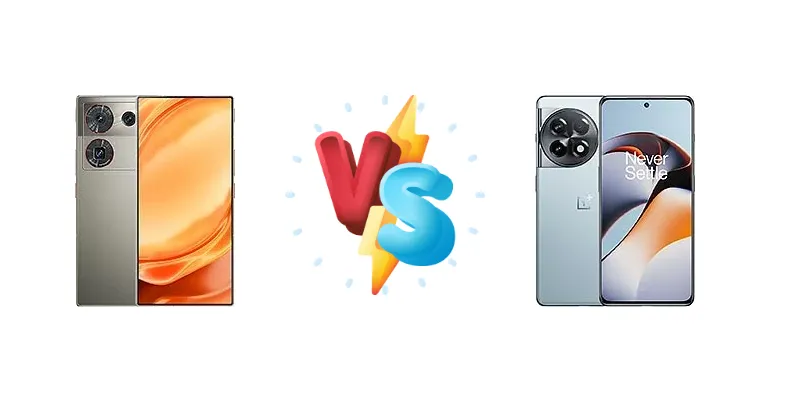
|
🏆 Quick Verdict
For users prioritizing raw performance and future-proofing, the ZTE nubia Z50 Ultra is the clear winner thanks to its Snapdragon 8 Gen 2. However, the OnePlus 11R offers a fantastic balance of power and value, with its 100W charging providing a significant convenience factor, making it ideal for those seeking a high-performing phone without the top-tier price tag.
| PHONES | ||
|---|---|---|
| Phone Names | ZTE nubia Z50 Ultra | OnePlus 11R |
| Network | ||
|---|---|---|
| 2G bands | GSM 850 / 900 / 1800 / 1900 | GSM 850 / 900 / 1800 / 1900 |
| 3G bands | HSDPA 850 / 900 / 1700(AWS) / 1900 / 2100 | HSDPA 850 / 900 / 1700(AWS) / 2100 |
| 4G bands | LTE | 1, 3, 4, 5, 8, 28, 34, 38, 39, 40, 41 |
| 5G bands | SA/NSA | 1, 3, 5, 8, 28, 40, 41, 77, 78 SA/NSA |
| Speed | HSPA, LTE, 5G | HSPA, LTE (3CA), 5G |
| Technology | GSM / CDMA / HSPA / CDMA2000 / LTE / 5G | GSM / CDMA / HSPA / LTE / 5G |
| CDMA2000 1x | CDMA 800 | |
| Launch | ||
|---|---|---|
| Announced | 2023, March 07 | 2023, February 07 |
| Status | Available. Released 2023, March 14 | Available. Released 2023, February 21 |
| Body | ||
|---|---|---|
| Build | - | Glass front, glass back (Gorilla Glass 5), plastic frame |
| Dimensions | 163.9 x 76.3 x 8.3 mm (6.45 x 3.00 x 0.33 in) | 163.4 x 74.3 x 8.7 mm (6.43 x 2.93 x 0.34 in) |
| SIM | Nano-SIM + Nano-SIM | Nano-SIM + Nano-SIM |
| Weight | 228 g (8.04 oz) | 204 g (7.20 oz) |
| Display | ||
|---|---|---|
| Resolution | 1116 x 2480 pixels, 20:9 ratio (~400 ppi density) | 1240 x 2772 pixels, 20:9 ratio (~451 ppi density) |
| Size | 6.8 inches, 111.6 cm2 (~89.3% screen-to-body ratio) | 6.74 inches, 109.2 cm2 (~90.0% screen-to-body ratio) |
| Type | AMOLED, 1B colors, 120Hz, HDR10+, 1500 nits (peak) | Fluid AMOLED, 1B colors, 120Hz, HDR10+, 1450 nits (peak) |
| Platform | ||
|---|---|---|
| CPU | Octa-core (1x3.2 GHz Cortex-X3 & 2x2.8 GHz Cortex-A715 & 2x2.8 GHz Cortex-A710 & 3x2.0 GHz Cortex-A510) | Octa-core (1x3.0 GHz Cortex-X2 & 3x2.5 GHz Cortex-A710 & 4x1.80 GHz Cortex-A510) |
| Chipset | Qualcomm SM8550-AB Snapdragon 8 Gen 2 (4 nm) | Qualcomm SM8475 Snapdragon 8+ Gen 1 (4 nm) |
| GPU | Adreno 740 | Adreno 730 |
| OS | Android 13, MyOS 13 | Android 13, upgradable to Android 15, OxygenOS 15 |
| Memory | ||
|---|---|---|
| Card slot | No | No |
| Internal | 256GB 8GB RAM, 256GB 12GB RAM, 512GB 12GB RAM, 1TB 16GB RAM | 128GB 8GB RAM, 256GB 16GB RAM, 512GB 18GB RAM |
| UFS 4.0 | UFS 3.1 | |
| Main Camera | ||
|---|---|---|
| Features | Laser AF, Ring-LED, dual-tone flash, panorama, HDR | Color spectrum sensor, LED flash, HDR, panorama |
| Single | 16 MP, f/2.0, 26mm (wide), 1/2.8", 1.22µm, under display | 16 MP, f/2.4, 24mm (wide), 1/3.09", 1.0µm |
| Triple | 64 MP, f/1.6, 35mm (standard), 1/1.73", 0.8µm, PDAF, OIS 64 MP, f/3.3, 85mm (periscope telephoto), 1/2.0", PDAF, OIS, 3.3x optical zoom (vs. 26mm cam) 50 MP, f/2.X, 14mm, 116˚ (ultrawide), PDAF | 50 MP, f/1.8, 24mm (wide), 1/1.56", 1.0µm, multi-directional PDAF, OIS 8 MP, f/2.2, 120˚ (ultrawide), 1/4.0", 1.12µm 2 MP (macro) |
| Video | 8K@30fps, 4K@30/60/120fps, 1080p@30/60fps, gyro-EIS, HDR10, 10‑bit video | 4K@30/60fps, 1080p@30/60/240fps, gyro-EIS |
| Selfie camera | ||
|---|---|---|
| Features | HDR | HDR |
| Single | 16 MP, f/2.0, 26mm (wide), 1/2.8", 1.22µm, under display | 16 MP, f/2.4, 24mm (wide), 1/3.09", 1.0µm |
| Video | 1080p@30fps | 1080p@30fps |
| Sound | ||
|---|---|---|
| 3.5mm jack | No | No |
| 35mm jack | No | No |
| Loudspeaker | Yes, with stereo speakers | Yes, with stereo speakers |
| 24-bit/192kHz audio | 24-bit/192kHz audio | |
| Comms | ||
|---|---|---|
| Bluetooth | 5.3, A2DP, LE Audio, aptX HD, aptX Adaptive, aptX Lossless | 5.3, A2DP, LE, aptX HD |
| Infrared port | Yes | Yes |
| NFC | Yes | Yes |
| Positioning | GPS (L1+L5), GLONASS (L1+L2+L5), GALILEO, BDS | GPS (L1+L5), GLONASS (G1), BDS (B1I+B1c+B2a), GALILEO (E1+E5a), QZSS (L1+L5) |
| Radio | No | No |
| USB | USB Type-C 3.1, OTG | USB Type-C 2.0 |
| WLAN | Wi-Fi 802.11 a/b/g/n/ac/6e, dual-band, Wi-Fi Direct | Wi-Fi 802.11 a/b/g/n/ac/6, dual-band |
| Features | ||
|---|---|---|
| Sensors | Fingerprint (under display, optical), accelerometer, gyro, proximity, compass | Fingerprint (under display, optical), accelerometer, gyro, proximity, compass |
| Battery | ||
|---|---|---|
| Charging | 80W wired, PD3.0, QC4 | 100W wired |
| Type | Li-Po 5000 mAh | Li-Po 5000 mAh |
| Misc | ||
|---|---|---|
| Colors | Black, Silver, Starry Sky | Galactic Silver, Sonic Black, Solar Red |
| Models | NX712J | CPH2487 |
| Price | About 540 EUR | About 600 EUR |
| SAR | - | 1.16 W/kg (head) 0.61 W/kg (body) |
ZTE nubia Z50 Ultra
- Superior performance with Snapdragon 8 Gen 2
- Potentially better camera system due to 'Ultra' branding
- Improved thermal efficiency for sustained performance
- Slower charging speed (80W vs 100W)
- Likely higher price point
OnePlus 11R
- Faster 100W wired charging
- Excellent value for money
- Still a very powerful Snapdragon 8+ Gen 1 processor
- Less powerful processor compared to Snapdragon 8 Gen 2
- Potentially less advanced camera system
Display Comparison
While specific display specs aren't provided, both phones likely feature high refresh rate AMOLED panels. The nubia Z50 Ultra, positioned as an 'Ultra' device, likely boasts a higher peak brightness and potentially a more sophisticated LTPO implementation for variable refresh rates, leading to improved power efficiency. The OnePlus 11R, while excellent, may prioritize cost savings in this area. Bezels are expected to be minimal on both, but the nubia's flagship status suggests a slight edge in screen-to-body ratio.
Camera Comparison
Without detailed camera specs, it's difficult to make definitive claims. However, the 'Ultra' branding of the nubia Z50 suggests a more sophisticated camera system. We can infer a larger main sensor and potentially more advanced image processing algorithms. The OnePlus 11R will likely offer a very good camera experience, but may lean towards a more balanced approach rather than pushing the boundaries of mobile photography. The absence of details on OIS and lens apertures makes a precise comparison impossible, but the nubia is expected to have an advantage in low-light performance and dynamic range.
Performance
The core difference lies in the chipsets. The ZTE nubia Z50 Ultra’s Snapdragon 8 Gen 2 (4nm) utilizes a more advanced architecture – Cortex-X3 prime core at 3.2GHz – compared to the OnePlus 11R’s Snapdragon 8+ Gen 1 (4nm) with its Cortex-X2 prime core at 3.0GHz. This translates to a noticeable performance uplift in CPU-intensive tasks and sustained GPU performance on the nubia. The 8 Gen 2’s improved efficiency also means less thermal throttling during extended gaming sessions. While the 11R’s 8+ Gen 1 is still incredibly capable, the 8 Gen 2 represents a generational leap. Both likely utilize LPDDR5x RAM, but the nubia may benefit from faster speeds due to chipset support.
Battery Life
The OnePlus 11R’s 100W wired charging is a significant advantage, allowing for a full charge in a considerably shorter time than the nubia Z50 Ultra’s 80W charging. While the nubia may have a larger battery capacity (unspecified), the 11R’s faster charging mitigates any potential disadvantage. The Snapdragon 8 Gen 2’s improved efficiency in the nubia Z50 Ultra will contribute to better battery life during typical usage, but the 11R’s rapid charging offers a compelling trade-off for users who prioritize convenience.
Buying Guide
Buy the ZTE nubia Z50 Ultra if you demand the absolute best performance for demanding tasks like gaming and video editing, and appreciate the benefits of the latest chipset technology. Buy the OnePlus 11R if you prioritize fast charging, a smooth user experience, and excellent value for money, and are comfortable with a slightly older, but still very capable, processor.