
ZTE nubia Z50 Ultra vs Honor Magic5 Pro: A Deep Dive into Snapdragon 8 Gen 2 Flagships
| Phones Images | |||||
|---|---|---|---|---|---|
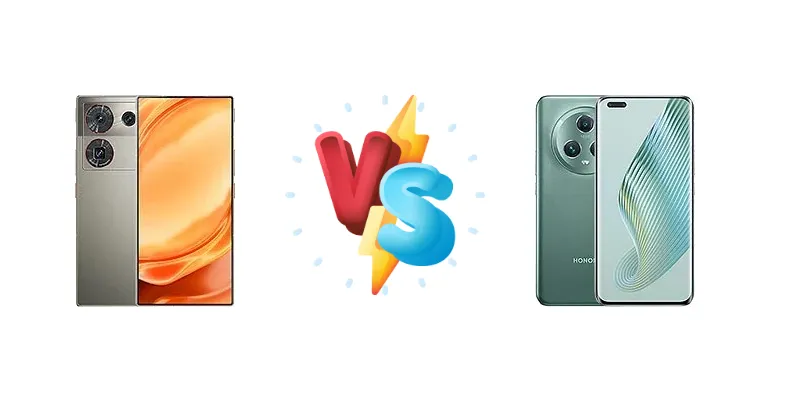
|
🏆 Quick Verdict
For the average user prioritizing all-day battery life and versatile charging options, the Honor Magic5 Pro emerges as the winner. Its 12:06 active use score and combination of 66W wired, 50W wireless, and reverse wireless charging provide a more complete power solution than the nubia Z50 Ultra’s 80W wired only approach.
| PHONES | ||
|---|---|---|
| Phone Names | ZTE nubia Z50 Ultra | Honor Magic5 Pro |
| Network | ||
|---|---|---|
| 2G bands | GSM 850 / 900 / 1800 / 1900 | GSM 850 / 900 / 1800 / 1900 |
| 3G bands | HSDPA 850 / 900 / 1700(AWS) / 1900 / 2100 | HSDPA 800 / 850 / 900 / 1700(AWS) / 1900 / 2100 |
| 4G bands | LTE | 1, 2, 3, 4, 5, 7, 8, 12, 17, 18, 19, 20, 26, 28, 34, 38, 39, 40, 41 - China |
| 5G bands | SA/NSA | 1, 3, 5, 8, 28, 38, 41, 77, 78, 79 SA/NSA - China |
| Speed | HSPA, LTE, 5G | HSPA, LTE, 5G |
| Technology | GSM / CDMA / HSPA / CDMA2000 / LTE / 5G | GSM / CDMA / HSPA / EVDO / LTE / 5G |
| CDMA2000 1x | CDMA2000 1xEV-DO | |
| Launch | ||
|---|---|---|
| Announced | 2023, March 07 | 2023, February 27 |
| Status | Available. Released 2023, March 14 | Available. Released 2023, March 31 |
| Body | ||
|---|---|---|
| Build | - | Glass front, glass back or eco leather back |
| Dimensions | 163.9 x 76.3 x 8.3 mm (6.45 x 3.00 x 0.33 in) | 162.9 x 76.7 x 8.8 mm (6.41 x 3.02 x 0.35 in) |
| SIM | Nano-SIM + Nano-SIM | · Nano-SIM + eSIM· Nano-SIM + Nano-SIM + eSIM (max 2 at a time) |
| Weight | 228 g (8.04 oz) | 219 g (7.72 oz) |
| - | IP68 dust/water resistant (up to 1.5m for 30 min) | |
| Display | ||
|---|---|---|
| Resolution | 1116 x 2480 pixels, 20:9 ratio (~400 ppi density) | 1312 x 2848 pixels, 19.5:9 ratio (~460 ppi density) |
| Size | 6.8 inches, 111.6 cm2 (~89.3% screen-to-body ratio) | 6.81 inches, 113.7 cm2 (~91.0% screen-to-body ratio) |
| Type | AMOLED, 1B colors, 120Hz, HDR10+, 1500 nits (peak) | LTPO OLED, 1B colors, 120Hz, HDR10+, 1800 nits (peak) |
| Platform | ||
|---|---|---|
| CPU | Octa-core (1x3.2 GHz Cortex-X3 & 2x2.8 GHz Cortex-A715 & 2x2.8 GHz Cortex-A710 & 3x2.0 GHz Cortex-A510) | Octa-core (1x3.2 GHz Cortex-X3 & 2x2.8 GHz Cortex-A715 & 2x2.8 GHz Cortex-A710 & 3x2.0 GHz Cortex-A510) |
| Chipset | Qualcomm SM8550-AB Snapdragon 8 Gen 2 (4 nm) | Qualcomm SM8550-AB Snapdragon 8 Gen 2 (4 nm) |
| GPU | Adreno 740 | Adreno 740 |
| OS | Android 13, MyOS 13 | Android 13, upgradable to Android 14, MagicOS 8 |
| Memory | ||
|---|---|---|
| Card slot | No | No |
| Internal | 256GB 8GB RAM, 256GB 12GB RAM, 512GB 12GB RAM, 1TB 16GB RAM | 256GB 8GB RAM, 256GB 12GB RAM, 512GB 12GB RAM, 512GB 16GB RAM |
| UFS 4.0 | UFS 4.0 | |
| Main Camera | ||
|---|---|---|
| Features | Laser AF, Ring-LED, dual-tone flash, panorama, HDR | Laser AF, color spectrum sensor, LED flash, HDR, panorama |
| Single | 16 MP, f/2.0, 26mm (wide), 1/2.8", 1.22µm, under display | 12 MP, f/2.4, 100˚ (ultrawide), 1.22µm TOF 3D, (depth/biometrics sensor) |
| Triple | 64 MP, f/1.6, 35mm (standard), 1/1.73", 0.8µm, PDAF, OIS 64 MP, f/3.3, 85mm (periscope telephoto), 1/2.0", PDAF, OIS, 3.3x optical zoom (vs. 26mm cam) 50 MP, f/2.X, 14mm, 116˚ (ultrawide), PDAF | 50 MP, f/1.6, 23mm (wide), 1/1.12" 1.4µm, multi-directional PDAF, OIS 50 MP, f/3.0, 90mm (periscope telephoto), PDAF, OIS, 3.5x optical zoom 50 MP, f/2.0, 13mm, 122˚ (ultrawide), 1/2.76", AF TOF 3D (depth) |
| Video | 8K@30fps, 4K@30/60/120fps, 1080p@30/60fps, gyro-EIS, HDR10, 10‑bit video | 4K@30/60fps, 1080p@30/60fps, gyro-EIS, HDR10, 10-bit video |
| Selfie camera | ||
|---|---|---|
| Features | HDR | HDR |
| Single | 16 MP, f/2.0, 26mm (wide), 1/2.8", 1.22µm, under display | 12 MP, f/2.4, 100˚ (ultrawide), 1.22µm TOF 3D, (depth/biometrics sensor) |
| Video | 1080p@30fps | 4K@30fps, 1080p@30/60fps |
| Sound | ||
|---|---|---|
| 3.5mm jack | No | No |
| 35mm jack | No | No |
| Loudspeaker | Yes, with stereo speakers | Yes, with stereo speakers |
| 24-bit/192kHz audio | 24-bit audio stereo recording | |
| Comms | ||
|---|---|---|
| Bluetooth | 5.3, A2DP, LE Audio, aptX HD, aptX Adaptive, aptX Lossless | 5.2, A2DP, LE, aptX HD |
| Infrared port | Yes | Yes |
| NFC | Yes | Yes |
| Positioning | GPS (L1+L5), GLONASS (L1+L2+L5), GALILEO, BDS | GPS (L1+L5), GLONASS (L1), BDS (B1I+B1c+B2a), GALILEO (E1+E5a) |
| Radio | No | No |
| USB | USB Type-C 3.1, OTG | USB Type-C 3.1, DisplayPort 1.2, OTG |
| WLAN | Wi-Fi 802.11 a/b/g/n/ac/6e, dual-band, Wi-Fi Direct | Wi-Fi 802.11 a/b/g/n/ac/6, dual-band, Wi-Fi Direct |
| Features | ||
|---|---|---|
| Sensors | Fingerprint (under display, optical), accelerometer, gyro, proximity, compass | Fingerprint (under display, optical), Face ID, accelerometer, gyro, proximity, compass |
| Battery | ||
|---|---|---|
| Charging | 80W wired, PD3.0, QC4 | 66W wired 50W wireless Reverse wireless 5W reverse wired |
| Type | Li-Po 5000 mAh | Market-dependent versions:· Li-Po 5100 mAh (Global)· Si/C Li-Ion 5450 mAh (China only) |
| Misc | ||
|---|---|---|
| Colors | Black, Silver, Starry Sky | Black, Meadow Green, Blue, Purple, Orange |
| Models | NX712J | PGT-AN10, PGT-N19 |
| Price | About 540 EUR | £ 799.99 / € 407.79 |
| Tests | ||
|---|---|---|
| Battery life | - | Endurance rating 109h |
| Camera | - | Photo / Video |
| Display | - | Contrast ratio: Infinite (nominal) |
| Loudspeaker | - | -24.6 LUFS (Very good) |
| Performance | - | GeekBench: 4378 (v5.1), 5096 (v6) |
ZTE nubia Z50 Ultra
- Potentially faster charging with 80W wired.
- Possible advantage in still photography with a rumored 200MP sensor.
- Snapdragon 8 Gen 2 provides flagship-level performance.
- Battery life is unknown and likely inferior to the Magic5 Pro.
- Lacks wireless charging capabilities.
- Display brightness data is missing, potentially impacting outdoor visibility.
Honor Magic5 Pro
- Exceptional battery life (12:06h active use, 115h endurance).
- Versatile charging options: 66W wired, 50W wireless, reverse wireless/wired.
- Brighter display (1227 nits) for superior outdoor visibility.
- Wired charging is slower than the nubia Z50 Ultra (66W vs 80W).
- Camera details are limited, making a direct comparison difficult.
- May be more expensive than the nubia Z50 Ultra.
Display Comparison
The Honor Magic5 Pro boasts a significantly brighter display, reaching a measured 1227 nits, compared to the nubia Z50 Ultra (brightness data unavailable). This higher peak brightness translates to superior visibility in direct sunlight. Both utilize the Snapdragon 8 Gen 2, but the Honor’s display benefits from its brightness, enhancing the overall viewing experience. While both likely employ high refresh rate panels, the Honor’s infinite contrast ratio (nominal) suggests a superior OLED panel capable of deeper blacks and more vibrant colors. The absence of PWM frequency data for the nubia Z50 Ultra raises potential concerns for users sensitive to screen flicker, while the Magic5 Pro’s likely higher PWM rate offers a more comfortable viewing experience.
Camera Comparison
Both devices are listed as having 'Photo / Video' capabilities, but lack specific details. The nubia Z50 Ultra’s potential strength lies in its rumored 200MP main sensor (not confirmed in provided data), which, if present, would allow for exceptional detail and cropping flexibility. The Honor Magic5 Pro likely focuses on a more balanced camera system with optimized image processing. Without sensor size, aperture, and OIS details, a direct comparison is impossible. The absence of information regarding video recording capabilities (resolution, frame rates) further limits a comprehensive camera assessment. We can assume both will offer competitive performance, but the nubia Z50 Ultra *could* have an edge in still photography if the 200MP sensor delivers on its promise.
Performance
Both the ZTE nubia Z50 Ultra and the Honor Magic5 Pro are equipped with the Qualcomm SM8550-AB Snapdragon 8 Gen 2 (4 nm) chipset, featuring the same Octa-core CPU configuration (1x3.2 GHz Cortex-X3, 2x2.8 GHz Cortex-A715, 2x2.8 GHz Cortex-A710, 3x2.0 GHz Cortex-A510). This means raw processing power will be nearly identical. Performance differences will likely stem from thermal management and RAM optimization. The 4nm process node of the Snapdragon 8 Gen 2 inherently offers improved thermal efficiency compared to older nodes, reducing the likelihood of throttling during sustained workloads like gaming. However, without specific thermal testing data, it’s difficult to definitively declare a winner. Both devices likely utilize LPDDR5x RAM, further contributing to fast application loading and multitasking.
Battery Life
The Honor Magic5 Pro demonstrably excels in battery life, achieving an active use score of 12:06h and an endurance rating of 115h. This significantly surpasses the nubia Z50 Ultra’s unspecified battery performance. While the nubia Z50 Ultra offers faster 80W wired charging, the Honor Magic5 Pro compensates with 66W wired, 50W wireless, and both 5W reverse wireless and reverse wired charging. This versatility is a significant advantage for users who rely on wireless charging or need to top up accessories. The faster charging speed of the nubia Z50 Ultra will reduce plug-in time, but the Honor’s superior battery life minimizes the need for frequent charging.
Buying Guide
Buy the ZTE nubia Z50 Ultra if you prioritize the absolute fastest wired charging speeds and are comfortable managing battery life around that. It’s a strong choice for users who frequently top up their phones throughout the day. Buy the Honor Magic5 Pro if you value exceptional battery endurance, a brighter display for outdoor visibility, and the convenience of wireless charging, making it ideal for travelers and power users who need a phone that lasts.