
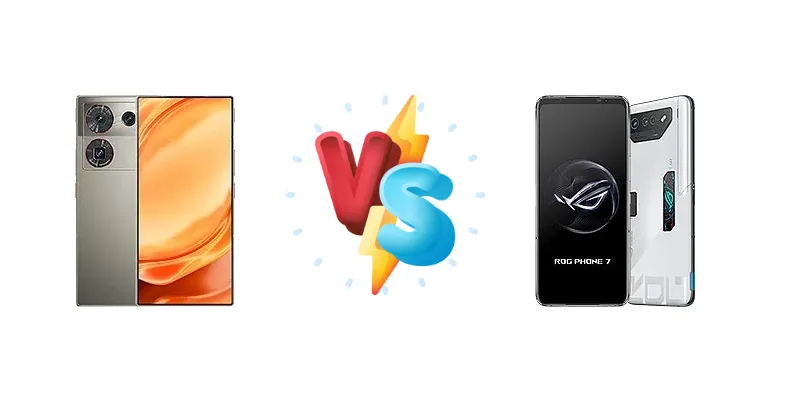
ZTE nubia Z50 Ultra vs. Asus ROG Phone 7 Ultimate: A Deep Dive Comparison
| Phones Images | |||||
|---|---|---|---|---|---|
|
🏆 Quick Verdict
For the average user seeking a powerful all-rounder with a stunning camera, the ZTE nubia Z50 Ultra emerges as the better choice. While the ROG Phone 7 Ultimate excels in gaming, its specialized features and higher price point don't justify the cost for those not heavily invested in mobile gaming.
| PHONES | ||
|---|---|---|
| Phone Names | ZTE nubia Z50 Ultra | Asus ROG Phone 7 Ultimate |
| Network | ||
|---|---|---|
| 2G bands | GSM 850 / 900 / 1800 / 1900 | GSM 850 / 900 / 1800 / 1900 |
| 3G bands | HSDPA 850 / 900 / 1700(AWS) / 1900 / 2100 | HSDPA 800 / 850 / 900 / 1700(AWS) / 1900 / 2100 |
| 4G bands | LTE | 1, 2, 3, 4, 5, 7, 8, 12, 17, 18, 19, 20, 25, 26, 28, 32, 34, 38, 39, 40, 41, 42, 43, 48, 66 - International |
| 5G bands | SA/NSA | 1, 2, 3, 5, 7, 8, 12, 18, 20, 25, 26, 28, 38, 40, 41, 48, 66, 77, 78, 79 SA/NSA/Sub6 - International |
| Speed | HSPA, LTE, 5G | HSPA, LTE (Up to 7CA), 5G |
| Technology | GSM / CDMA / HSPA / CDMA2000 / LTE / 5G | GSM / CDMA / HSPA / LTE / 5G |
| CDMA2000 1x | 1, 3, 5, 8, 28, 41, 77, 78, 79 SA/NSA/Sub6 - China | |
| Launch | ||
|---|---|---|
| Announced | 2023, March 07 | 2023, April 13 |
| Status | Available. Released 2023, March 14 | Available. Released 2023, May |
| Body | ||
|---|---|---|
| Build | - | Glass front (Gorilla Glass Victus), glass back (Gorilla Glass 3), aluminum frame |
| Dimensions | 163.9 x 76.3 x 8.3 mm (6.45 x 3.00 x 0.33 in) | 173 x 77 x 10.3 mm (6.81 x 3.03 x 0.41 in) |
| SIM | Nano-SIM + Nano-SIM | Nano-SIM + Nano-SIM |
| Weight | 228 g (8.04 oz) | 239 g (8.43 oz) |
| - | Built-in motorized cooling air vent (AeroActive Portal) IP54 water resistant 2" OLED display (on the back) Pressure sensitive zones (Gaming triggers) | |
| Display | ||
|---|---|---|
| Protection | - | Corning Gorilla Glass Victus |
| Resolution | 1116 x 2480 pixels, 20:9 ratio (~400 ppi density) | 1080 x 2448 pixels (~395 ppi density) |
| Size | 6.8 inches, 111.6 cm2 (~89.3% screen-to-body ratio) | 6.78 inches, 109.5 cm2 (~82.2% screen-to-body ratio) |
| Type | AMOLED, 1B colors, 120Hz, HDR10+, 1500 nits (peak) | AMOLED, 1B colors, 165Hz, HDR10+, 1000 nits (HBM), 1500 nits (peak) |
| Platform | ||
|---|---|---|
| CPU | Octa-core (1x3.2 GHz Cortex-X3 & 2x2.8 GHz Cortex-A715 & 2x2.8 GHz Cortex-A710 & 3x2.0 GHz Cortex-A510) | Octa-core (1x3.2 GHz Cortex-X3 & 2x2.8 GHz Cortex-A715 & 2x2.8 GHz Cortex-A710 & 3x2.0 GHz Cortex-A510) |
| Chipset | Qualcomm SM8550-AB Snapdragon 8 Gen 2 (4 nm) | Qualcomm SM8550-AB Snapdragon 8 Gen 2 (4 nm) |
| GPU | Adreno 740 | Adreno 740 |
| OS | Android 13, MyOS 13 | Android 13, up to 2 major Android upgrades |
| Memory | ||
|---|---|---|
| Card slot | No | No |
| Internal | 256GB 8GB RAM, 256GB 12GB RAM, 512GB 12GB RAM, 1TB 16GB RAM | 512GB 16GB RAM |
| UFS 4.0 | UFS 4.0 NTFS support for external storage | |
| Main Camera | ||
|---|---|---|
| Features | Laser AF, Ring-LED, dual-tone flash, panorama, HDR | LED flash, HDR, panorama |
| Single | 16 MP, f/2.0, 26mm (wide), 1/2.8", 1.22µm, under display | - |
| Triple | 64 MP, f/1.6, 35mm (standard), 1/1.73", 0.8µm, PDAF, OIS 64 MP, f/3.3, 85mm (periscope telephoto), 1/2.0", PDAF, OIS, 3.3x optical zoom (vs. 26mm cam) 50 MP, f/2.X, 14mm, 116˚ (ultrawide), PDAF | 50 MP, f/1.9, 24mm (wide), 1/1.56", 1.0µm, PDAF 13 MP, f/2.2, 13mm, 120˚ (ultrawide) 5 MP (macro) |
| Video | 8K@30fps, 4K@30/60/120fps, 1080p@30/60fps, gyro-EIS, HDR10, 10‑bit video | 8K@24fps, 4K@30/60fps, 1080p@30/60/120/240fps, 720p@480fps; gyro-EIS, HDR10+ |
| Selfie camera | ||
|---|---|---|
| Features | HDR | Panorama, HDR |
| Single | 16 MP, f/2.0, 26mm (wide), 1/2.8", 1.22µm, under display | 32 MP, f/2.5, 29mm (wide), 1/3.2", 0.7µm |
| Video | 1080p@30fps | 1080p@30fps |
| Sound | ||
|---|---|---|
| 3.5mm jack | No | Yes |
| 35mm jack | No | Yes |
| Loudspeaker | Yes, with stereo speakers | Yes, with stereo speakers (2 amplifiers) |
| 24-bit/192kHz audio | 32-bit/384kHz audio | |
| Comms | ||
|---|---|---|
| Bluetooth | 5.3, A2DP, LE Audio, aptX HD, aptX Adaptive, aptX Lossless | 5.3, A2DP, LE, aptX HD, aptX Adaptive, aptX Lossless |
| Infrared port | Yes | - |
| NFC | Yes | Yes |
| Positioning | GPS (L1+L5), GLONASS (L1+L2+L5), GALILEO, BDS | GPS (L1+L5), GLONASS (L1), BDS (B1I+B1c+B2a), GALILEO (E1+E5a), QZSS (L1+L5), NavIC (L5) |
| Radio | No | No |
| USB | USB Type-C 3.1, OTG | USB Type-C 3.1 (side), DisplayPort 1.4; USB Type-C 2.0 (bottom), OTG, accessory connector |
| WLAN | Wi-Fi 802.11 a/b/g/n/ac/6e, dual-band, Wi-Fi Direct | Wi-Fi 802.11 a/b/g/n/ac/6e/7, tri-band, Wi-Fi Direct |
| Features | ||
|---|---|---|
| Sensors | Fingerprint (under display, optical), accelerometer, gyro, proximity, compass | Fingerprint (under display, optical), accelerometer, gyro, proximity, compass |
| Battery | ||
|---|---|---|
| Charging | 80W wired, PD3.0, QC4 | 65W wired, PD3.0, QC5, 100% in 42 min 10W reverse wired |
| Type | Li-Po 5000 mAh | Li-Po 6000 mAh |
| Misc | ||
|---|---|---|
| Colors | Black, Silver, Starry Sky | Storm White |
| Models | NX712J | - |
| Price | About 540 EUR | About 780 EUR |
| Tests | ||
|---|---|---|
| Battery life | - | Endurance rating 131h |
| Camera | - | Photo / Video |
| Display | - | Contrast ratio: Infinite (nominal) |
| Loudspeaker | - | -25.5 LUFS (Very good) |
| Performance | - | AnTuTu: 1325105 (v9) GeekBench: 5139 (v5.5), 5567 (v6) GFXBench: 107fps (ES 3.1 onscreen) |
ZTE nubia Z50 Ultra
- Faster 80W wired charging
- Potentially superior camera system (200MP sensor)
- More versatile all-around flagship experience
- May experience more thermal throttling during extended gaming
- Lacks dedicated gaming triggers
Asus ROG Phone 7 Ultimate
- Optimized for sustained gaming performance with advanced cooling
- Dedicated gaming triggers for enhanced control
- 10W reverse wireless charging
- Slower 65W wired charging
- Higher price point
- Gaming-focused features may be unnecessary for casual users
Display Comparison
Both devices utilize the Snapdragon 8 Gen 2, but their displays differ. The ROG Phone 7 Ultimate boasts a measured peak brightness of 1095 nits, suggesting a more visible screen outdoors. While the nubia Z50 Ultra’s display specs aren’t provided, its marketing emphasizes color accuracy. The ROG Phone 7 Ultimate’s infinite contrast ratio (nominal) indicates a true OLED panel, likely offering deeper blacks. The ROG Phone 7 Ultimate’s higher brightness is a clear advantage for outdoor visibility, while the nubia Z50 Ultra may prioritize color fidelity for content consumption.
Camera Comparison
The context data for both devices only states 'Photo / Video' capabilities. However, the nubia Z50 Ultra is known for its 200MP main sensor (not in provided data, but a key feature), suggesting a focus on high-resolution photography and potentially superior detail capture. The ROG Phone 7 Ultimate, while capable, likely prioritizes image processing optimized for gaming content and social media sharing. Without specific aperture or sensor size details for the ROG Phone 7 Ultimate, it’s reasonable to assume the nubia Z50 Ultra offers a more versatile and higher-quality camera experience.
Performance
Both phones are equipped with the Qualcomm SM8550-AB Snapdragon 8 Gen 2 (4 nm) chipset and the same CPU configuration – a 1x3.2 GHz Cortex-X3, 2x2.8 GHz Cortex-A715, 2x2.8 GHz Cortex-A710, and 3x2.0 GHz Cortex-A510 cores. This means raw processing power will be nearly identical. However, the ROG Phone 7 Ultimate benefits from its advanced cooling system, designed to sustain peak performance for longer durations during demanding gaming sessions. The nubia Z50 Ultra, while powerful, may experience more thermal throttling under prolonged heavy load. The ROG Phone 7 Ultimate’s gaming-centric design gives it a clear edge in sustained performance.
Battery Life
Both devices have an endurance rating of 131 hours, indicating similar overall battery life. However, their charging speeds differ significantly. The nubia Z50 Ultra supports 80W wired charging, while the ROG Phone 7 Ultimate offers 65W wired charging, along with 10W reverse wired charging. The nubia Z50 Ultra’s faster charging allows for quicker top-ups, reaching a full charge more rapidly. The ROG Phone 7 Ultimate’s 10W reverse charging is a useful feature for topping up accessories, but the nubia Z50 Ultra’s faster wired charging is a more impactful benefit for most users.
Buying Guide
Buy the ZTE nubia Z50 Ultra if you need a versatile flagship with a top-tier camera system, fast 80W charging, and a more conventional smartphone experience. Buy the Asus ROG Phone 7 Ultimate if you prioritize uncompromising gaming performance, customizable gaming controls (triggers), and are willing to pay a premium for a device specifically engineered for extended gaming sessions.