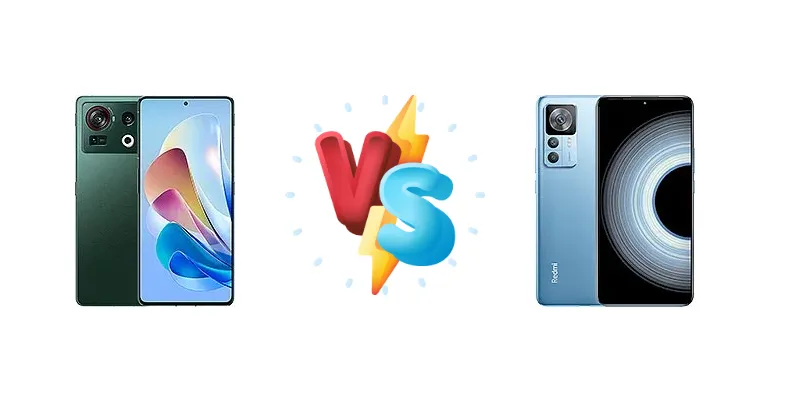
The smartphone market is brimming with powerful devices, and the ZTE Nubia Z40S Pro and Xiaomi Redmi K50 Ultra are two contenders vying for your attention. Both pack the Snapdragon 8+ Gen 1, promising flagship-level performance, but differences in charging, camera features, and overall design set them apart. Let's dive into a comprehensive comparison to help you decide which one is right for you.
🏆 Quick Verdict
The Redmi K50 Ultra edges out the Nubia Z40S Pro thanks to its significantly faster 120W charging and potentially more refined software experience. While the Nubia offers a magnetic wireless charging option, the K50 Ultra's overall package delivers better value and speed.
| Network |
|---|
| 2G bands | GSM 850 / 900 / 1800 / 1900 | GSM 850 / 900 / 1800 / 1900 |
| 3G bands | HSDPA 850 / 900 / 1700(AWS) / 1900 / 2100 | HSDPA 850 / 900 / 1700(AWS) / 1900 / 2100 |
| 4G bands | 1, 3, 4, 5, 7, 8, 12, 17, 20, 34, 38, 39, 40, 41 | 1, 3, 4, 5, 8, 18, 19, 26, 34, 38, 39, 40, 41, 42 |
| 5G bands | 1, 3, 5, 8, 28, 41, 78 SA/NSA | 1, 3, 5, 8, 28, 38, 40, 41, 77, 78 SA/NSA |
| Speed | HSPA, LTE, 5G | HSPA, LTE, 5G |
| Technology | GSM / CDMA / HSPA / LTE / 5G | GSM / CDMA / HSPA / CDMA2000 / LTE / 5G |
| | - | CDMA2000 1x |
| Launch |
|---|
| Announced | 2022, July 20 | 2022, August 11 |
| Status | Available. Released 2022, July 26 | Available. Released 2022, August 25 |
| Body |
|---|
| Build | Glass front, aluminum frame, glass back | - |
| Dimensions | 161.3 x 74 x 8.1 mm (6.35 x 2.91 x 0.32 in) | 163.1 x 75.9 x 8.6 mm (6.42 x 2.99 x 0.34 in) |
| SIM | Nano-SIM + Nano-SIM | Nano-SIM + Nano-SIM |
| Weight | 205 g (7.23 oz) | 202 g (7.13 oz) |
| Display |
|---|
| Resolution | 1080 x 2400 pixels, 20:9 ratio (~395 ppi density) | 1220 x 2712 pixels, 20:9 ratio (~446 ppi density) |
| Size | 6.67 inches, 107.4 cm2 (~90.0% screen-to-body ratio) | 6.67 inches, 107.4 cm2 (~86.7% screen-to-body ratio) |
| Type | AMOLED, 1B colors, 144Hz, HDR10+, 1000 nits | OLED, 68B colors, 144Hz, HDR10+, Dolby Vision |
| Platform |
|---|
| CPU | Octa-core (1x3.19 GHz Cortex-X2 & 3x2.75 GHz Cortex-A710 & 4x1.80 GHz Cortex-A510) | Octa-core (1x3.19 GHz Cortex-X2 & 3x2.75 GHz Cortex-A710 & 4x1.80 GHz Cortex-A510) |
| Chipset | Qualcomm SM8475 Snapdragon 8+ Gen 1 (4 nm) | Qualcomm SM8475 Snapdragon 8+ Gen 1 (4 nm) |
| GPU | Adreno 730 | Adreno 730 |
| OS | Android 12, upgradable to Android 13, MyOS 13 | Android 12, MIUI 13 |
| Memory |
|---|
| Card slot | No | No |
| Internal | 128GB 8GB RAM, 256GB 8GB RAM, 256GB 12GB RAM, 512GB 12GB RAM, 1TB 18GB RAM | 128GB 8GB RAM, 256GB 8GB RAM, 256GB 12GB RAM, 512GB 12GB RAM |
| | - | UFS 3.1 |
| Main Camera |
|---|
| Features | Dual-LED flash, panorama, HDR | Color spectrum sensor, LED flash, HDR, panorama |
| Triple | 64 MP, f/1.6, 35mm (standard), 1/1.7", PDAF, OIS
8 MP, f/3.4, 125mm (periscope telephoto), 1/4.0", PDAF, OIS, 5x optical zoom
50 MP, f/2.2, 14mm, 116˚ (ultrawide), AF | 108 MP, f/1.6, (wide), 1/1.67", PDAF, OIS
8 MP, f/2.2, 120˚, (ultrawide)
2 MP (macro) |
| Video | 8K, 4K@30/60/120fps, 1080p@30/60/120fps, gyro-EIS | 4K@30/60fps, 1080p@30/60/120/240/960fps |
| Selfie camera |
|---|
| Features | HDR | HDR |
| Single | 16 MP, f/2.5, (wide) | 20 MP, (wide) |
| Video | Yes | 1080p@30/60fps, 720p@120fps |
| Sound |
|---|
| 3.5mm jack | No | No |
| 35mm jack | No | No |
| Loudspeaker | Yes, with stereo speakers | Yes, with stereo speakers |
| | - | 24-bit/192kHz audio |
| Comms |
|---|
| Bluetooth | 5.2, A2DP, LE, aptX HD, aptX Adaptive | 5.2, A2DP, LE, aptX HD, aptX Adaptive |
| Infrared port | - | Yes |
| NFC | Yes | Yes |
| Positioning | GPS, GLONASS, GALILEO, BDS | GPS (L1+L5), GLONASS (L1), BDS (B1I+B1c+B2a), GALILEO (E1+E5a), QZSS (L1+L5), NavIC (L5) |
| Radio | No | No |
| USB | USB Type-C 3.1, OTG | USB Type-C 2.0, OTG |
| WLAN | Wi-Fi 802.11 a/b/g/n/ac/6, dual-band, Wi-Fi Direct | Wi-Fi 802.11 a/b/g/n/ac/6e, dual-band, Wi-Fi Direct |
| Features |
|---|
| Sensors | Fingerprint (under display, optical), accelerometer, gyro, proximity, compass | Fingerprint (under display, optical), accelerometer, gyro, proximity, compass |
| Battery |
|---|
| Charging | 80W wired (regular version)
120W wired; 15W magnetic wireless (120W version) | 120W wired, PD3.0, 100% in 19 min |
| Type | Market-dependent versions:· Li-Po 5000 mAh (regular version)· Li-Po 4600 mAh (120W version) | Li-Po 5000 mAh |
| Misc |
|---|
| Colors | Interstellar Black, Star Black, Silver | Black, Gray, Blue, Mercedes AMG |
| Models | NX702J | 22081212C |
| Price | About 490 EUR | About 430 EUR |
ZTE nubia Z40S Pro
- Unique design
- Magnetic wireless charging (120W version)
- Potentially excellent camera tuning
- High-quality AMOLED display
- Slower wired charging (regular version)
- Software support may be less consistent than Xiaomi
- Availability may be limited in some regions
Xiaomi Redmi K50 Ultra
- Blazing-fast 120W wired charging
- Potentially more refined MIUI software
- Strong all-around flagship performance
- Excellent value for money
- Design may be less distinctive
- Wireless charging is absent
- MIUI can be heavily customized (which some may dislike)
Display Comparison
Both phones feature high-quality AMOLED displays with 120Hz refresh rates, offering vibrant colors and smooth scrolling. The Nubia Z40S Pro likely has a slightly curved display, while the Redmi K50 Ultra might opt for a flatter panel. Screen brightness and color accuracy are expected to be excellent on both, but specific measurements would require testing.
Camera Comparison
The Nubia Z40S Pro is expected to have a strong camera system, potentially with a focus on computational photography and unique features. The Redmi K50 Ultra is also expected to have a capable camera setup, likely emphasizing versatility with multiple lenses. Detailed camera comparisons would require extensive testing, but initial impressions suggest both offer excellent image quality.
Performance
Powered by the Snapdragon 8+ Gen 1, both devices deliver exceptional performance for gaming, multitasking, and demanding applications. Thermal management will be a key factor; we'd expect both to handle sustained loads well, but real-world testing will reveal any throttling issues. Software optimization plays a crucial role here, with Xiaomi's MIUI potentially offering a more refined experience.
Battery Life
The Redmi K50 Ultra's 120W wired charging is a significant advantage, allowing for incredibly fast charging times. The Nubia Z40S Pro offers 80W wired charging (regular version) or 120W (120W version) and 15W magnetic wireless charging, providing flexibility but not matching the K50 Ultra's wired speed.
Buying Guide
The ZTE Nubia Z40S Pro is ideal for users who prioritize a unique design, potentially better camera tuning (depending on software updates), and appreciate the convenience of magnetic wireless charging. The Xiaomi Redmi K50 Ultra is the better choice for those seeking the fastest charging speeds, a potentially more polished MIUI experience, and a strong all-around flagship at a competitive price.
Frequently Asked Questions
❓ Which phone has better battery life?
While both have decent battery capacity, the Redmi K50 Ultra's significantly faster charging speed gives it an edge in overall battery usability.
❓ Is the Nubia Z40S Pro worth buying if I want wireless charging?
Yes, the 120W version of the Nubia Z40S Pro offers magnetic wireless charging, which is a unique feature. However, consider if the slower wired charging and potential software limitations are acceptable tradeoffs.