
ZTE nubia Z40S Pro vs. vivo iQOO 9 Pro: A Detailed Comparison of Snapdragon Flagships
| Phones Images | |||||
|---|---|---|---|---|---|
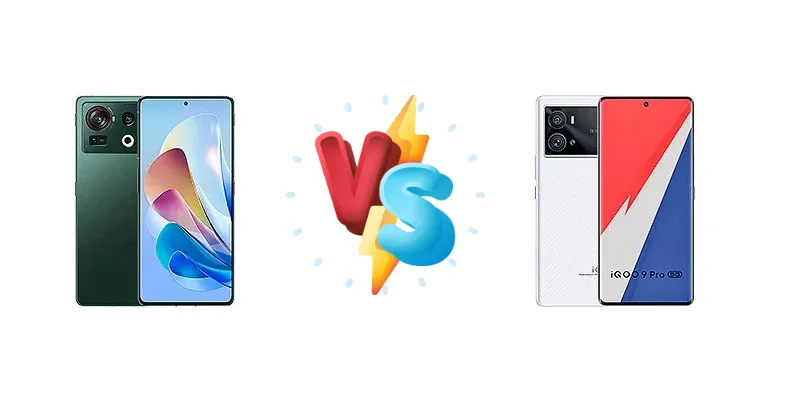
|
🏆 Quick Verdict
For most users, the ZTE nubia Z40S Pro emerges as the stronger choice. Its Snapdragon 8+ Gen 1 offers superior thermal efficiency and slightly better CPU performance, translating to sustained performance in demanding tasks. While the iQOO 9 Pro boasts faster wired charging and a comparable battery endurance rating, the nubia’s overall package provides a more refined experience.
| PHONES | ||
|---|---|---|
| Phone Names | ZTE nubia Z40S Pro | vivo iQOO 9 Pro |
| Network | ||
|---|---|---|
| 2G bands | GSM 850 / 900 / 1800 / 1900 | GSM 850 / 900 / 1800 / 1900 |
| 3G bands | HSDPA 850 / 900 / 1700(AWS) / 1900 / 2100 | HSDPA 850 / 900 / 1700(AWS) / 1900 / 2100 |
| 4G bands | 1, 3, 4, 5, 7, 8, 12, 17, 20, 34, 38, 39, 40, 41 | 1, 2, 3, 4, 5, 7, 8, 12, 17, 18, 19, 20, 25, 26, 28, 32, 34, 38, 39, 40, 41, 42, 66 |
| 5G bands | 1, 3, 5, 8, 28, 41, 78 SA/NSA | 1, 3, 5, 7, 8, 20, 28, 38, 40, 41, 66, 77, 78, 79 SA/NSA |
| Speed | HSPA, LTE, 5G | HSPA, LTE, 5G |
| Technology | GSM / CDMA / HSPA / LTE / 5G | GSM / CDMA / HSPA / CDMA2000 / LTE / 5G |
| - | CDMA2000 1x | |
| Launch | ||
|---|---|---|
| Announced | 2022, July 20 | 2022, January 05 |
| Status | Available. Released 2022, July 26 | Available. Released 2022, January 12 |
| Body | ||
|---|---|---|
| Build | Glass front, aluminum frame, glass back | Glass front (Panda Glass), aluminum frame, glass back or aramid fiber back |
| Dimensions | 161.3 x 74 x 8.1 mm (6.35 x 2.91 x 0.32 in) | 164.8 x 75.2 x 8.8 mm |
| SIM | Nano-SIM + Nano-SIM | Nano-SIM + Nano-SIM |
| Weight | 205 g (7.23 oz) | 204 g or 210 g (7.20 oz) |
| - | Splash and dust resistant | |
| Display | ||
|---|---|---|
| Protection | - | Panda Glass |
| Resolution | 1080 x 2400 pixels, 20:9 ratio (~395 ppi density) | 1440 x 3200 pixels, 20:9 ratio (~518 ppi density) |
| Size | 6.67 inches, 107.4 cm2 (~90.0% screen-to-body ratio) | 6.78 inches, 111.0 cm2 (~89.6% screen-to-body ratio) |
| Type | AMOLED, 1B colors, 144Hz, HDR10+, 1000 nits | LTPO2 AMOLED, 1B colors, 120Hz, HDR10+, Dolby Vision, 500 nits (typ), 1000 nits (HBM), 1500 nits (peak) |
| Platform | ||
|---|---|---|
| CPU | Octa-core (1x3.19 GHz Cortex-X2 & 3x2.75 GHz Cortex-A710 & 4x1.80 GHz Cortex-A510) | Octa-core (1x3.00 GHz Cortex-X2 & 3x2.50 GHz Cortex-A710 & 4x1.80 GHz Cortex-A510) |
| Chipset | Qualcomm SM8475 Snapdragon 8+ Gen 1 (4 nm) | Qualcomm SM8450 Snapdragon 8 Gen 1 (4 nm) |
| GPU | Adreno 730 | Adreno 730 |
| OS | Android 12, upgradable to Android 13, MyOS 13 | Android 12, Funtouch 12 (International), OriginOS Ocean (China) |
| Memory | ||
|---|---|---|
| Card slot | No | No |
| Internal | 128GB 8GB RAM, 256GB 8GB RAM, 256GB 12GB RAM, 512GB 12GB RAM, 1TB 18GB RAM | 256GB 8GB RAM, 256GB 12GB RAM, 512GB 12GB RAM |
| - | UFS 3.1 (V6) | |
| Main Camera | ||
|---|---|---|
| Features | Dual-LED flash, panorama, HDR | Dual-LED lash, HDR, panorama |
| Single | - | 16 MP, f/2.5, (wide), 1/3.1", 1.0µm |
| Triple | 64 MP, f/1.6, 35mm (standard), 1/1.7", PDAF, OIS 8 MP, f/3.4, 125mm (periscope telephoto), 1/4.0", PDAF, OIS, 5x optical zoom 50 MP, f/2.2, 14mm, 116˚ (ultrawide), AF | 50 MP, f/1.8, (wide), 1/1.57", 1.0µm, PDAF, gimbal OIS 16 MP, f/2.2, 60mm (telephoto), 1/3.1", 1.0µm, PDAF, OIS, 2.5x optical zoom 50 MP, f/2.3, 15mm, 150˚ (ultrawide), 1/2.76", 0.64µm, AF |
| Video | 8K, 4K@30/60/120fps, 1080p@30/60/120fps, gyro-EIS | 8K@30fps, 4K@24/30/60fps, 1080p@30/60fps, gyro-EIS |
| Selfie camera | ||
|---|---|---|
| Features | HDR | HDR |
| Single | 16 MP, f/2.5, (wide) | 16 MP, f/2.5, (wide), 1/3.1", 1.0µm |
| Video | Yes | 1080p@30fps, gyro-EIS |
| Sound | ||
|---|---|---|
| 3.5mm jack | No | No |
| 35mm jack | No | No |
| Loudspeaker | Yes, with stereo speakers | Yes, with dual speakers |
| - | 32-bit/384kHz audio | |
| Comms | ||
|---|---|---|
| Bluetooth | 5.2, A2DP, LE, aptX HD, aptX Adaptive | 5.2, A2DP, LE, aptX HD, aptX Adaptive, aptX Lossless |
| Infrared port | - | Yes |
| NFC | Yes | Yes |
| Positioning | GPS, GLONASS, GALILEO, BDS | GPS, GLONASS, GALILEO, BDS, QZSS |
| Radio | No | No |
| USB | USB Type-C 3.1, OTG | USB Type-C 2.0, OTG |
| WLAN | Wi-Fi 802.11 a/b/g/n/ac/6, dual-band, Wi-Fi Direct | Wi-Fi 802.11 a/b/g/n/ac/6, dual-band, Wi-Fi Direct |
| Features | ||
|---|---|---|
| Sensors | Fingerprint (under display, optical), accelerometer, gyro, proximity, compass | Fingerprint (under display, ultrasonic), accelerometer, gyro, proximity, compass |
| Battery | ||
|---|---|---|
| Charging | 80W wired (regular version) 120W wired; 15W magnetic wireless (120W version) | 120W wired, 50% in 8 min, 100% in 20 min 50W wireless 10W reverse wireless |
| Type | Market-dependent versions:· Li-Po 5000 mAh (regular version)· Li-Po 4600 mAh (120W version) | 4700 mAh |
| Misc | ||
|---|---|---|
| Colors | Interstellar Black, Star Black, Silver | Legend (White w/ BMW M branding), Dark Cruise, Orange |
| Models | NX702J | V2172A, I2022 |
| Price | About 490 EUR | About 630 EUR |
| Tests | ||
|---|---|---|
| Battery life | - | Endurance rating 97h |
| Camera | - | Photo / Video |
| Display | - | Contrast ratio: Infinite (nominal) |
| Loudspeaker | - | -24.8 LUFS (Very good) |
| Performance | - | AnTuTu: 862324 (v8), 997948 (v9) GeekBench: 3708 (v5.1) GFXBench: 46fps (ES 3.1 onscreen) |
ZTE nubia Z40S Pro
- More efficient Snapdragon 8+ Gen 1 chipset
- Potentially better sustained performance
- Available with 120W charging (certain models)
- Charging speed varies by model (80W vs 120W)
- Limited display specifications available
vivo iQOO 9 Pro
- Ultra-fast 120W wired charging
- 50W wireless charging and 10W reverse wireless
- Confirmed 1000 nits peak brightness
- Snapdragon 8 Gen 1 is less thermally efficient
- Potential for more throttling under heavy load
Display Comparison
Both devices offer high-quality displays, but specific details are limited. The iQOO 9 Pro is confirmed to reach 1000 nits of peak brightness, suggesting excellent outdoor visibility. While the nubia Z40S Pro’s display specs are not provided, nubia typically employs AMOLED panels with vibrant colors. The iQOO 9 Pro’s ‘Infinite’ contrast ratio is a marketing term, common to AMOLED technology. Without refresh rate or resolution details for the nubia, it’s difficult to definitively declare a winner, but the iQOO 9 Pro’s confirmed brightness gives it a slight edge.
Camera Comparison
Both phones are listed as having Photo/Video capabilities, but detailed camera specifications are absent. Without sensor size, aperture, or OIS details, a meaningful comparison is impossible. It’s reasonable to assume both will offer versatile camera systems, but the lack of specifics prevents a clear assessment. We can infer that both will likely include a primary wide-angle lens, ultrawide, and potentially a telephoto lens, but the quality will depend on the hardware not provided.
Performance
The nubia Z40S Pro’s Snapdragon 8+ Gen 1 (4nm) is a clear advantage over the iQOO 9 Pro’s Snapdragon 8 Gen 1 (4nm). The ‘+’ variant features a higher peak CPU clock speed (3.19 GHz vs 3.00 GHz) and improved thermal characteristics. Both CPUs share the same core configuration – 1x Cortex-X2, 3x Cortex-A710, and 4x Cortex-A510 – but the 8+ Gen 1’s efficiency gains mean less throttling during prolonged gaming sessions. While both likely utilize LPDDR5x RAM, the nubia’s chipset provides a performance uplift.
Battery Life
The iQOO 9 Pro’s charging capabilities are a standout feature, offering 120W wired charging, achieving 50% charge in 8 minutes and 100% in 20 minutes. It also supports 50W wireless and 10W reverse wireless charging. The nubia Z40S Pro comes in two variants: 80W wired (standard) and 120W wired with 15W magnetic wireless. Both phones share an endurance rating of 97 hours, suggesting similar real-world battery life despite potential differences in battery capacity (not specified). The iQOO 9 Pro’s faster charging speeds are a significant convenience factor.
Buying Guide
Buy the ZTE nubia Z40S Pro if you prioritize sustained performance during gaming or intensive applications, and value the efficiency gains of the Snapdragon 8+ Gen 1. Buy the vivo iQOO 9 Pro if you absolutely need the fastest possible wired charging speeds (120W vs 80W/120W) and appreciate the convenience of 50W wireless charging, and are willing to potentially manage slightly more thermal throttling under heavy load.