
ZTE nubia Z40S Pro vs Oppo Find X5 Pro: A Deep Dive into Flagship Performance
| Phones Images | |||||
|---|---|---|---|---|---|
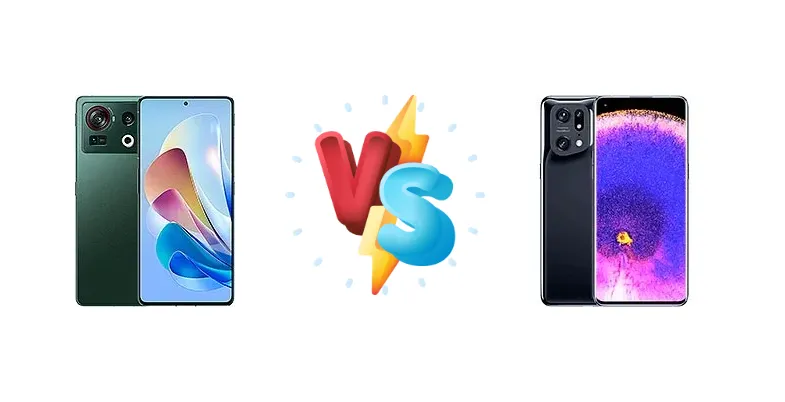
|
🏆 Quick Verdict
For most users, the Oppo Find X5 Pro offers a more balanced and polished experience. Its excellent camera system, coupled with a solid endurance rating, makes it the safer bet. However, the nubia Z40S Pro’s Snapdragon 8+ Gen 1 and potentially faster charging (depending on the version) appeal to power users and gamers.
| PHONES | ||
|---|---|---|
| Phone Names | ZTE nubia Z40S Pro | Oppo Find X5 Pro |
| Network | ||
|---|---|---|
| 2G bands | GSM 850 / 900 / 1800 / 1900 | GSM 850 / 900 / 1800 / 1900 |
| 3G bands | HSDPA 850 / 900 / 1700(AWS) / 1900 / 2100 | HSDPA 800 / 850 / 900 / 1700(AWS) / 1900 / 2100 |
| 4G bands | 1, 3, 4, 5, 7, 8, 12, 17, 20, 34, 38, 39, 40, 41 | 1, 2, 3, 4, 5, 7, 8, 12, 13, 17, 18, 19, 20, 25, 26, 28, 32, 34, 38, 39, 40, 41, 42, 66 - Global |
| 5G bands | 1, 3, 5, 8, 28, 41, 78 SA/NSA | 1, 2, 3, 5, 7, 8, 12, 13, 18, 20, 25, 26, 28, 38, 40, 41, 66, 77, 78, 79 SA/NSA - Global |
| Speed | HSPA, LTE, 5G | HSPA, LTE, 5G |
| Technology | GSM / CDMA / HSPA / LTE / 5G | GSM / CDMA / HSPA / CDMA2000 / LTE / 5G |
| - | 1, 2, 3, 5, 8, 20, 28, 38, 41, 66, 77, 78, 79 SA/NSA - China | |
| Launch | ||
|---|---|---|
| Announced | 2022, July 20 | 2022, February 24 |
| Status | Available. Released 2022, July 26 | Available. Released 2022, March 14 |
| Body | ||
|---|---|---|
| Build | Glass front, aluminum frame, glass back | Glass front (Gorilla Glass Victus), ceramic back or eco leather back, aluminum frame |
| Dimensions | 161.3 x 74 x 8.1 mm (6.35 x 2.91 x 0.32 in) | 163.7 x 73.9 x 8.5 or 8.8 mm |
| SIM | Nano-SIM + Nano-SIM | Nano-SIM + eSIM |
| Weight | 205 g (7.23 oz) | 218 g or 195 g (6.88 oz) |
| - | IP68 dust/water resistant (up to 1.5m for 30 min) | |
| Display | ||
|---|---|---|
| Protection | - | Corning Gorilla Glass Victus |
| Resolution | 1080 x 2400 pixels, 20:9 ratio (~395 ppi density) | 1440 x 3216 pixels, 20:9 ratio (~525 ppi density) |
| Size | 6.67 inches, 107.4 cm2 (~90.0% screen-to-body ratio) | 6.7 inches, 108.4 cm2 (~89.6% screen-to-body ratio) |
| Type | AMOLED, 1B colors, 144Hz, HDR10+, 1000 nits | LTPO2 AMOLED, 1B colors, 120Hz, HDR10+, BT.2020, 500 nits (typ), 800 nits (HBM), 1300 nits (peak) |
| Platform | ||
|---|---|---|
| CPU | Octa-core (1x3.19 GHz Cortex-X2 & 3x2.75 GHz Cortex-A710 & 4x1.80 GHz Cortex-A510) | Octa-core (1x3.00 GHz Cortex-X2 & 3x2.50 GHz Cortex-A710 & 4x1.80 GHz Cortex-A510) - GlobalOcta-core (1x3.05 GHz Cortex-X2 & 3x2.85 GHz Cortex-A710 & 4x1.80 GHz Cortex-A510) - China |
| Chipset | Qualcomm SM8475 Snapdragon 8+ Gen 1 (4 nm) | Qualcomm SM8450 Snapdragon 8 Gen 1 (4 nm) - GlobalMediatek Dimensity 9000 (4 nm) - China |
| GPU | Adreno 730 | Adreno 730 - GlobalMali-G710 MC10 - China |
| OS | Android 12, upgradable to Android 13, MyOS 13 | Android 12, upgradable to Android 14, ColorOS 14 |
| Memory | ||
|---|---|---|
| Card slot | No | No |
| Internal | 128GB 8GB RAM, 256GB 8GB RAM, 256GB 12GB RAM, 512GB 12GB RAM, 1TB 18GB RAM | 256GB 8GB RAM, 256GB 12GB RAM, 512GB 12GB RAM |
| - | UFS 3.1 | |
| Main Camera | ||
|---|---|---|
| Features | Dual-LED flash, panorama, HDR | Hasselblad Color Calibration, color spectrum sensor, LED flash, HDR, panorama |
| Single | - | 32 MP, f/2.4, 21mm (wide), 1/2.74", 0.8µm |
| Triple | 64 MP, f/1.6, 35mm (standard), 1/1.7", PDAF, OIS 8 MP, f/3.4, 125mm (periscope telephoto), 1/4.0", PDAF, OIS, 5x optical zoom 50 MP, f/2.2, 14mm, 116˚ (ultrawide), AF | 50 MP, f/1.7, 25mm (wide), 1/1.56", 1.0µm, multi-directional PDAF, OIS (3-axis sensor-shift, 2-axis lens-shift) 13 MP, f/2.4, 52mm (telephoto), 1/3.4", 2x optical zoom, PDAF 50 MP, f/2.2, 15mm, 110˚ (ultrawide), 1/1.56", 1.0µm, multi-directional PDAF |
| Video | 8K, 4K@30/60/120fps, 1080p@30/60/120fps, gyro-EIS | 4K@30/60fps, 1080p@30/60/240fps; gyro-EIS; HDR, 10‑bit video |
| Selfie camera | ||
|---|---|---|
| Features | HDR | Panorama |
| Single | 16 MP, f/2.5, (wide) | 32 MP, f/2.4, 21mm (wide), 1/2.74", 0.8µm |
| Video | Yes | 1080p@30fps, gyro-EIS |
| Sound | ||
|---|---|---|
| 3.5mm jack | No | No |
| 35mm jack | No | No |
| Loudspeaker | Yes, with stereo speakers | Yes, with stereo speakers |
| Comms | ||
|---|---|---|
| Bluetooth | 5.2, A2DP, LE, aptX HD, aptX Adaptive | 5.2, A2DP, LE, aptX HD |
| NFC | Yes | Yes |
| Positioning | GPS, GLONASS, GALILEO, BDS | GPS (L1), GLONASS (L1), BDS (B1I+B1c), GALILEO (E1+E5a), QZSS (L1) |
| Radio | No | No |
| USB | USB Type-C 3.1, OTG | USB Type-C 3.1, OTG |
| WLAN | Wi-Fi 802.11 a/b/g/n/ac/6, dual-band, Wi-Fi Direct | Wi-Fi 802.11 a/b/g/n/ac/6e, dual-band, Wi-Fi Direct |
| Features | ||
|---|---|---|
| Sensors | Fingerprint (under display, optical), accelerometer, gyro, proximity, compass | Fingerprint (under display, optical), accelerometer, gyro, proximity, compass |
| - | Oppo Find X5 Pro Dimensity model has no MariSilicon X image chip, 5-axis OIS and Hasselblad’s color calibration | |
| Battery | ||
|---|---|---|
| Charging | 80W wired (regular version) 120W wired; 15W magnetic wireless (120W version) | 80W wired, PD, 50% in 12 min 50W wireless, 100% in 47 min 10W reverse wireless |
| Type | Market-dependent versions:· Li-Po 5000 mAh (regular version)· Li-Po 4600 mAh (120W version) | Li-Po 5000 mAh |
| Misc | ||
|---|---|---|
| Colors | Interstellar Black, Star Black, Silver | Ceramic Black, Ceramic White, Blue (eco leather) |
| Models | NX702J | PFEM10, CPH2305, PFFM20 |
| Price | About 490 EUR | € 449.00 / $ 430.24 / £ 1,049.00 |
| Tests | ||
|---|---|---|
| Battery life | - | Endurance rating 101h |
| Camera | - | Photo / Video |
| Display | - | Contrast ratio: Infinite (nominal) |
| Loudspeaker | - | -24.7 LUFS (Very good) |
| Performance | - | AnTuTu: 1012896 (v9) GeekBench: 3433 (v5.1) GFXBench: 44fps (ES 3.1 onscreen) |
ZTE nubia Z40S Pro
- Superior processor performance with Snapdragon 8+ Gen 1
- Potentially much faster charging (up to 120W)
- Magnetic wireless charging support
- Camera specs are unknown, potential for inconsistency
- Battery capacity not specified, could be smaller than Oppo
Oppo Find X5 Pro
- Excellent camera system with refined image processing
- Solid battery life with 101-hour endurance rating
- Faster wireless charging (50W) than nubia's standard offering
- Slower processor compared to Snapdragon 8+ Gen 1
- Wired charging is slower than nubia's 120W version
Display Comparison
The Oppo Find X5 Pro boasts a measured peak brightness of 762 nits, providing excellent visibility outdoors. While the nubia Z40S Pro’s display specs are not provided, nubia typically employs high-quality AMOLED panels. The Find X5 Pro’s infinite contrast ratio (nominal) suggests a superior viewing experience with deep blacks. Without specific details on the nubia’s panel technology (LTPO, PWM dimming rate), it’s difficult to definitively declare a winner, but the Find X5 Pro’s measured brightness gives it an edge for outdoor usability.
Camera Comparison
Both devices are described as having capable photo/video systems, but specific details are lacking. The nubia Z40S Pro’s camera specs are unknown, while the Find X5 Pro’s strengths likely lie in its image processing algorithms and potentially larger sensor size (typical for Oppo flagships). Without sensor size or aperture information for the nubia, it’s difficult to assess its low-light performance. The Find X5 Pro’s reputation for consistent image quality and video stabilization gives it a likely advantage, assuming a similar sensor setup to previous Oppo flagships.
Performance
The nubia Z40S Pro’s Snapdragon 8+ Gen 1 (4nm) offers a clear advantage over the Oppo Find X5 Pro’s Snapdragon 8 Gen 1 (4nm) or Dimensity 9000 (4nm). The ‘+’ generation chip features higher clock speeds (3.19 GHz Cortex-X2 vs 3.00 GHz/3.05 GHz) and improved thermal efficiency. This translates to sustained performance during demanding tasks like gaming. The Dimensity 9000 in the China variant of the Find X5 Pro is competitive, but the Snapdragon 8+ Gen 1 generally edges it out in GPU performance. Both phones utilize LPDDR5 RAM, but the nubia’s superior chipset provides a noticeable performance uplift.
Battery Life
The Oppo Find X5 Pro has an endurance rating of 101 hours, indicating solid battery life. The nubia Z40S Pro’s battery capacity is not specified, but its charging capabilities are a major differentiator. The nubia offers 80W wired charging (standard) or 120W (special version), significantly faster than the Find X5 Pro’s 80W wired charging. Furthermore, the nubia includes 15W magnetic wireless charging, while the Find X5 Pro offers 50W wireless charging. The nubia’s faster wired charging, especially the 120W version, allows for significantly quicker top-ups, potentially mitigating a smaller battery capacity.
Buying Guide
Buy the ZTE nubia Z40S Pro if you demand the absolute fastest processor for gaming and multitasking, and prioritize extremely rapid charging. You're willing to potentially trade off some camera refinement for peak performance. Buy the Oppo Find X5 Pro if you value a consistently excellent camera experience, a refined software experience, and a more balanced approach to battery life and charging, even if it means slightly less raw processing power.