
ZTE nubia Z40S Pro vs OnePlus 10 Pro: A Deep Dive into Flagship Performance
| Phones Images | |||||
|---|---|---|---|---|---|
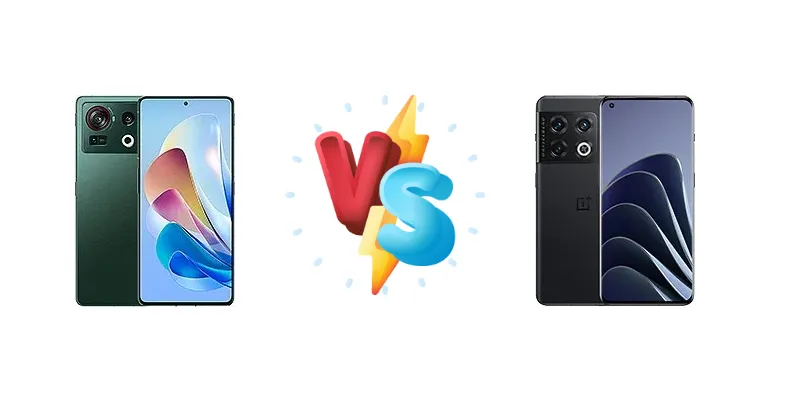
|
🏆 Quick Verdict
For most users, the ZTE nubia Z40S Pro emerges as the stronger contender. Its Snapdragon 8+ Gen 1 chipset provides a performance edge and improved thermal efficiency over the OnePlus 10 Pro’s Snapdragon 8 Gen 1, coupled with significantly faster wired charging. While OnePlus offers wireless charging, the nubia’s overall value proposition is more compelling.
| PHONES | ||
|---|---|---|
| Phone Names | ZTE nubia Z40S Pro | OnePlus 10 Pro |
| Network | ||
|---|---|---|
| 2G bands | GSM 850 / 900 / 1800 / 1900 | GSM 850 / 900 / 1800 / 1900 |
| 3G bands | HSDPA 850 / 900 / 1700(AWS) / 1900 / 2100 | HSDPA 800 / 850 / 900 / 1700(AWS) / 1900 / 2100 |
| 4G bands | 1, 3, 4, 5, 7, 8, 12, 17, 20, 34, 38, 39, 40, 41 | 1, 2, 3, 4, 5, 7, 8, 12, 13, 17, 18, 19, 20, 25, 26, 28, 30, 32, 38, 39, 40, 41, 46, 48, 66, 71 - International |
| 5G bands | 1, 3, 5, 8, 28, 41, 78 SA/NSA | 1, 2, 3, 5, 7, 8, 20, 25, 28, 30, 38, 40, 41, 48, 66, 71, 77, 78 SA/NSA - International |
| Speed | HSPA, LTE, 5G | HSPA 42.2/5.76 Mbps, LTE (4CA) Cat18 1200/200 Mbps, 5G |
| Technology | GSM / CDMA / HSPA / LTE / 5G | GSM / CDMA / HSPA / EVDO / LTE / 5G |
| - | 1, 3, 5, 8, 28, 40, 41, 78, 79 SA/NSA - India | |
| Launch | ||
|---|---|---|
| Announced | 2022, July 20 | 2022, January 11 |
| Status | Available. Released 2022, July 26 | Available. Released 2022, January 13 |
| Body | ||
|---|---|---|
| Build | Glass front, aluminum frame, glass back | Glass front (Gorilla Glass Victus), glass back (Gorilla Glass 5), aluminum frame |
| Dimensions | 161.3 x 74 x 8.1 mm (6.35 x 2.91 x 0.32 in) | 163 x 73.9 x 8.6 mm (6.42 x 2.91 x 0.34 in) |
| SIM | Nano-SIM + Nano-SIM | · Nano-SIM· Nano-SIM + Nano-SIM |
| Weight | 205 g (7.23 oz) | 201 g (7.09 oz) |
| - | IP68 dust/water resistant - T-Mobile only (not for use underwater, liquid damage is not covered under warranty) | |
| Display | ||
|---|---|---|
| Protection | - | Corning Gorilla Glass Victus |
| Resolution | 1080 x 2400 pixels, 20:9 ratio (~395 ppi density) | 1440 x 3216 pixels, 20:9 ratio (~525 ppi density) |
| Size | 6.67 inches, 107.4 cm2 (~90.0% screen-to-body ratio) | 6.7 inches, 108.4 cm2 (~90.0% screen-to-body ratio) |
| Type | AMOLED, 1B colors, 144Hz, HDR10+, 1000 nits | LTPO2 Fluid AMOLED, 1B colors, 120Hz, HDR10+, 500 nits (typ), 800 nits (HBM), 1300 nits (peak) |
| - | Always-on display | |
| Platform | ||
|---|---|---|
| CPU | Octa-core (1x3.19 GHz Cortex-X2 & 3x2.75 GHz Cortex-A710 & 4x1.80 GHz Cortex-A510) | Octa-core (1x3.00 GHz Cortex-X2 & 3x2.50 GHz Cortex-A710 & 4x1.80 GHz Cortex-A510) |
| Chipset | Qualcomm SM8475 Snapdragon 8+ Gen 1 (4 nm) | Qualcomm SM8450 Snapdragon 8 Gen 1 (4 nm) |
| GPU | Adreno 730 | Adreno 730 |
| OS | Android 12, upgradable to Android 13, MyOS 13 | Android 12, upgradable to Android 14, OxygenOS 14 (International), ColorOS (China) |
| Memory | ||
|---|---|---|
| Card slot | No | No |
| Internal | 128GB 8GB RAM, 256GB 8GB RAM, 256GB 12GB RAM, 512GB 12GB RAM, 1TB 18GB RAM | 128GB 8GB RAM, 256GB 8GB RAM, 256GB 12GB RAM, 512GB 12GB RAM |
| - | UFS 3.1 | |
| Main Camera | ||
|---|---|---|
| Features | Dual-LED flash, panorama, HDR | Laser AF, color spectrum sensor, Hasselblad Color Calibration, Dual-LED dual-tone flash, HDR, panorama |
| Single | - | 32 MP, f/2.2, (wide), 1/2.74", 0.8µm |
| Triple | 64 MP, f/1.6, 35mm (standard), 1/1.7", PDAF, OIS 8 MP, f/3.4, 125mm (periscope telephoto), 1/4.0", PDAF, OIS, 5x optical zoom 50 MP, f/2.2, 14mm, 116˚ (ultrawide), AF | 48 MP, f/1.8, 23mm (wide), 1/1.43", 1.12µm, multi-directional PDAF, OIS 8 MP, f/2.4, 77mm (telephoto), 1.0µm, PDAF, OIS, 3.3x optical zoom 50 MP, f/2.2, 14mm, 150˚ (ultrawide), 1/2.76", 0.64µm |
| Video | 8K, 4K@30/60/120fps, 1080p@30/60/120fps, gyro-EIS | 8K@24fps, 4K@30/60/120fps, 1080p@30/60/240fps, Auto HDR, gyro-EIS |
| Selfie camera | ||
|---|---|---|
| Features | HDR | HDR |
| Single | 16 MP, f/2.5, (wide) | 32 MP, f/2.2, (wide), 1/2.74", 0.8µm |
| Video | Yes | 1080p@30fps, gyro-EIS |
| Sound | ||
|---|---|---|
| 3.5mm jack | No | No |
| 35mm jack | No | No |
| Loudspeaker | Yes, with stereo speakers | Yes, with stereo speakers |
| - | 24-bit/192kHz audio | |
| Comms | ||
|---|---|---|
| Bluetooth | 5.2, A2DP, LE, aptX HD, aptX Adaptive | 5.2, A2DP, LE, aptX HD |
| NFC | Yes | Yes |
| Positioning | GPS, GLONASS, GALILEO, BDS | GPS (L1+L5), GLONASS (G1), BDS (B1), GALILEO (E1+E5a) |
| Radio | No | No |
| USB | USB Type-C 3.1, OTG | USB Type-C 3.1, OTG |
| WLAN | Wi-Fi 802.11 a/b/g/n/ac/6, dual-band, Wi-Fi Direct | Wi-Fi 802.11 a/b/g/n/ac/6, dual-band, Wi-Fi Direct |
| Features | ||
|---|---|---|
| Sensors | Fingerprint (under display, optical), accelerometer, gyro, proximity, compass | Fingerprint (under display, optical), accelerometer, gyro, proximity, compass, barometer |
| Battery | ||
|---|---|---|
| Charging | 80W wired (regular version) 120W wired; 15W magnetic wireless (120W version) | 80W wired, PD, 100% in 32 min (International) 65W wired, PD, 58% in 15 min (North America) 50W wireless Reverse wireless |
| Type | Market-dependent versions:· Li-Po 5000 mAh (regular version)· Li-Po 4600 mAh (120W version) | Li-Po 5000 mAh |
| Misc | ||
|---|---|---|
| Colors | Interstellar Black, Star Black, Silver | Volcanic Black, Emerald Forest, Panda White (Extreme Edition) |
| Models | NX702J | NE2210, NE2211, NE2213, NE2215, NE2217 |
| Price | About 490 EUR | $ 264.39 / C$ 349.99 / £ 360.00 / € 399.99 |
| SAR | - | 1.16 W/kg (head) 0.70 W/kg (body) |
| Tests | ||
|---|---|---|
| Battery life | - | Endurance rating 107h |
| Camera | - | Photo / Video |
| Display | - | Contrast ratio: Infinite (nominal) |
| Loudspeaker | - | -25.2 LUFS (Very good) |
| Performance | - | AnTuTu: 886248 (v9) GeekBench: 3447 (v5.1) GFXBench: 48fps (ES 3.1 onscreen) |
ZTE nubia Z40S Pro
- Faster Snapdragon 8+ Gen 1 processor
- Significantly faster wired charging (up to 120W)
- Potential for better thermal management
- Software experience may be less refined than OnePlus
- Wireless charging speed is slower than OnePlus
OnePlus 10 Pro
- Refined and established OxygenOS software
- Faster wireless charging (50W)
- Hasselblad-tuned camera system
- Older Snapdragon 8 Gen 1 processor
- Slower wired charging speeds (especially in North America)
- Potential for thermal throttling under sustained load
Display Comparison
Both devices feature high-quality displays, but direct comparison data is limited. The OnePlus 10 Pro is confirmed to reach 780 nits of peak brightness, a respectable figure for outdoor visibility. While the nubia Z40S Pro’s peak brightness isn’t specified, its panel technology and target market suggest a comparable or potentially higher output. Both likely employ LTPO technology for adaptive refresh rates, conserving battery life. Bezels are expected to be minimal on both, but the nubia’s design language often leans towards maximizing screen real estate.
Camera Comparison
Both phones are advertised as having strong camera capabilities, but detailed sensor information is needed for a precise comparison. The OnePlus 10 Pro’s camera system is well-documented, featuring Hasselblad color calibration. The nubia Z40S Pro’s camera specs are less readily available, but its positioning suggests a focus on high-resolution photography. Without specific sensor size and aperture details, it’s difficult to definitively declare a winner. However, the OnePlus 10 Pro’s established image processing pipeline and Hasselblad partnership provide a degree of confidence in consistent image quality.
Performance
The nubia Z40S Pro’s Snapdragon 8+ Gen 1 (4nm) is the key differentiator here. Built on a more efficient 4nm process compared to the OnePlus 10 Pro’s Snapdragon 8 Gen 1 (4nm), the 8+ Gen 1 offers improved sustained performance and reduced thermal throttling. The CPU configuration is similar – both feature a Cortex-X2 prime core, Cortex-A710 performance cores, and Cortex-A510 efficiency cores – but the 8+ Gen 1’s higher clock speeds (3.19 GHz vs 3.00 GHz) and architectural improvements translate to a noticeable advantage in demanding tasks. Both utilize LPDDR5 RAM, but the nubia’s newer chipset benefits from optimized memory controllers.
Battery Life
The OnePlus 10 Pro boasts an endurance rating of 107 hours, indicating solid battery life. However, the nubia Z40S Pro compensates for any potential capacity difference with its significantly faster charging capabilities. The regular version offers 80W wired charging, while the 120W version can fully charge in a remarkably short time. The OnePlus 10 Pro’s 80W (International) or 65W (North America) wired charging is slower, taking 32 minutes for a full charge (International). The nubia also adds 15W magnetic wireless charging, a feature absent in the base OnePlus 10 Pro, though the OnePlus offers 50W wireless charging.
Buying Guide
Buy the ZTE nubia Z40S Pro if you prioritize raw performance, exceptionally fast charging, and are comfortable with a potentially less polished software experience. Buy the OnePlus 10 Pro if you value a refined software experience, established brand reputation, and the convenience of wireless charging, even if it means sacrificing some processing power and charging speed.