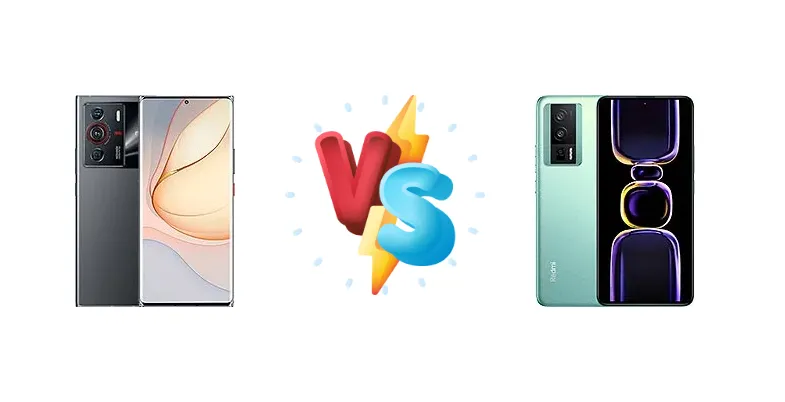
The smartphone market is brimming with options, making it tough to choose. Today, we're pitting two strong contenders against each other: the ZTE nubia Z40 Pro and the Xiaomi Redmi K60. Both offer premium features, but which one delivers the best overall experience?
🏆 Quick Verdict
The Redmi K60 edges out the nubia Z40 Pro thanks to its more efficient Snapdragon 8+ Gen 1 chipset, faster wireless charging, and generally more polished software experience. While the Z40 Pro boasts a unique gravity-sensing magnetic wireless charging, the K60 provides a more consistently superior package.
| Network |
|---|
| 2G bands | GSM 850 / 900 / 1800 / 1900 | GSM 850 / 900 / 1800 / 1900 |
| 3G bands | HSDPA 850 / 900 / 1700(AWS) / 1900 / 2100 | HSDPA 800 / 850 / 900 / 1700(AWS) / 2100 |
| 4G bands | 1, 3, 5, 7, 8, 4, 12, 17, 20, 34, 38, 39, 40, 41 | 1, 3, 4, 5, 8, 18, 19, 26, 34, 38, 39, 40, 41, 42 |
| 5G bands | 1, 3, 5, 8, 28, 41, 78 SA/NSA | 1, 3, 5, 8, 28, 38, 41, 77, 78 SA/NSA |
| Speed | HSPA, LTE, 5G | HSPA, LTE, 5G |
| Technology | GSM / CDMA / HSPA / LTE / 5G | GSM / CDMA / HSPA / CDMA2000 / LTE / 5G |
| | CDMA 800 | CDMA2000 1x |
| Launch |
|---|
| Announced | 2022, February 25 | 2022, December 27 |
| Status | Available. Released 2022, March 02 | Available. Released 2023, January 01 |
| Body |
|---|
| Build | Glass front, aluminum frame, glass back | - |
| Dimensions | 161.9 x 72.9 x 8.4 mm (6.37 x 2.87 x 0.33 in) | 162.8 x 75.4 x 8.6 mm or 8.8 mm |
| SIM | Nano-SIM + Nano-SIM | Nano-SIM + Nano-SIM |
| Weight | 199 g (7.02 oz) | 199 g or 204 g (7.02 oz) |
| Display |
|---|
| Resolution | 1080 x 2400 pixels, 20:9 ratio (~395 ppi density) | 1440 x 3200 pixels, 20:9 ratio (~526 ppi density) |
| Size | 6.67 inches, 107.4 cm2 (~91.0% screen-to-body ratio) | 6.67 inches, 107.4 cm2 (~87.5% screen-to-body ratio) |
| Type | AMOLED, 1B colors, 144Hz, HDR10+, 1000 nits | OLED, 68B colors, 120Hz, Dolby Vision, HDR10+, 1400 nits (peak) |
| Platform |
|---|
| CPU | Octa-core (1x3.00 GHz Cortex-X2 & 3x2.50 GHz Cortex-A710 & 4x1.80 GHz Cortex-A510) | Octa-core (1x3.0 GHz Cortex-X2 & 3x2.5 GHz Cortex-A710 & 4x1.80 GHz Cortex-A510) |
| Chipset | Qualcomm SM8450 Snapdragon 8 Gen 1 (4 nm) | Qualcomm SM8475 Snapdragon 8+ Gen 1 (4 nm) |
| GPU | Adreno 730 | Adreno 730 |
| OS | Android 12, MyOS 12 | Android 13, MIUI 14 |
| Memory |
|---|
| Card slot | No | No |
| Internal | 128GB 8GB RAM, 256GB 8GB RAM, 256GB 12GB RAM, 512GB 12GB RAM, 1TB 16GB RAM | 128GB 8GB RAM, 256GB 8GB RAM, 256GB 12GB RAM, 256GB 16GB RAM, 512GB 12GB RAM, 512GB 16GB RAM, 1TB 16GB RAM |
| | UFS 3.1 | UFS 3.1 |
| Main Camera |
|---|
| Features | Dual-LED flash, panorama, HDR | Color spectrum sensor, Dual-LED dual-tone flash, HDR, panorama |
| Single | 16 MP, f/2.5, (wide) | - |
| Triple | 64 MP, f/1.7, 35mm (standard), 1/1.7", PDAF, OIS
8 MP, f/3.4, 125mm (periscope telephoto), 1/4.0", PDAF, OIS, 5x optical zoom
50 MP, f/2.2, 14mm, 116˚ (ultrawide) | 64 MP, f/1.8, (wide), 1/2.0", 0.7µm, PDAF, OIS
8 MP, f/2.2, 120˚ (ultrawide), 1/4.0", 1.12µm
2 MP (macro) |
| Video | Yes | 8K@24fps, 4K@30/60fps, 1080p@30/60/120/240/960fps, 720p@1920fps, gyro-EIS |
| Selfie camera |
|---|
| Features | HDR | HDR |
| Single | 16 MP, f/2.5, (wide) | 16 MP, f/2.5, (wide), 1/3.06", 1.0µm |
| Video | Yes | 1080p@30/60/120fps |
| Sound |
|---|
| 3.5mm jack | No | No |
| 35mm jack | No | No |
| Loudspeaker | Yes, with stereo speakers | Yes, with stereo speakers |
| | 24-bit/192kHz audio | 24-bit/192kHz audio |
| Comms |
|---|
| Bluetooth | 5.2, A2DP, LE, aptX HD, aptX Adaptive | 5.3, A2DP, LE |
| Infrared port | - | Yes |
| NFC | Yes | Yes |
| Positioning | GPS, GLONASS, GALILEO, BDS | GPS (L1), GLONASS (G1), BDS (B1I+B1c), GALILEO (E1), QZSS (L1) |
| Radio | No | Unspecified |
| USB | USB Type-C 3.1, OTG | USB Type-C 2.0, OTG |
| WLAN | Wi-Fi 802.11 a/b/g/n/ac/6, dual-band, Wi-Fi Direct | Wi-Fi 802.11 a/b/g/n/ac/6e, dual-band, Wi-Fi Direct |
| Features |
|---|
| Sensors | Fingerprint (under display, optical), accelerometer, gyro, proximity, compass | Fingerprint (under display, optical), accelerometer, gyro, proximity, compass |
| Battery |
|---|
| Charging | 66W wired; 15W magnetic wireless (gravity version)
80W wired (regular version) | 67W wired, PD3.0, QC3+
30W wireless |
| Type | Market-dependent versions:· Li-Po 5000 mAh (regular version)· Li-Po 4600 mAh (gravity version) | Li-Po 5500 mAh |
| Misc |
|---|
| Colors | Interstellar Black, Star Black, Silver | Black, White, Blue, Green |
| Models | NX701J | - |
| Price | About 500 EUR | About 350 EUR |
ZTE nubia Z40 Pro
- Unique gravity-sensing magnetic wireless charging
- Excellent main camera
- Vibrant AMOLED display
- Fast wired charging (80W option)
- Snapdragon 8 Gen 1 can throttle under load
- Software support may be limited compared to Xiaomi
- Wireless charging is magnetic and gravity-dependent
Xiaomi Redmi K60
- More efficient Snapdragon 8+ Gen 1 chipset
- Longer battery life
- Faster wireless charging (30W)
- Generally more polished software experience
- Competitive camera system
- Design might be less distinctive
- Wireless charging speed isn't the fastest
Display Comparison
Both phones feature excellent AMOLED displays with high refresh rates (120Hz). The Redmi K60 might have slightly better color accuracy and brightness, but the difference is minimal. The nubia Z40 Pro's display is known for its vibrant colors and smooth scrolling.
Camera Comparison
The nubia Z40 Pro is often praised for its impressive main camera, capable of capturing detailed and vibrant photos. The Redmi K60's camera system is versatile, offering good performance across all lenses. Low-light performance is competitive on both devices, but the Redmi K60's image processing might be slightly more refined.
Performance
The Redmi K60's Snapdragon 8+ Gen 1 offers a noticeable performance advantage over the Z40 Pro's Snapdragon 8 Gen 1, particularly in sustained workloads. Expect smoother gaming and less thermal throttling on the Redmi K60. Both phones handle everyday tasks with ease.
Battery Life
The Redmi K60 has a larger battery capacity and benefits from the more efficient Snapdragon 8+ Gen 1, resulting in longer battery life. While the nubia Z40 Pro's 66W/80W wired charging is fast, the Redmi K60's 30W wireless charging is a welcome addition.
Buying Guide
The ZTE nubia Z40 Pro is ideal for users who prioritize a unique design and are intrigued by the gravity-sensing wireless charging. The Xiaomi Redmi K60 is a better choice for those seeking a reliable, high-performing flagship with excellent battery life and a more mainstream software experience.
Frequently Asked Questions
❓ Is the nubia Z40 Pro's magnetic wireless charging practical?
It's a unique feature, but its reliance on gravity can be limiting. It's best suited for bedside charging where the phone can be consistently positioned.
❓ Which phone has better software support?
Xiaomi generally offers more consistent and longer-term software updates compared to ZTE.