
ZTE nubia Z40 Pro vs. Xiaomi Black Shark 5 Pro: A Deep Dive Comparison
| Phones Images | |||||
|---|---|---|---|---|---|
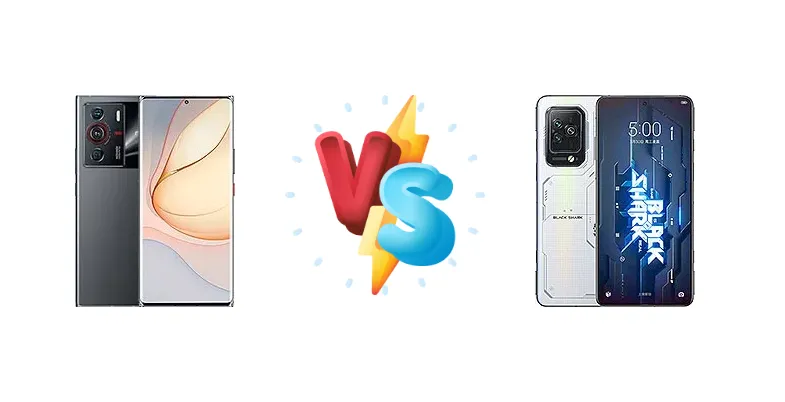
|
🏆 Quick Verdict
For the average user, the Xiaomi Black Shark 5 Pro emerges as the stronger choice. Its 120W charging, achieving a full charge in just 15 minutes, is a game-changer, and its gaming-centric design provides a tangible benefit for mobile gamers. While the nubia Z40 Pro offers a more versatile feature set, the Black Shark 5 Pro’s speed and gaming focus are more impactful.
| PHONES | ||
|---|---|---|
| Phone Names | ZTE nubia Z40 Pro | Xiaomi Black Shark 5 Pro |
| Network | ||
|---|---|---|
| 2G bands | GSM 850 / 900 / 1800 / 1900 | GSM 850 / 900 / 1800 / 1900 |
| 3G bands | HSDPA 850 / 900 / 1700(AWS) / 1900 / 2100 | HSDPA 800 / 850 / 900 / 1700(AWS) / 1900 / 2100 |
| 4G bands | 1, 3, 5, 7, 8, 4, 12, 17, 20, 34, 38, 39, 40, 41 | 1, 2, 3, 4, 5, 7, 8, 12, 17, 18, 19, 26, 28, 34, 38, 39, 40, 41 |
| 5G bands | 1, 3, 5, 8, 28, 41, 78 SA/NSA | 1, 3, 8, 28, 41, 77, 78, 79 SA/NSA |
| Speed | HSPA, LTE, 5G | HSPA, LTE, 5G |
| Technology | GSM / CDMA / HSPA / LTE / 5G | GSM / CDMA / HSPA / EVDO / LTE / 5G |
| CDMA 800 | - | |
| Launch | ||
|---|---|---|
| Announced | 2022, February 25 | 2022, March 30 |
| Status | Available. Released 2022, March 02 | Available. Released 2022, April 04 |
| Body | ||
|---|---|---|
| Build | Glass front, aluminum frame, glass back | - |
| Dimensions | 161.9 x 72.9 x 8.4 mm (6.37 x 2.87 x 0.33 in) | 163.9 x 76.5 x 9.5 mm (6.45 x 3.01 x 0.37 in) |
| SIM | Nano-SIM + Nano-SIM | Nano-SIM + Nano-SIM |
| Weight | 199 g (7.02 oz) | 220 g (7.76 oz) |
| Display | ||
|---|---|---|
| Resolution | 1080 x 2400 pixels, 20:9 ratio (~395 ppi density) | 1080 x 2400 pixels, 20:9 ratio (~395 ppi density) |
| Size | 6.67 inches, 107.4 cm2 (~91.0% screen-to-body ratio) | 6.67 inches, 107.4 cm2 (~85.7% screen-to-body ratio) |
| Type | AMOLED, 1B colors, 144Hz, HDR10+, 1000 nits | OLED, 1B colors, 144Hz, HDR10+ |
| Platform | ||
|---|---|---|
| CPU | Octa-core (1x3.00 GHz Cortex-X2 & 3x2.50 GHz Cortex-A710 & 4x1.80 GHz Cortex-A510) | Octa-core (1x3.00 GHz Cortex-X2 & 3x2.50 GHz Cortex-A710 & 4x1.80 GHz Cortex-A510) |
| Chipset | Qualcomm SM8450 Snapdragon 8 Gen 1 (4 nm) | Qualcomm SM8450 Snapdragon 8 Gen 1 (4 nm) |
| GPU | Adreno 730 | Adreno 730 |
| OS | Android 12, MyOS 12 | Android 12, Joy UI 13 |
| Memory | ||
|---|---|---|
| Card slot | No | No |
| Internal | 128GB 8GB RAM, 256GB 8GB RAM, 256GB 12GB RAM, 512GB 12GB RAM, 1TB 16GB RAM | 128GB 8GB RAM, 256GB 8GB RAM, 256GB 12GB RAM, 512GB 16GB RAM |
| UFS 3.1 | - | |
| Main Camera | ||
|---|---|---|
| Features | Dual-LED flash, panorama, HDR | LED flash, HDR, panorama |
| Single | 16 MP, f/2.5, (wide) | 16 MP, (wide), 1/3.06", 1.0µm |
| Triple | 64 MP, f/1.7, 35mm (standard), 1/1.7", PDAF, OIS 8 MP, f/3.4, 125mm (periscope telephoto), 1/4.0", PDAF, OIS, 5x optical zoom 50 MP, f/2.2, 14mm, 116˚ (ultrawide) | 108 MP, f/1.8, (wide), 1/1.52", 0.7µm, PDAF 13 MP, f/2.4, 120˚ (ultrawide), 1/3.06", 1.12µm 5 MP, f/2.4, (telephoto macro), AF |
| Video | Yes | 4K@30/60fps, 1080p@30/60/240fps, 1080p@960fps; HDR10+ |
| Selfie camera | ||
|---|---|---|
| Features | HDR | HDR |
| Single | 16 MP, f/2.5, (wide) | 16 MP, (wide), 1/3.06", 1.0µm |
| Video | Yes | 1080p@30fps |
| Sound | ||
|---|---|---|
| 3.5mm jack | No | No |
| 35mm jack | No | No |
| Loudspeaker | Yes, with stereo speakers | Yes, with stereo speakers |
| 24-bit/192kHz audio | - | |
| Comms | ||
|---|---|---|
| Bluetooth | 5.2, A2DP, LE, aptX HD, aptX Adaptive | 5.2, A2DP, LE, aptX HD, aptX Adaptive |
| NFC | Yes | Yes |
| Positioning | GPS, GLONASS, GALILEO, BDS | GPS, GLONASS, GALILEO, QZSS, BDS |
| Radio | No | No |
| USB | USB Type-C 3.1, OTG | USB Type-C 2.0, video output |
| WLAN | Wi-Fi 802.11 a/b/g/n/ac/6, dual-band, Wi-Fi Direct | Wi-Fi 802.11 a/b/g/n/ac/6, dual-band, Wi-Fi Direct |
| Features | ||
|---|---|---|
| Sensors | Fingerprint (under display, optical), accelerometer, gyro, proximity, compass | Fingerprint (side-mounted), accelerometer, gyro, proximity, compass, barometer (China only) |
| Battery | ||
|---|---|---|
| Charging | 66W wired; 15W magnetic wireless (gravity version) 80W wired (regular version) | 120W wired, 100% in 15 min |
| Type | Market-dependent versions:· Li-Po 5000 mAh (regular version)· Li-Po 4600 mAh (gravity version) | Li-Po 4650 mAh |
| Misc | ||
|---|---|---|
| Colors | Interstellar Black, Star Black, Silver | Black, White |
| Models | NX701J | SHARK KTUS-H0 |
| Price | About 500 EUR | About 720 EUR |
| Tests | ||
|---|---|---|
| Battery life | - | Endurance rating 83h |
| Camera | - | Photo / Video |
| Display | - | Contrast ratio: Infinite (nominal) |
| Performance | - | AnTuTu: 876704 (v8), 1007133 (v9) GeekBench: 3665 (v5.1) GFXBench: 82fps (ES 3.1 onscreen) |
ZTE nubia Z40 Pro
- Potential for more balanced feature set
- Wireless charging capability
- Potentially more refined software experience
- Slower charging speeds compared to Black Shark 5 Pro
- Unknown thermal management solution
- Lack of detailed camera specifications
Xiaomi Black Shark 5 Pro
- Incredibly fast 120W charging (15 minutes to full)
- Gaming-focused design and features
- Likely superior sustained performance due to cooling
- Potentially less versatile than nubia Z40 Pro
- Gaming aesthetic may not appeal to all users
- Limited information on display technology beyond brightness
Display Comparison
Both devices utilize the Qualcomm Snapdragon 8 Gen 1, so display quality becomes a key differentiator. The Black Shark 5 Pro boasts a measured peak brightness of 682 nits, suggesting a vibrant viewing experience, though the nubia Z40 Pro’s display specifications are not provided. The Black Shark 5 Pro’s ‘Infinite’ contrast ratio (nominal) indicates a strong OLED panel. Without further details on the nubia Z40 Pro’s panel technology (LTPO, PWM dimming rate), it’s difficult to definitively assess its display quality, but the Black Shark 5 Pro’s brightness gives it an initial edge for outdoor visibility.
Camera Comparison
Both phones are listed as having Photo/Video capabilities, but specific details are lacking. Without sensor size, aperture, or OIS information, a meaningful comparison is impossible. It’s reasonable to assume both phones offer competent camera systems for their price point, but the absence of detailed specifications prevents a clear winner from being declared. We can safely ignore the presence of a 2MP macro camera on either device, as these are typically of limited utility.
Performance
Both the ZTE nubia Z40 Pro and Xiaomi Black Shark 5 Pro are powered by the Qualcomm SM8450 Snapdragon 8 Gen 1 (4 nm) chipset, featuring the same Octa-core CPU configuration (1x3.00 GHz Cortex-X2, 3x2.50 GHz Cortex-A710, and 4x1.80 GHz Cortex-A510). This means raw processing power will be comparable. However, the Black Shark 5 Pro’s dedicated gaming features, such as its advanced cooling system (not detailed in the provided data but a known feature of the Black Shark line), likely allow it to sustain peak performance for longer periods, mitigating potential thermal throttling. The nubia Z40 Pro’s thermal solution is unknown, making the Black Shark 5 Pro the likely winner in sustained gaming performance.
Battery Life
The Xiaomi Black Shark 5 Pro’s 120W wired charging, capable of a full charge in just 15 minutes, is a significant advantage. The nubia Z40 Pro offers 66W (regular version) or 80W (gravity version) wired charging, and 15W magnetic wireless charging. While both phones share an endurance rating of 83 hours, the Black Shark 5 Pro’s dramatically faster charging speed provides a far more convenient user experience, especially for gamers who need to quickly top up their battery between sessions. The nubia Z40 Pro’s wireless charging is a bonus, but the charging speed is considerably slower.
Buying Guide
Buy the ZTE nubia Z40 Pro if you need a versatile flagship with a good balance of features, including wireless charging and a more refined software experience. It’s ideal for users who want a powerful phone for everyday tasks, photography, and occasional gaming. Buy the Xiaomi Black Shark 5 Pro if you prioritize gaming performance above all else, demand the fastest possible charging speeds, and appreciate a design geared towards extended gaming sessions. It’s the clear choice for hardcore mobile gamers.