
ZTE nubia Z40 Pro vs Xiaomi 12 Pro (Dimensity): Which Flagship Reigns Supreme?
| Phones Images | |||||
|---|---|---|---|---|---|
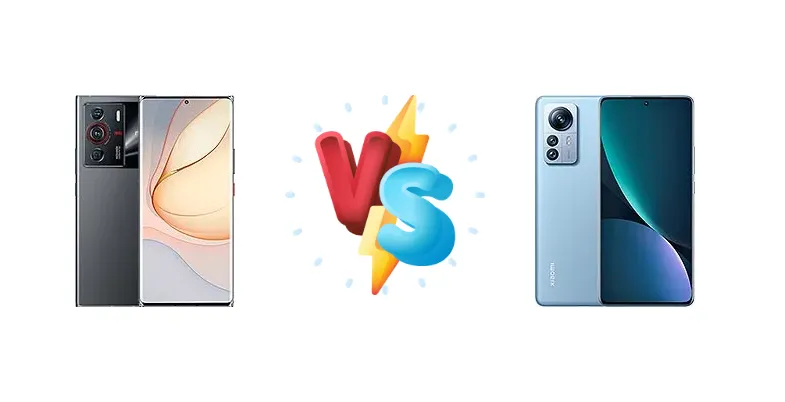
|
🏆 Quick Verdict
For the average user prioritizing consistent performance and efficient charging, the Xiaomi 12 Pro (Dimensity) emerges as the stronger choice. Its Dimensity 9000+ chipset offers superior sustained performance and thermal management compared to the Snapdragon 8 Gen 1 in the nubia Z40 Pro, despite the latter's slightly higher peak CPU clock speed.
| PHONES | ||
|---|---|---|
| Phone Names | ZTE nubia Z40 Pro | Xiaomi 12 Pro (Dimensity) |
| Network | ||
|---|---|---|
| 2G bands | GSM 850 / 900 / 1800 / 1900 | GSM 850 / 900 / 1800 / 1900 |
| 3G bands | HSDPA 850 / 900 / 1700(AWS) / 1900 / 2100 | HSDPA 800 / 850 / 900 / 1700(AWS) / 1900 / 2100 |
| 4G bands | 1, 3, 5, 7, 8, 4, 12, 17, 20, 34, 38, 39, 40, 41 | 1, 2, 3, 4, 5, 7, 8, 18, 19, 26, 34, 38, 39, 40, 41, 42 |
| 5G bands | 1, 3, 5, 8, 28, 41, 78 SA/NSA | 1, 3, 5, 8, 28, 38, 40, 41, 77, 78 SA/NSA |
| Speed | HSPA, LTE, 5G | HSPA, LTE, 5G |
| Technology | GSM / CDMA / HSPA / LTE / 5G | GSM / CDMA / HSPA / EVDO / LTE / 5G |
| CDMA 800 | CDMA2000 1xEV-DO | |
| Launch | ||
|---|---|---|
| Announced | 2022, February 25 | 2022, July 04 |
| Status | Available. Released 2022, March 02 | Available. Released 2022, July 13 |
| Body | ||
|---|---|---|
| Build | Glass front, aluminum frame, glass back | - |
| Dimensions | 161.9 x 72.9 x 8.4 mm (6.37 x 2.87 x 0.33 in) | 163.6 x 74.6 x 8.2 mm (6.44 x 2.94 x 0.32 in) |
| SIM | Nano-SIM + Nano-SIM | Nano-SIM + Nano-SIM |
| Weight | 199 g (7.02 oz) | 201 g (7.09 oz) |
| Display | ||
|---|---|---|
| Protection | - | Corning Gorilla Glass Victus |
| Resolution | 1080 x 2400 pixels, 20:9 ratio (~395 ppi density) | 1440 x 3200 pixels, 20:9 ratio (~521 ppi density) |
| Size | 6.67 inches, 107.4 cm2 (~91.0% screen-to-body ratio) | 6.73 inches, 109.4 cm2 (~89.6% screen-to-body ratio) |
| Type | AMOLED, 1B colors, 144Hz, HDR10+, 1000 nits | LTPO2 AMOLED, 1B colors, 120Hz, Dolby Vision, HDR10+, 1000 nits (HBM), 1500 nits (peak) |
| Platform | ||
|---|---|---|
| CPU | Octa-core (1x3.00 GHz Cortex-X2 & 3x2.50 GHz Cortex-A710 & 4x1.80 GHz Cortex-A510) | Octa-core (1x3.20 GHz Cortex-X2 & 3x2.85 GHz Cortex-A710 & 4x1.80 GHz Cortex-A510) |
| Chipset | Qualcomm SM8450 Snapdragon 8 Gen 1 (4 nm) | Mediatek Dimensity 9000+ (4 nm) |
| GPU | Adreno 730 | Mali-G710 MC10 |
| OS | Android 12, MyOS 12 | Android 12, MIUI 13 |
| Memory | ||
|---|---|---|
| Card slot | No | No |
| Internal | 128GB 8GB RAM, 256GB 8GB RAM, 256GB 12GB RAM, 512GB 12GB RAM, 1TB 16GB RAM | 128GB 8GB RAM, 256GB 12GB RAM |
| UFS 3.1 | UFS 3.1 | |
| Main Camera | ||
|---|---|---|
| Features | Dual-LED flash, panorama, HDR | Color spectrum sensor, Dual-LED dual-tone flash, HDR, panorama |
| Single | 16 MP, f/2.5, (wide) | 32 MP, f/2.5, 26mm (wide), 0.7µm |
| Triple | 64 MP, f/1.7, 35mm (standard), 1/1.7", PDAF, OIS 8 MP, f/3.4, 125mm (periscope telephoto), 1/4.0", PDAF, OIS, 5x optical zoom 50 MP, f/2.2, 14mm, 116˚ (ultrawide) | 50 MP, f/1.9, 24mm (wide), 1/1.28", 1.22µm, dual pixel PDAF, OIS 13 MP, f/2.4, 15mm, 123˚ (ultrawide), 1/3.06", 1.12µm 5 MP, f/2.4, 50mm (telephoto macro), AF |
| Video | Yes | 4K@30/60fps, 1080p@30/60/120fps, gyro-EIS |
| Selfie camera | ||
|---|---|---|
| Features | HDR | HDR, panorama |
| Single | 16 MP, f/2.5, (wide) | 32 MP, f/2.5, 26mm (wide), 0.7µm |
| Video | Yes | 1080p@30/60fps, 720p@120fps |
| Sound | ||
|---|---|---|
| 3.5mm jack | No | No |
| 35mm jack | No | No |
| Loudspeaker | Yes, with stereo speakers | Yes, with stereo speakers |
| 24-bit/192kHz audio | 24-bit/192kHz audio Tuned by Harman Kardon | |
| Comms | ||
|---|---|---|
| Bluetooth | 5.2, A2DP, LE, aptX HD, aptX Adaptive | 5.3, A2DP, LE |
| Infrared port | - | Yes |
| NFC | Yes | Yes |
| Positioning | GPS, GLONASS, GALILEO, BDS | GPS (L1+L5), GLONASS (L1), BDS (B1I+B1c+B2a), GALILEO (E1+E5a), QZSS (L1+L5), NavIC (L5) |
| Radio | No | No |
| USB | USB Type-C 3.1, OTG | USB Type-C 2.0, OTG |
| WLAN | Wi-Fi 802.11 a/b/g/n/ac/6, dual-band, Wi-Fi Direct | Wi-Fi 802.11 a/b/g/n/ac/6, dual-band, Wi-Fi Direct |
| Features | ||
|---|---|---|
| Sensors | Fingerprint (under display, optical), accelerometer, gyro, proximity, compass | Fingerprint (under display, optical), accelerometer, gyro, proximity, compass |
| Battery | ||
|---|---|---|
| Charging | 66W wired; 15W magnetic wireless (gravity version) 80W wired (regular version) | 67W wired, PD3.0, QC4 |
| Type | Market-dependent versions:· Li-Po 5000 mAh (regular version)· Li-Po 4600 mAh (gravity version) | Li-Po 5160 mAh |
| Misc | ||
|---|---|---|
| Colors | Interstellar Black, Star Black, Silver | Gray, Blue |
| Models | NX701J | 2207122MC |
| Price | About 500 EUR | About 570 EUR |
ZTE nubia Z40 Pro
- Option for magnetic wireless charging
- Potentially more natural color science (based on brand history)
- Higher peak wired charging speed (80W version)
- Snapdragon 8 Gen 1 prone to thermal throttling
- Potentially less efficient power consumption
- Wireless charging speed is relatively slow (15W)
Xiaomi 12 Pro (Dimensity)
- Dimensity 9000+ offers superior sustained performance
- More efficient power management
- Faster and more versatile wired charging (67W, PD3.0, QC4)
- No magnetic wireless charging
- Potentially more saturated color science (based on brand history)
- May lack the flexibility of nubia's charging options
Display Comparison
While both devices feature 4nm chipsets, display details are missing. Assuming both utilize high-refresh-rate AMOLED panels (typical for this class), the key differentiator will be peak brightness and color calibration. The Xiaomi 12 Pro, given Xiaomi’s history, likely prioritizes vibrant, punchy colors, while nubia often aims for more accurate, natural tones. The absence of LTPO information means we can't assess adaptive refresh rate efficiency, a crucial factor for battery life.
Camera Comparison
Camera specifications are absent, making a direct comparison difficult. However, both brands typically employ high-resolution main sensors. The nubia Z40 Pro’s image processing likely leans towards a more natural look, while Xiaomi often favors brighter, more saturated images. Without knowing sensor sizes and aperture values, it’s impossible to determine which device excels in low-light photography. The presence or absence of advanced features like 8K video recording or advanced stabilization would also be key differentiators.
Performance
The core battle lies between the Qualcomm Snapdragon 8 Gen 1 in the nubia Z40 Pro and the MediaTek Dimensity 9000+ in the Xiaomi 12 Pro. The Dimensity 9000+ boasts a slightly higher peak CPU clock speed (3.20 GHz vs 3.00 GHz) and, crucially, a more efficient architecture. This translates to better sustained performance under load, as the Dimensity 9000+ is less prone to thermal throttling. Both utilize the same Cortex-A510 efficiency cores, but the Dimensity’s Cortex-A710 cores run at a higher clock speed (2.85 GHz vs 2.50 GHz). Both phones feature LPDDR5 RAM, but the real-world impact will be minimized by the chipset's inherent performance differences.
Battery Life
The nubia Z40 Pro offers a choice of 66W or 80W wired charging, alongside 15W magnetic wireless charging. The Xiaomi 12 Pro provides 67W wired charging with PD3.0 and QC4 support. While the nubia Z40 Pro’s 80W option is slightly faster, the Xiaomi 12 Pro’s broader compatibility with charging standards is a benefit. The actual 0-100% charge time will depend on battery capacity (unspecified), but the Xiaomi 12 Pro’s more efficient chipset could offset a potentially smaller battery size.
Buying Guide
Buy the ZTE nubia Z40 Pro if you need the flexibility of both wired and magnetic wireless charging, and are comfortable potentially managing thermal throttling during extended, demanding tasks. Buy the Xiaomi 12 Pro (Dimensity) if you prefer a more consistently smooth experience, especially during gaming or video editing, and value a refined software experience with faster charging speeds.