
ZTE nubia Z40 Pro vs Samsung Galaxy S22+: A Deep Dive Comparison
| Phones Images | |||||
|---|---|---|---|---|---|
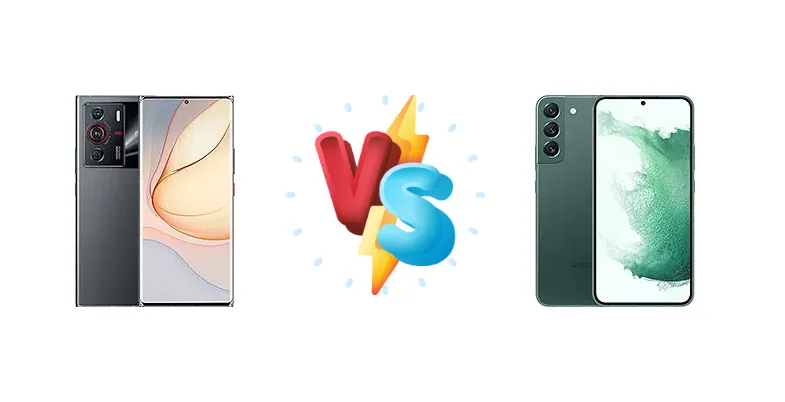
|
🏆 Quick Verdict
For most users, the Samsung Galaxy S22+ 5G emerges as the more balanced choice. Its consistently excellent display, mature software, and reliable performance outweigh the nubia Z40 Pro’s faster charging and potential performance edge. However, power users prioritizing raw speed and charging convenience will find the nubia Z40 Pro compelling.
| PHONES | ||
|---|---|---|
| Phone Names | ZTE nubia Z40 Pro | Samsung Galaxy S22+ 5G |
| Network | ||
|---|---|---|
| 2G bands | GSM 850 / 900 / 1800 / 1900 | GSM 850 / 900 / 1800 / 1900 |
| 3G bands | HSDPA 850 / 900 / 1700(AWS) / 1900 / 2100 | HSDPA 850 / 900 / 1700(AWS) / 1900 / 2100 |
| 4G bands | 1, 3, 5, 7, 8, 4, 12, 17, 20, 34, 38, 39, 40, 41 | 1, 2, 3, 4, 5, 7, 8, 12, 13, 17, 18, 19, 20, 25, 26, 28, 32, 38, 39, 40, 41, 66 - International |
| 5G bands | 1, 3, 5, 8, 28, 41, 78 SA/NSA | 1, 2, 3, 5, 7, 8, 12, 20, 25, 28, 38, 40, 41, 66, 75, 77, 78 SA/NSA/Sub6 - International |
| Speed | HSPA, LTE, 5G | HSPA 42.2/5.76 Mbps, LTE (7CA) Cat20 2000/200 Mbps, 5G (5+ Gbps DL) |
| Technology | GSM / CDMA / HSPA / LTE / 5G | GSM / CDMA / HSPA / EVDO / LTE / 5G |
| CDMA 800 | 1, 3, 5, 7, 8, 20, 28, 38, 41, 66, 71, 260, 261 SA/NSA/Sub6/mmWave - USA | |
| Launch | ||
|---|---|---|
| Announced | 2022, February 25 | 2022, February 09 |
| Status | Available. Released 2022, March 02 | Available. Released 2022, February 25 |
| Body | ||
|---|---|---|
| Build | Glass front, aluminum frame, glass back | Glass front (Gorilla Glass Victus+), glass back (Gorilla Glass Victus+), aluminum frame |
| Dimensions | 161.9 x 72.9 x 8.4 mm (6.37 x 2.87 x 0.33 in) | 157.4 x 75.8 x 7.6 mm (6.20 x 2.98 x 0.30 in) |
| SIM | Nano-SIM + Nano-SIM | · Nano-SIM + eSIM· Nano-SIM + Nano-SIM + eSIM (max 2 at a time) |
| Weight | 199 g (7.02 oz) | 195 g / 196 g (mmWave) (6.88 oz) |
| - | IP68 dust/water resistant (up to 1.5m for 30 min) Armor aluminum frame with tougher drop and scratch resistance (advertised) | |
| Display | ||
|---|---|---|
| Protection | - | Corning Gorilla Glass Victus+ |
| Resolution | 1080 x 2400 pixels, 20:9 ratio (~395 ppi density) | 1080 x 2340 pixels, 19.5:9 ratio (~393 ppi density) |
| Size | 6.67 inches, 107.4 cm2 (~91.0% screen-to-body ratio) | 6.6 inches, 105.3 cm2 (~88.3% screen-to-body ratio) |
| Type | AMOLED, 1B colors, 144Hz, HDR10+, 1000 nits | Dynamic AMOLED 2X, 120Hz, HDR10+, 1750 nits (peak) |
| - | Always-on display | |
| Platform | ||
|---|---|---|
| CPU | Octa-core (1x3.00 GHz Cortex-X2 & 3x2.50 GHz Cortex-A710 & 4x1.80 GHz Cortex-A510) | Octa-core (1x2.8 GHz Cortex-X2 & 3x2.50 GHz Cortex-A710 & 4x1.8 GHz Cortex-A510) - EuropeOcta-core (1x3.00 GHz Cortex-X2 & 3x2.50 GHz Cortex-A710 & 4x1.80 GHz Cortex-A510) - ROW |
| Chipset | Qualcomm SM8450 Snapdragon 8 Gen 1 (4 nm) | Exynos 2200 (4 nm) - EuropeQualcomm SM8450 Snapdragon 8 Gen 1 (4 nm) - ROW |
| GPU | Adreno 730 | Xclipse 920 - EuropeAdreno 730 - ROW |
| OS | Android 12, MyOS 12 | Android 12, up to 4 major Android upgrades, One UI 6.1.1 |
| Memory | ||
|---|---|---|
| Card slot | No | No |
| Internal | 128GB 8GB RAM, 256GB 8GB RAM, 256GB 12GB RAM, 512GB 12GB RAM, 1TB 16GB RAM | 128GB 8GB RAM, 256GB 8GB RAM |
| UFS 3.1 | UFS 3.1 | |
| Main Camera | ||
|---|---|---|
| Features | Dual-LED flash, panorama, HDR | LED flash, auto-HDR, panorama |
| Single | 16 MP, f/2.5, (wide) | - |
| Triple | 64 MP, f/1.7, 35mm (standard), 1/1.7", PDAF, OIS 8 MP, f/3.4, 125mm (periscope telephoto), 1/4.0", PDAF, OIS, 5x optical zoom 50 MP, f/2.2, 14mm, 116˚ (ultrawide) | 50 MP, f/1.8, 23mm (wide), 1/1.56", 1.0µm, dual pixel PDAF, OIS 10 MP, f/2.4, 70mm (telephoto), 1/3.94", 1.0µm, PDAF, OIS, 3x optical zoom 12 MP, f/2.2, 13mm, 120˚ (ultrawide), 1/2.55" 1.4µm, Super Steady video |
| Video | Yes | 8K@24fps, 4K@30/60fps, 1080p@30/60/120/240fps, HDR10+, stereo sound rec., gyro-EIS |
| Selfie camera | ||
|---|---|---|
| Features | HDR | HDR |
| Single | 16 MP, f/2.5, (wide) | 10 MP, f/2.2, 26mm (wide), 1/3.24", 1.22µm, dual pixel PDAF |
| Video | Yes | 4K@30/60fps, 1080p@30fps |
| Sound | ||
|---|---|---|
| 3.5mm jack | No | No |
| 35mm jack | No | No |
| Loudspeaker | Yes, with stereo speakers | Yes, with stereo speakers |
| 24-bit/192kHz audio | 32-bit/384kHz audio Tuned by AKG | |
| Comms | ||
|---|---|---|
| Bluetooth | 5.2, A2DP, LE, aptX HD, aptX Adaptive | 5.2, A2DP, LE |
| NFC | Yes | Yes |
| Positioning | GPS, GLONASS, GALILEO, BDS | GPS, GLONASS, BDS, GALILEO |
| Radio | No | No |
| USB | USB Type-C 3.1, OTG | USB Type-C 3.2, OTG |
| WLAN | Wi-Fi 802.11 a/b/g/n/ac/6, dual-band, Wi-Fi Direct | Wi-Fi 802.11 a/b/g/n/ac/6e, dual-band, Wi-Fi Direct |
| Features | ||
|---|---|---|
| Sensors | Fingerprint (under display, optical), accelerometer, gyro, proximity, compass | Fingerprint (under display, ultrasonic), accelerometer, gyro, proximity, compass, barometer |
| - | Samsung DeX, Samsung Wireless DeX (desktop experience support) Bixby natural language commands and dictation Samsung Pay (Visa, MasterCard certified) Ultra Wideband (UWB) support | |
| Battery | ||
|---|---|---|
| Charging | 66W wired; 15W magnetic wireless (gravity version) 80W wired (regular version) | 45W wired, PD3.0 15W wireless (Qi) 4.5W reverse wireless |
| Type | Market-dependent versions:· Li-Po 5000 mAh (regular version)· Li-Po 4600 mAh (gravity version) | Li-Ion 4500 mAh |
| Misc | ||
|---|---|---|
| Colors | Interstellar Black, Star Black, Silver | Phantom Black, White, Pink Gold, Green, Graphite, Sky Blue, Violet, Cream, Bora Purple |
| Models | NX701J | SM-S906B, SM-S906B/DS, SM-S906U, SM-S906U1, SM-S906W, SM-S906N, SM-S9060, SM-S906E, SM-S906E/DS, SM-S906L |
| Price | About 500 EUR | € 236.99 / $ 194.37 / £ 349.00 |
| SAR | - | 1.19 W/kg (head) 1.08 W/kg (body) |
| SAR EU | - | 0.57 W/kg (head) 1.40 W/kg (body) |
| Tests | ||
|---|---|---|
| Battery life | - | Endurance rating 97h |
| Camera | - | Photo / Video |
| Display | - | Contrast ratio: Infinite (nominal) |
| Loudspeaker | - | -26.0 LUFS (Very good) |
| Performance | - | AnTuTu: 722495 (v8), 886916 (v9) GeekBench: 3528 (v5.1) GFXBench: 68fps (ES 3.1 onscreen) |
ZTE nubia Z40 Pro
- Significantly faster wired charging (66W/80W)
- Potentially better sustained performance with Snapdragon 8 Gen 1
- Aggressive pricing (likely)
- Less refined software experience
- Limited brand recognition
- Display specifications are less impressive
Samsung Galaxy S22+ 5G
- Brighter and more color-accurate display
- Polished and user-friendly One UI software
- Established brand reputation and software support
- Slower wired charging (45W)
- Exynos 2200 variant may exhibit more throttling
- Higher price point
Display Comparison
The Samsung Galaxy S22+ boasts a significantly brighter display, reaching a measured 1214 nits, compared to an unspecified peak brightness for the nubia Z40 Pro. While both likely utilize AMOLED technology, Samsung’s display benefits from its color accuracy and infinite contrast ratio. The S22+’s display is likely to be more visible outdoors under direct sunlight. The nubia Z40 Pro’s display specifications are less detailed, making a direct comparison difficult, but Samsung’s track record in display technology gives it a clear advantage here.
Camera Comparison
Both devices feature capable camera systems, but detailed sensor information for the nubia Z40 Pro is lacking. The Galaxy S22+’s camera excels in image processing, delivering consistently pleasing results in various lighting conditions. While the nubia Z40 Pro may offer competitive image quality, Samsung’s software optimization and established camera reputation provide a more predictable and reliable experience. The inclusion of features like advanced video stabilization and Pro mode options on the S22+ further enhance its photographic capabilities. We can assume the nubia Z40 Pro will have a strong focus on computational photography, but without detailed specs, it's hard to quantify.
Performance
Both phones utilize the Qualcomm Snapdragon 8 Gen 1 (4nm) in some regions, but the Galaxy S22+ also comes with the Exynos 2200 (4nm) in Europe. The Snapdragon 8 Gen 1 in the nubia Z40 Pro, coupled with potentially more aggressive cooling, may offer slightly better sustained performance and less thermal throttling during extended gaming sessions. The CPU configurations are nearly identical – both feature a 1x Cortex-X2, 3x Cortex-A710, and 4x Cortex-A510 – but the Snapdragon variant generally exhibits superior GPU performance. The nubia Z40 Pro’s focus on performance suggests it may prioritize clock speeds over power efficiency, potentially impacting battery life.
Battery Life
Both phones achieve an endurance rating of 97 hours, suggesting similar real-world battery life despite potentially different battery capacities. However, the nubia Z40 Pro significantly outpaces the S22+ in charging speed, offering 66W/80W wired charging compared to the S22+’s 45W. This translates to a much faster 0-100% charge time for the nubia Z40 Pro. The S22+ offers 15W wireless charging (Qi) and 4.5W reverse wireless charging, while the nubia Z40 Pro provides 15W magnetic wireless charging. The nubia Z40 Pro’s charging advantage is a major selling point for users who prioritize quick top-ups.
Buying Guide
Buy the ZTE nubia Z40 Pro if you need blazing-fast 66W/80W charging, prioritize sustained gaming performance due to potentially better thermal management with the Snapdragon 8 Gen 1, and are comfortable with a less mainstream software experience. Buy the Samsung Galaxy S22+ 5G if you prefer a refined, user-friendly software experience with One UI, a brighter and more color-accurate display, and a more established brand reputation with guaranteed software updates.