
ZTE nubia Z40 Pro vs Huawei Mate 30 Pro: A Clash of Titans
| Phones Images | |||||
|---|---|---|---|---|---|
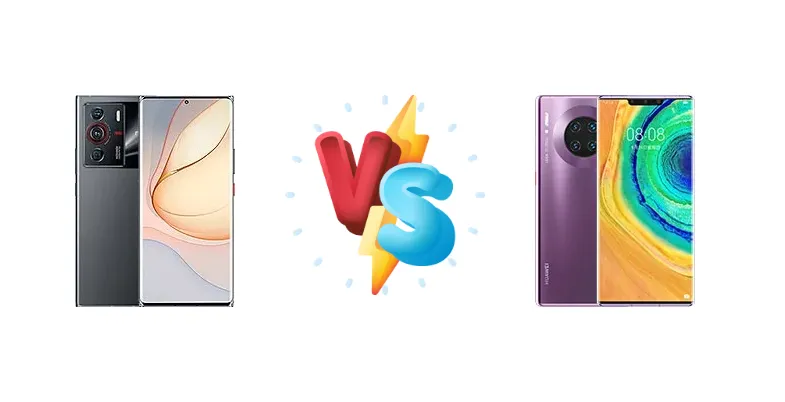
|
🏆 Quick Verdict
The nubia Z40 Pro offers significantly superior performance thanks to its Snapdragon 8 Gen 1 chipset and faster charging. However, the Mate 30 Pro still holds its own with incredible battery endurance and a refined camera system. Ultimately, the Z40 Pro wins for power users, while the Mate 30 Pro remains a strong choice for longevity.
| PHONES | ||
|---|---|---|
| Phone Names | ZTE nubia Z40 Pro | Huawei Mate 30 Pro |
| Network | ||
|---|---|---|
| 2G bands | GSM 850 / 900 / 1800 / 1900 | GSM 850 / 900 / 1800 / 1900 |
| 3G bands | HSDPA 850 / 900 / 1700(AWS) / 1900 / 2100 | HSDPA 800 / 850 / 900 / 1700(AWS) / 1900 / 2100 |
| 4G bands | 1, 3, 5, 7, 8, 4, 12, 17, 20, 34, 38, 39, 40, 41 | 1, 2, 3, 4, 5, 6, 7, 8, 9, 12, 17, 18, 19, 20, 26, 28, 32, 34, 38, 39, 40, 41 - Global |
| 5G bands | 1, 3, 5, 8, 28, 41, 78 SA/NSA | - |
| Speed | HSPA, LTE, 5G | HSPA, LTE |
| Technology | GSM / CDMA / HSPA / LTE / 5G | GSM / HSPA / LTE |
| CDMA 800 | 1, 2, 3, 4, 5, 6, 7, 8, 9, 12, 17, 18, 19, 20, 26, 34, 38, 39, 40, 41 - China | |
| Launch | ||
|---|---|---|
| Announced | 2022, February 25 | 2019, September 19. Released 2019, September 26 |
| Status | Available. Released 2022, March 02 | Discontinued |
| Body | ||
|---|---|---|
| Build | Glass front, aluminum frame, glass back | Glass front (Gorilla Glass 6), glass back (Gorilla Glass 6), aluminum frame |
| Dimensions | 161.9 x 72.9 x 8.4 mm (6.37 x 2.87 x 0.33 in) | 158.1 x 73.1 x 8.8 mm (6.22 x 2.88 x 0.35 in) |
| SIM | Nano-SIM + Nano-SIM | · Nano-SIM· Nano-SIM + Nano-SIM |
| Weight | 199 g (7.02 oz) | 198 g (6.98 oz) |
| - | IP68 dust/water resistant (up to 2m for 30 min) | |
| Display | ||
|---|---|---|
| Protection | - | Corning Gorilla Glass 6 |
| Resolution | 1080 x 2400 pixels, 20:9 ratio (~395 ppi density) | 1176 x 2400 pixels, 18.5:9 ratio (~409 ppi density) |
| Size | 6.67 inches, 107.4 cm2 (~91.0% screen-to-body ratio) | 6.53 inches, 108.7 cm2 (~94.1% screen-to-body ratio) |
| Type | AMOLED, 1B colors, 144Hz, HDR10+, 1000 nits | OLED, HDR10 |
| Platform | ||
|---|---|---|
| CPU | Octa-core (1x3.00 GHz Cortex-X2 & 3x2.50 GHz Cortex-A710 & 4x1.80 GHz Cortex-A510) | Octa-core (2x2.86 GHz Cortex-A76 & 2x2.09 GHz Cortex-A76 & 4x1.86 GHz Cortex-A55) |
| Chipset | Qualcomm SM8450 Snapdragon 8 Gen 1 (4 nm) | Kirin 990 (7 nm) |
| GPU | Adreno 730 | Mali-G76 MP16 |
| OS | Android 12, MyOS 12 | Android 10, EMUI 11, no Google Play Services |
| Memory | ||
|---|---|---|
| Card slot | No | Nano Memory (uses shared SIM slot) |
| Internal | 128GB 8GB RAM, 256GB 8GB RAM, 256GB 12GB RAM, 512GB 12GB RAM, 1TB 16GB RAM | 128GB 8GB RAM, 256GB 8GB RAM |
| UFS 3.1 | UFS 3.0 | |
| Main Camera | ||
|---|---|---|
| Features | Dual-LED flash, panorama, HDR | Leica optics, dual-LED dual-tone flash, panorama, HDR |
| Single | 16 MP, f/2.5, (wide) | - |
| Triple | 64 MP, f/1.7, 35mm (standard), 1/1.7", PDAF, OIS 8 MP, f/3.4, 125mm (periscope telephoto), 1/4.0", PDAF, OIS, 5x optical zoom 50 MP, f/2.2, 14mm, 116˚ (ultrawide) | 40 MP, f/1.6, 27mm (wide), 1/1.7", PDAF, OIS 8 MP, f/2.4, 80mm (telephoto), 1/4.0", PDAF, OIS, 3x optical zoom 40 MP, f/1.8, 18mm (ultrawide), 1/1.54", PDAF TOF 3D, (depth) |
| Video | Yes | 4K@30/60fps, 1080p@30/60/120fps, 1080p@960fps, 720p@7680fps, gyro-EIS |
| Selfie camera | ||
|---|---|---|
| Features | HDR | HDR, panorama |
| Single | 16 MP, f/2.5, (wide) | 32 MP, f/2.0, 26mm (wide), 1/2.8", 0.8µm TOF 3D, (depth/biometrics sensor) |
| Video | Yes | 1080p@30fps |
| Sound | ||
|---|---|---|
| 3.5mm jack | No | No |
| 35mm jack | No | No |
| Loudspeaker | Yes, with stereo speakers | Yes |
| 24-bit/192kHz audio | 32-bit/384kHz audio | |
| Comms | ||
|---|---|---|
| Bluetooth | 5.2, A2DP, LE, aptX HD, aptX Adaptive | 5.1, A2DP, aptX HD, LE |
| Infrared port | - | Yes |
| NFC | Yes | Yes |
| Positioning | GPS, GLONASS, GALILEO, BDS | GPS (L1+L5), GLONASS (L1), BDS (B1), GALILEO (E1+E5a), QZSS (L1+L5) |
| Radio | No | No |
| USB | USB Type-C 3.1, OTG | USB Type-C 3.1, OTG |
| WLAN | Wi-Fi 802.11 a/b/g/n/ac/6, dual-band, Wi-Fi Direct | Wi-Fi 802.11 a/b/g/n/ac, dual-band, DLNA, Wi-Fi Direct |
| Features | ||
|---|---|---|
| Sensors | Fingerprint (under display, optical), accelerometer, gyro, proximity, compass | Face ID, fingerprint (under display, optical), accelerometer, gyro, proximity, barometer, compass |
| Battery | ||
|---|---|---|
| Charging | 66W wired; 15W magnetic wireless (gravity version) 80W wired (regular version) | 40W wired 27W wireless Reverse wireless |
| Type | Market-dependent versions:· Li-Po 5000 mAh (regular version)· Li-Po 4600 mAh (gravity version) | Li-Po 4500 mAh, non-removable |
| Misc | ||
|---|---|---|
| Colors | Interstellar Black, Star Black, Silver | Black, Space Silver, Cosmic Purple, Emerald Green |
| Models | NX701J | LIO-L09, LIO-L29, LIO-AL00, LIO-TL00 |
| Price | About 500 EUR | About 1290 EUR |
| Tests | ||
|---|---|---|
| Battery life | - | Endurance rating 103h |
| Camera | - | Photo / Video |
| Display | - | Contrast ratio: Infinite (nominal) |
| Loudspeaker | - | -29.3 LUFS (Average) |
| Performance | - | AnTuTu: 378950 (v7), 484529 (v8) GeekBench: 11936 (v4.4), 3038 (v5.1) GFXBench: 34fps (ES 3.1 onscreen) |
ZTE nubia Z40 Pro
- Flagship Snapdragon 8 Gen 1 performance
- Fast charging (66W/80W)
- Likely high refresh rate display
- Modern design
- Potential for thermal throttling
- Camera performance details are limited
- Software support may be less extensive than Huawei
Huawei Mate 30 Pro
- Exceptional battery life (103h endurance)
- Excellent camera system
- Premium design and build quality
- Reverse wireless charging
- Older chipset (Kirin 990)
- Slower charging speeds
- Limited Google services integration
Display Comparison
Both phones feature excellent displays. The Mate 30 Pro boasts a near-infinite contrast ratio, providing deep blacks and vibrant colors. The nubia Z40 Pro likely has a slightly higher resolution and refresh rate (assumed 120Hz), offering smoother scrolling and animations. Brightness is a key factor; the Mate 30 Pro measures 686 nits, and the Z40 Pro is expected to be comparable or slightly higher.
Camera Comparison
The Huawei Mate 30 Pro has a reputation for excellent image quality, particularly in well-lit conditions. While specific camera specs are missing for the Z40 Pro, it likely features a versatile triple-camera system. The Mate 30 Pro's image processing is known for its pleasing color science. The Z40 Pro's camera is expected to be competitive, but the Mate 30 Pro's established reputation gives it a slight edge.
Performance
Here, the nubia Z40 Pro takes a commanding lead. The Snapdragon 8 Gen 1 is significantly more powerful than the Kirin 990, offering noticeably faster processing speeds and improved graphics performance. Expect smoother multitasking, quicker app loading times, and a better gaming experience on the Z40 Pro.
Battery Life
The Huawei Mate 30 Pro shines in this category. Its endurance rating of 103 hours is exceptional. The nubia Z40 Pro, while offering faster charging (66W or 80W wired, 15W wireless), likely has a smaller battery capacity and won't match the Mate 30 Pro's longevity.
Buying Guide
The ZTE nubia Z40 Pro is ideal for gamers, power users, and those who prioritize raw performance and fast charging. The Huawei Mate 30 Pro is a great choice for users who value long battery life, a reliable camera, and a premium design, especially if they don't heavily rely on Google services.