
ZTE nubia Z30 Pro vs. vivo X80 Pro: A Deep Dive into Performance, Charging, and Camera Capabilities
| Phones Images | |||||
|---|---|---|---|---|---|
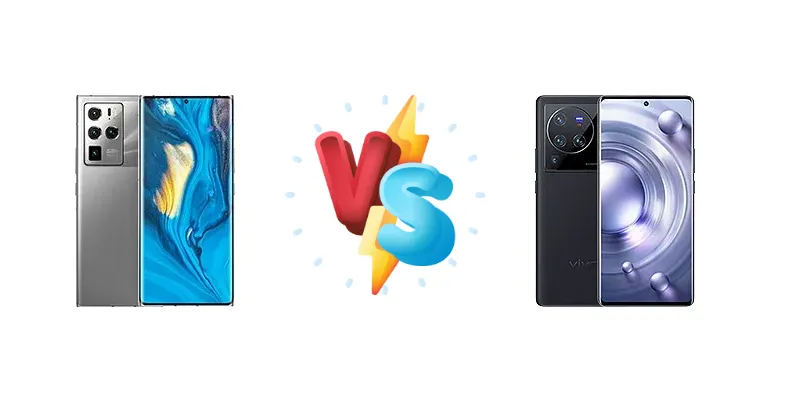
|
🏆 Quick Verdict
For the average user prioritizing all-around performance and a more polished software experience, the vivo X80 Pro is the stronger choice. Its Snapdragon 8 Gen 1 or Dimensity 9000 chipset offers a significant performance leap over the nubia Z30 Pro’s Snapdragon 888, and its more versatile charging options (including wireless) add convenience.
| PHONES | ||
|---|---|---|
| Phone Names | ZTE nubia Z30 Pro | vivo X80 Pro |
| Network | ||
|---|---|---|
| 2G bands | GSM 850 / 900 / 1800 / 1900 | GSM 850 / 900 / 1800 / 1900 |
| 3G bands | HSDPA 850 / 900 / 1700(AWS) / 1900 / 2100 | HSDPA 800 / 850 / 900 / 1700(AWS) / 1900 / 2100 |
| 4G bands | 1, 2, 3, 4, 5, 7, 8, 12, 17, 18, 19, 20, 26, 28, 34, 38, 39, 40, 41 | 1, 2, 3, 4, 5, 7, 8, 12, 13, 17, 18, 19, 20, 26, 28, 32, 38, 39, 40, 41, 42, 66 - International |
| 5G bands | 1, 3, 28, 41, 77, 78, 79 SA/NSA | 1, 2, 3, 5, 7, 8, 20, 28, 38, 40, 41, 66, 77, 78 SA/NSA - International |
| Speed | HSPA, LTE, 5G | HSPA, LTE, 5G |
| Technology | GSM / CDMA / HSPA / LTE / 5G | GSM / CDMA / HSPA / EVDO / LTE / 5G |
| CDMA 800 | 1, 3, 5, 7, 8, 12, 20, 28, 66, 38, 40, 41, 77, 78, 79 SA/NSA - China | |
| Launch | ||
|---|---|---|
| Announced | 2021, May 20 | 2022, April 25 |
| Status | Available. Released 2021, May 25 | Available. Released 2022, April 29 |
| Body | ||
|---|---|---|
| Build | - | Glass front (Schott Xensation Up), glass back or ceramic back or eco leather back, aluminum frame |
| Dimensions | 161.8 x 73 x 8.5 mm (6.37 x 2.87 x 0.33 in) | 164.6 x 75.3 x 9.1 mm (6.48 x 2.96 x 0.36 in) |
| SIM | Nano-SIM + Nano-SIM | Nano-SIM + Nano-SIM |
| Weight | 198 g (6.98 oz) | 215 g / 219 g (7.58 oz) |
| - | IP68 dust/water resistant (up to 1.5m for 30 min) | |
| Display | ||
|---|---|---|
| Protection | - | Schott Xensation Up |
| Resolution | 1080 x 2400 pixels, 20:9 ratio (~395 ppi density) | 1440 x 3200 pixels, 20:9 ratio (~517 ppi density) |
| Size | 6.67 inches, 107.4 cm2 (~90.9% screen-to-body ratio) | 6.78 inches, 111.4 cm2 (~89.9% screen-to-body ratio) |
| Type | AMOLED, 1B colors, 144Hz, HDR10+ | LTPO3 AMOLED, 1B colors, 120Hz, HDR10+, 1500 nits (peak) |
| Platform | ||
|---|---|---|
| CPU | Octa-core (1x2.84 GHz Cortex-X1 & 3x2.42 GHz Cortex-A78 & 4x1.80 GHz Cortex-A55) | Octa-core (1x3.00 GHz Cortex-X2 & 3x2.50 GHz Cortex-A710 & 4x1.80 GHz Cortex-A510)Octa-core (1x3.05 GHz Cortex-X2 & 3x2.85 GHz Cortex-A710 & 4x1.80 GHz Cortex-A510) |
| Chipset | Qualcomm SM8350 Snapdragon 888 5G (5 nm) | Qualcomm SM8450 Snapdragon 8 Gen 1 (4 nm)Mediatek Dimensity 9000 (4 nm) |
| GPU | Adreno 660 | Adreno 730Mali-G710 MC10 |
| OS | Android 11, nubia UI 9 | Android 12, upgradable to Android 14, Funtouch 14 (Global), OriginOS Ocean (China) |
| Memory | ||
|---|---|---|
| Card slot | No | No |
| Internal | 256GB 8GB RAM, 256GB 12GB RAM, 512GB 16GB RAM | 256GB 8GB RAM, 256GB 12GB RAM, 512GB 12GB RAM |
| UFS 3.1 | UFS 3.1 | |
| Main Camera | ||
|---|---|---|
| Features | Laser AF, Dual-LED flash, panorama, HDR | Laser AF, color spectrum sensor, Zeiss optics, Zeiss T* lens coating, Pixel Shift, dual-LED dual-tone flash, HDR, panorama |
| Quad | 64 MP, f/1.6, 26mm (wide), 1/1.72", 0.8µm, PDAF, OIS 64 MP, f/1.9, 35mm (standard), 1/1.97", 0.7µm, PDAF 8 MP, f/3.4, 123mm (periscope telephoto), 1/4.0", PDAF, OIS, 5x optical zoom 64 MP, f/2.2, 13mm, 120˚ (ultrawide), 1/1.97", 0.7µm | 50 MP, f/1.6, (wide), 1/1.3", PDAF, OIS 8 MP, f/3.4, (periscope telephoto), 1/4.4", 1.0µm, PDAF, OIS, 5x optical zoom 12 MP, f/1.9, 50mm (telephoto), 1/2.93", 1.22µm, dual pixel PDAF, 2x optical zoom, gimbal OIS 48 MP, f/2.2, 114˚ (ultrawide), 1/2.0", AF |
| Single | 16 MP | 32 MP, f/2.5, 24mm (wide), 1/2.8", 0.8µm |
| Video | 8K@30fps, 4K@30/60fps, 1080p@30fps, gyro-EIS, HDR10, 10‑bit video | 8K@30fps, 4K@30/60fps, 1080p@30/60fps, gyro-EIS |
| Selfie camera | ||
|---|---|---|
| Features | HDR | HDR |
| Single | 16 MP | 32 MP, f/2.5, 24mm (wide), 1/2.8", 0.8µm |
| Video | 4K@30fps, 1080p@30fps | 1080p@30fps |
| Sound | ||
|---|---|---|
| 3.5mm jack | No | No |
| 35mm jack | No | No |
| Loudspeaker | Yes, with stereo speakers | Yes, with stereo speakers |
| 24-bit/192kHz audio | 32-bit/192kHz audio | |
| Comms | ||
|---|---|---|
| Bluetooth | 5.1, A2DP, LE, aptX | 5.2 (Snapdragon)/ 5.3 (Dimensity), A2DP, LE, aptX HD, aptX Adaptive, aptX Lossless |
| Infrared port | - | Yes |
| NFC | Yes | Yes |
| Positioning | GPS, GLONASS, GALILEO, BDS | GPS (L1+L5), GLONASS, BDS, GALILEO, QZSS, NavIC |
| Radio | No | No |
| USB | USB Type-C 3.1 | USB Type-C 3.1 (Global)/ 3.2 (China), OTG |
| WLAN | Wi-Fi 802.11 a/b/g/n/ac/6, dual-band, Wi-Fi Direct | Wi-Fi 802.11 a/b/g/n/ac/6, dual-band, Wi-Fi Direct |
| Features | ||
|---|---|---|
| Sensors | Fingerprint (under display, optical), accelerometer, gyro, proximity, compass | Fingerprint (under display, ultrasonic), accelerometer, gyro, proximity, compass |
| Battery | ||
|---|---|---|
| Charging | 120W wired, 100% in 15 min | 80W wired, 100% in 38 min 50W wireless, 100% in 50 min Reverse wired |
| Type | Li-Po 4200 mAh | 4700 mAh |
| Misc | ||
|---|---|---|
| Colors | Silver, Black, Black/Gold | Cosmic Black, Blue, Orange |
| Models | NX667J | V2185A, V2145 |
| Price | About 640 EUR | About 850 EUR |
| Tests | ||
|---|---|---|
| Battery life | - | Endurance rating 79h |
| Camera | - | Photo / Video |
| Display | - | Contrast ratio: Infinite (nominal) |
| Loudspeaker | - | -25.1 LUFS (Very good) |
ZTE nubia Z30 Pro
- Industry-leading 120W wired charging
- Potentially lower price point
- Snapdragon 888 still capable for most tasks
- Older Snapdragon 888 chipset
- Limited information on display quality
- Less versatile charging options
vivo X80 Pro
- More powerful Snapdragon 8 Gen 1 or Dimensity 9000 chipset
- Brighter and higher contrast display
- Wireless and reverse wired charging
- Slower wired charging than nubia Z30 Pro
- Potentially higher price
- Software experience may vary
Display Comparison
The vivo X80 Pro boasts a brighter display, reaching a measured 1014 nits, which translates to better visibility in direct sunlight compared to the nubia Z30 Pro (brightness data unavailable). While both likely utilize high refresh rate panels, the X80 Pro’s infinite contrast ratio suggests a superior OLED panel. The lack of detailed display specs for the nubia Z30 Pro makes a precise comparison difficult, but the X80 Pro clearly holds an advantage in raw display quality.
Camera Comparison
Both phones are advertised as having strong camera capabilities, but specifics are limited. The X80 Pro likely benefits from vivo’s established image processing pipeline and potentially larger sensor sizes. Without detailed sensor information for the nubia Z30 Pro, it’s difficult to make a direct comparison. However, the X80 Pro’s focus on both photo and video suggests a more well-rounded camera experience. The inclusion of OIS (Optical Image Stabilization) is expected on both, but the X80 Pro’s image processing algorithms are likely more refined.
Performance
The core difference lies in the chipsets. The vivo X80 Pro offers a choice between the Qualcomm Snapdragon 8 Gen 1 (4nm) and the MediaTek Dimensity 9000 (4nm), both built on a more efficient 4nm process than the nubia Z30 Pro’s 5nm Snapdragon 888. This translates to improved thermal management and sustained performance, particularly during demanding tasks like gaming. The X80 Pro’s CPU, featuring the Cortex-X2 core clocked at 3.00/3.05 GHz, provides a noticeable performance uplift over the Z30 Pro’s 2.84 GHz Cortex-X1. The newer architecture of the A710 cores in the X80 Pro further enhances multi-core performance.
Battery Life
Both devices achieve an endurance rating of 79 hours, suggesting similar overall battery life despite the nubia Z30 Pro’s unspecified battery capacity. However, the charging speeds are drastically different. The nubia Z30 Pro’s 120W wired charging is incredibly fast, achieving a full charge in just 15 minutes. The vivo X80 Pro’s 80W wired charging takes 38 minutes, while its 50W wireless charging adds another 50 minutes. The X80 Pro also offers reverse wired charging, a feature absent on the nubia Z30 Pro. While the nubia Z30 Pro wins on raw charging speed, the X80 Pro offers more versatility.
Buying Guide
Buy the ZTE nubia Z30 Pro if you absolutely prioritize the fastest wired charging available – its 120W capability is unmatched here – and are comfortable with a potentially less refined software experience. Buy the vivo X80 Pro if you value sustained performance, a more versatile camera system, and the convenience of wireless charging, even if it means a longer full charge time.