
ZTE nubia Z20 vs Xiaomi Redmi K20 Pro Premium: A Deep Dive into 2019 Flagship Performance
| Phones Images | |||||
|---|---|---|---|---|---|
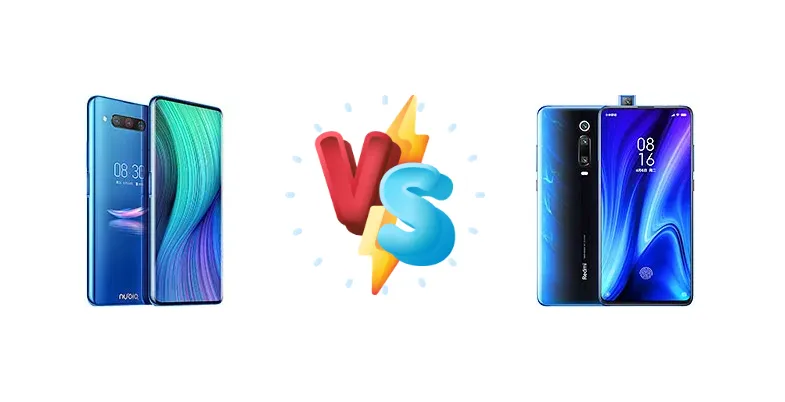
|
🏆 Quick Verdict
For the average user prioritizing longevity and consistent performance, the Xiaomi Redmi K20 Pro Premium edges out the nubia Z20. While both share the Snapdragon 855+ chipset, the K20 Pro Premium’s QC4 charging standard offers broader compatibility and potentially faster charging speeds with compatible adapters, making it a more practical daily driver.
| PHONES | ||
|---|---|---|
| Phone Names | ZTE nubia Z20 | Xiaomi Redmi K20 Pro Premium |
| Network | ||
|---|---|---|
| 2G bands | GSM 850 / 900 / 1800 / 1900 | GSM 850 / 900 / 1800 / 1900 |
| 3G bands | HSDPA 850 / 900 / 1700(AWS) / 1900 / 2100 | HSDPA 850 / 900 / 1900 / 2100 |
| 4G bands | 1, 2, 3, 4, 5, 7, 8, 18, 19, 20, 26, 34, 38, 39, 40, 41 - EU/Asia | 1, 3, 5, 7, 8, 34, 38, 39, 40, 41 |
| Speed | HSPA 42.2/5.76 Mbps, LTE (6CA) Cat18 1200/150 Mbps | HSPA, LTE |
| Technology | GSM / CDMA / HSPA / EVDO / LTE | GSM / CDMA / HSPA / LTE |
| 1, 2, 3, 4, 5, 7, 8, 12, 17, 18, 19, 20, 25, 26, 28, 30, 34, 38, 39, 40, 41, 66 - NA | CDMA 800 & TD-SCDMA | |
| Launch | ||
|---|---|---|
| Announced | 2019, August. Released 2019, August | 2019, September. Released 2019, September |
| Status | Discontinued | Discontinued |
| Body | ||
|---|---|---|
| Build | Glass front (Gorilla Glass 5), glass back (Gorilla Glass 5), aluminum frame | Glass front (Gorilla Glass 5), glass back (Gorilla Glass 5), aluminum frame |
| Dimensions | 158.6 x 75.3 x 9 mm (6.24 x 2.96 x 0.35 in) | 156.7 x 74.3 x 8.8 mm (6.17 x 2.93 x 0.35 in) |
| SIM | Nano-SIM + Nano-SIM | Nano-SIM + Nano-SIM |
| Weight | 186 g (6.56 oz) | 191 g (6.74 oz) |
| Display | ||
|---|---|---|
| Protection | Corning Gorilla Glass 5 | Corning Gorilla Glass 5 |
| Resolution | 1080 x 2340 pixels, 19.5:9 ratio (~401 ppi density) | 1080 x 2340 pixels, 19.5:9 ratio (~403 ppi density) |
| Size | 6.42 inches, 101.2 cm2 (~84.7% screen-to-body ratio) | 6.39 inches, 100.2 cm2 (~86.1% screen-to-body ratio) |
| Type | AMOLED, HDR10, 600 nits (typ) | Super AMOLED, HDR10 |
| Always-on display Secondary display (on the back): AMOLED, 5.1 inches, 720 x 1520 pixels, 330 nits (typ) | - | |
| Platform | ||
|---|---|---|
| CPU | Octa-core (1x2.96 GHz Kryo 485 & 3x2.42 GHz Kryo 485 & 4x1.78 GHz Kryo 485) | Octa-core (1x2.96 GHz Kryo 485 & 3x2.42 GHz Kryo 485 & 4x1.8 GHz Kryo 485) |
| Chipset | Qualcomm SM8150 Snapdragon 855+ (7 nm) | Qualcomm SM8150 Snapdragon 855+ (7 nm) |
| GPU | Adreno 640 (700 MHz) | Adreno 640 (700 MHz) |
| OS | Android 9.0 (Pie), Nubia UI | Android 10, MIUI 11 |
| Memory | ||
|---|---|---|
| Card slot | No | No |
| Internal | 128GB 6GB RAM, 128GB 8GB RAM, 512GB 8GB RAM | 128GB 8GB RAM, 512GB 8GB RAM, 512GB 12GB RAM |
| UFS 3.0 | UFS 2.1 | |
| Main Camera | ||
|---|---|---|
| Features | Dual-LED dual-tone flash, second soft flash, HDR, panorama | Laser AF, Dual-LED flash, HDR, panorama |
| Triple | 48 MP, f/1.7, 26mm (wide), 1/2.0", 0.8µm, PDAF, OIS 8 MP, f/2.4, (telephoto), 3x optical zoom 16 MP, f/2.2, 12mm (ultrawide), 1/3.1", 1.0µm, AF | 48 MP, f/1.8, 26mm (wide), 1/2.0", 0.8µm, PDAF 8 MP, f/2.4, 53mm (telephoto), 1/4.0", 1.12µm, PDAF, 2x optical zoom 13 MP, f/2.4, 12mm (ultrawide), 1/3.1", 1.12µm |
| Video | 8K@15fps, 4K@30/60fps, 1080p@30/60fps, 720p@1920fps | 4K@30/60fps, 1080p@30/120/240fps, 1080p@960fps |
| Selfie camera | ||
|---|---|---|
| Features | Dual-LED dual-tone flash, HDR, panorama | HDR |
| Single | - | Motorized pop-up 20 MP, f/2.2, (wide), 1/3.4", 0.8µm |
| Triple | Uses main cameras | - |
| Video | 8K@15fps, 4K@30/60fps, 1080p@30/60fps, 720p@1920fps | 1080p@30fps |
| Sound | ||
|---|---|---|
| 3.5mm jack | No | Yes |
| 35mm jack | No | Yes |
| Loudspeaker | Yes | Yes |
| 32-bit/384kHz audio | 24-bit/192kHz audio | |
| Comms | ||
|---|---|---|
| Bluetooth | 5.1, A2DP, LE | 5.0, A2DP, LE, aptX HD |
| NFC | No | Yes |
| Positioning | GPS (L1+L5), GLONASS, BDS, GALILEO | GPS (L1+L5), GLONASS (G1), BDS (B1), GALILEO (E1+E5a) |
| Radio | No | Yes |
| USB | USB Type-C, OTG | USB Type-C 2.0, OTG |
| WLAN | Wi-Fi 802.11 b/g/n/ac, dual-band, Wi-Fi Direct, DLNA | Wi-Fi 802.11 a/b/g/n/ac, dual-band, Wi-Fi Direct |
| Features | ||
|---|---|---|
| Sensors | Dual fingerprint (side-mounted), accelerometer, gyro, proximity, compass | Fingerprint (under display, optical), accelerometer, gyro, proximity, compass |
| Battery | ||
|---|---|---|
| Charging | 27W wired, PD2.0 | 27W wired, QC4 |
| Type | Li-Po 4000 mAh, non-removable | Li-Po 4000 mAh, non-removable |
| Misc | ||
|---|---|---|
| Colors | Twilight Blue, Diamond Black | Carbon black, Flame red, Glacier blue, Summer Honey, Pearl White |
| Models | NX627J | - |
| Price | About 550 EUR | About 450 EUR |
| Tests | ||
|---|---|---|
| Battery life | Endurance rating 100h | - |
| Camera | Photo / Video | - |
| Display | Contrast ratio: Infinite (nominal) | - |
| Loudspeaker | Voice 71dB / Noise 73dB / Ring 74dB | - |
| Performance | AnTuTu: 371150 (v7), 355478 (v8) GeekBench: 10101 (v4.4) GFXBench: 37fps (ES 3.1 onscreen) | - |
ZTE nubia Z20
- Exceptional 100-hour endurance rating
- PD2.0 charging support (with compatible chargers)
- Potentially brighter display (615 nits measured)
- PD2.0 charging may have limited adapter compatibility
- Limited software update support compared to Xiaomi
Xiaomi Redmi K20 Pro Premium
- QC4 charging offers broader adapter compatibility
- Likely more refined software experience (MIUI)
- Slightly higher CPU clock speed on one core (negligible)
- Battery life likely lower than nubia Z20
- Display brightness unknown
Display Comparison
Both phones lack detailed display specifications beyond the nubia Z20’s measured 615 nits of peak brightness. Given their release timeframe, both likely utilize AMOLED panels. The nubia Z20’s 'Infinite' contrast ratio is a marketing term common to AMOLED displays, indicating perfect blacks. Without knowing the Redmi K20 Pro Premium’s brightness, the nubia Z20 likely offers a more visible display in direct sunlight due to its measured output. However, the absence of refresh rate information for both devices means they likely operate at the standard 60Hz, a limitation compared to modern displays.
Camera Comparison
Both devices are listed with 'Photo / Video' capabilities, offering minimal insight into camera performance. Without sensor size, aperture, or image processing details, a direct comparison is impossible. However, given Xiaomi’s historical focus on camera technology, the Redmi K20 Pro Premium likely benefits from more sophisticated image processing algorithms. The absence of any mention of multiple cameras suggests both phones may rely on a primary sensor and potentially a depth sensor, but details remain scarce. The lack of information makes it impossible to assess low-light performance or video stabilization capabilities.
Performance
The core performance is virtually identical, as both the ZTE nubia Z20 and Xiaomi Redmi K20 Pro Premium are powered by the Qualcomm SM8150 Snapdragon 855+ (7 nm) chipset. Both feature the same octa-core CPU configuration: 1x2.96 GHz Kryo 485, 3x2.42 GHz Kryo 485, and 4x1.78 GHz Kryo 485. The slight difference in the fourth Kryo core clock speed (1.8 GHz on the K20 Pro Premium vs 1.78 GHz on the Z20) is negligible in real-world performance. Thermal management will likely be the differentiating factor, but without testing data, it’s difficult to determine which phone sustains peak performance for longer periods. Both will benefit from adequate cooling during intensive tasks.
Battery Life
The nubia Z20 boasts an impressive 100-hour endurance rating, suggesting a large battery capacity optimized for longevity. While the exact mAh isn’t specified, this rating indicates superior battery life compared to typical smartphones. The Redmi K20 Pro Premium’s battery capacity is unknown, but both phones support 27W wired charging. However, they utilize different standards: PD2.0 on the nubia Z20 and QC4 on the Redmi K20 Pro Premium. QC4 generally offers wider compatibility with various chargers, potentially leading to faster charging times with compatible adapters. The nubia Z20’s reliance on PD2.0 might limit charging speed with non-PD chargers.
Buying Guide
Buy the ZTE nubia Z20 if you prioritize maximum endurance and are comfortable with the PD2.0 charging ecosystem. Its 100-hour endurance rating suggests it can easily last a full day, even with heavy use. Buy the Xiaomi Redmi K20 Pro Premium if you value faster charging compatibility and a slightly more refined software experience, as Xiaomi’s MIUI generally receives more frequent updates than nubia’s UI.