
ZTE nubia Z20 vs Xiaomi Mi 9T Pro: A Deep Dive into Snapdragon 855+ Power
| Phones Images | |||||
|---|---|---|---|---|---|
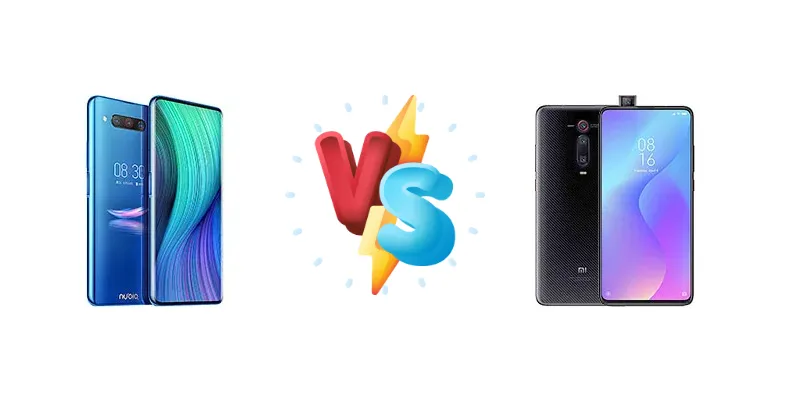
|
🏆 Quick Verdict
For most users, the Xiaomi Mi 9T Pro emerges as the slightly better choice. While both phones offer comparable Snapdragon 855+ performance and excellent battery life, the Mi 9T Pro’s QC4 charging protocol provides broader compatibility and potentially faster charging speeds with a wider range of chargers.
| PHONES | ||
|---|---|---|
| Phone Names | ZTE nubia Z20 | Xiaomi Mi 9T Pro |
| Network | ||
|---|---|---|
| 2G bands | GSM 850 / 900 / 1800 / 1900 | GSM 850 / 900 / 1800 / 1900 |
| 3G bands | HSDPA 850 / 900 / 1700(AWS) / 1900 / 2100 | HSDPA 850 / 900 / 1700(AWS) / 1900 / 2100 |
| 4G bands | 1, 2, 3, 4, 5, 7, 8, 18, 19, 20, 26, 34, 38, 39, 40, 41 - EU/Asia | 1, 2, 3, 4, 5, 7, 8, 20, 28, 38, 40 |
| Speed | HSPA 42.2/5.76 Mbps, LTE (6CA) Cat18 1200/150 Mbps | HSPA, LTE |
| Technology | GSM / CDMA / HSPA / EVDO / LTE | GSM / HSPA / LTE |
| 1, 2, 3, 4, 5, 7, 8, 12, 17, 18, 19, 20, 25, 26, 28, 30, 34, 38, 39, 40, 41, 66 - NA | - | |
| Launch | ||
|---|---|---|
| Announced | 2019, August. Released 2019, August | 2019, August 21. Released 2019, August 21 |
| Status | Discontinued | Discontinued |
| Body | ||
|---|---|---|
| Build | Glass front (Gorilla Glass 5), glass back (Gorilla Glass 5), aluminum frame | Glass front (Gorilla Glass 5), glass back (Gorilla Glass 5), aluminum frame |
| Dimensions | 158.6 x 75.3 x 9 mm (6.24 x 2.96 x 0.35 in) | 156.7 x 74.3 x 8.8 mm (6.17 x 2.93 x 0.35 in) |
| SIM | Nano-SIM + Nano-SIM | Nano-SIM + Nano-SIM |
| Weight | 186 g (6.56 oz) | 191 g (6.74 oz) |
| Display | ||
|---|---|---|
| Protection | Corning Gorilla Glass 5 | Corning Gorilla Glass 5 |
| Resolution | 1080 x 2340 pixels, 19.5:9 ratio (~401 ppi density) | 1080 x 2340 pixels, 19.5:9 ratio (~403 ppi density) |
| Size | 6.42 inches, 101.2 cm2 (~84.7% screen-to-body ratio) | 6.39 inches, 100.2 cm2 (~86.1% screen-to-body ratio) |
| Type | AMOLED, HDR10, 600 nits (typ) | Super AMOLED, HDR |
| Always-on display Secondary display (on the back): AMOLED, 5.1 inches, 720 x 1520 pixels, 330 nits (typ) | - | |
| Platform | ||
|---|---|---|
| CPU | Octa-core (1x2.96 GHz Kryo 485 & 3x2.42 GHz Kryo 485 & 4x1.78 GHz Kryo 485) | Octa-core (1x2.84 GHz Kryo 485 & 3x2.42 GHz Kryo 485 & 4x1.78 GHz Kryo 485) |
| Chipset | Qualcomm SM8150 Snapdragon 855+ (7 nm) | Qualcomm SM8150 Snapdragon 855 (7 nm) |
| GPU | Adreno 640 (700 MHz) | Adreno 640 |
| OS | Android 9.0 (Pie), Nubia UI | Android 9.0 (Pie), upgradable to Android 11, MIUI 12.5 |
| Memory | ||
|---|---|---|
| Card slot | No | No |
| Internal | 128GB 6GB RAM, 128GB 8GB RAM, 512GB 8GB RAM | 64GB 6GB RAM, 128GB 6GB RAM, 256GB 8GB RAM |
| UFS 3.0 | UFS 2.1 | |
| Main Camera | ||
|---|---|---|
| Features | Dual-LED dual-tone flash, second soft flash, HDR, panorama | Laser AF, Dual-LED flash, HDR, panorama |
| Triple | 48 MP, f/1.7, 26mm (wide), 1/2.0", 0.8µm, PDAF, OIS 8 MP, f/2.4, (telephoto), 3x optical zoom 16 MP, f/2.2, 12mm (ultrawide), 1/3.1", 1.0µm, AF | 48 MP, f/1.8, 26mm (wide), 1/2.0", 0.8µm, PDAF 8 MP, f/2.4, 53mm (telephoto), 1/4.0", 1.12µm, PDAF, 2x optical zoom 13 MP, f/2.4, 12mm (ultrawide), 1/3.1", 1.12µm |
| Video | 8K@15fps, 4K@30/60fps, 1080p@30/60fps, 720p@1920fps | 4K@30/60fps, 1080p@30/120/240fps, 1080p@960fps |
| Selfie camera | ||
|---|---|---|
| Features | Dual-LED dual-tone flash, HDR, panorama | HDR |
| Single | - | Motorized pop-up 20 MP, f/2.2, (wide), 1/3.4", 0.8µm |
| Triple | Uses main cameras | - |
| Video | 8K@15fps, 4K@30/60fps, 1080p@30/60fps, 720p@1920fps | 1080p@30fps |
| Sound | ||
|---|---|---|
| 3.5mm jack | No | Yes |
| 35mm jack | No | Yes |
| Loudspeaker | Yes | Yes |
| 32-bit/384kHz audio | 24-bit/192kHz audio | |
| Comms | ||
|---|---|---|
| Bluetooth | 5.1, A2DP, LE | 5.0, A2DP, LE, aptX HD |
| NFC | No | Yes |
| Positioning | GPS (L1+L5), GLONASS, BDS, GALILEO | GPS (L1+L5), GLONASS (G1), BDS (B1), GALILEO (E1+E5a) |
| Radio | No | Yes |
| USB | USB Type-C, OTG | USB Type-C 2.0, OTG |
| WLAN | Wi-Fi 802.11 b/g/n/ac, dual-band, Wi-Fi Direct, DLNA | Wi-Fi 802.11 a/b/g/n/ac, dual-band, Wi-Fi Direct |
| Features | ||
|---|---|---|
| Sensors | Dual fingerprint (side-mounted), accelerometer, gyro, proximity, compass | Fingerprint (under display, optical), accelerometer, gyro, proximity, compass |
| Battery | ||
|---|---|---|
| Charging | 27W wired, PD2.0 | 27W wired, QC4 |
| Type | Li-Po 4000 mAh, non-removable | Li-Po 4000 mAh, non-removable |
| Misc | ||
|---|---|---|
| Colors | Twilight Blue, Diamond Black | Carbon black, Red flame, Glacier blue |
| Models | NX627J | M1903F11G |
| Price | About 550 EUR | About 150 EUR |
| SAR | - | 1.03 W/kg (head) 0.72 W/kg (body) |
| SAR EU | - | 1.30 W/kg (head) 1.51 W/kg (body) |
| Tests | ||
|---|---|---|
| Audio quality | - | Noise -93.9dB / Crosstalk -94.2dB |
| Battery life | Endurance rating 100h | Endurance rating 103h |
| Camera | Photo / Video | - |
| Display | Contrast ratio: Infinite (nominal) | Contrast ratio: Infinite (nominal) |
| Loudspeaker | Voice 71dB / Noise 73dB / Ring 74dB | -26.9 LUFS (Good) |
| Performance | AnTuTu: 371150 (v7), 355478 (v8) GeekBench: 10101 (v4.4) GFXBench: 37fps (ES 3.1 onscreen) | AnTuTu: 368846 (v7), 437823 (v8) GeekBench: 10684 (v4.4), 2732 (v5.1) GFXBench: 36fps (ES 3.1 onscreen) |
ZTE nubia Z20
- Slightly higher CPU clock speed (potentially marginal gains)
- Measured peak display brightness of 615 nits
- PD2.0 charging support
- PD2.0 charging has limited charger compatibility
- Less established software support compared to Xiaomi
Xiaomi Mi 9T Pro
- QC4 charging offers wider charger compatibility
- Xiaomi’s established software and update track record
- Potentially faster real-world charging speeds
- Slightly lower CPU clock speed (minimal impact)
- Display brightness not officially specified
Display Comparison
Both the ZTE nubia Z20 and Xiaomi Mi 9T Pro feature displays with an 'Infinite' contrast ratio, indicating deep blacks typical of OLED panels. However, the nubia Z20 boasts a measured peak brightness of 615 nits, a crucial metric for outdoor visibility. While the Mi 9T Pro’s brightness isn’t specified, this advantage gives the Z20 an edge in direct sunlight. Both devices lack high refresh rate panels, a common omission in this price bracket at the time of release.
Camera Comparison
Both devices are listed as having 'Photo / Video' capabilities, lacking specific details. Without sensor size or aperture information, a direct comparison is difficult. However, given Xiaomi’s strong image processing reputation, the Mi 9T Pro likely delivers more consistently pleasing images, particularly in challenging lighting conditions. The absence of detailed camera specs suggests neither phone prioritizes photography as a key selling point.
Performance
The core of both phones is the Qualcomm SM8150 Snapdragon 855+ (7nm). The nubia Z20’s CPU configuration runs at a slightly higher peak clock speed (2.96 GHz vs 2.84 GHz on the Mi 9T Pro), but this difference is unlikely to translate into a noticeable real-world performance gain for most users. Both utilize an octa-core setup with the same Kryo 485 architecture. The Mi 9T Pro’s advantage lies in its QC4 charging, which, while both support 27W charging, offers wider compatibility with existing chargers. The 7nm process node ensures efficient power consumption and thermal management on both devices.
Battery Life
Both phones achieve impressive endurance ratings – 100 hours for the nubia Z20 and 103 hours for the Mi 9T Pro. This suggests comparable real-world battery life. However, the Mi 9T Pro’s support for Qualcomm Quick Charge 4 (QC4) offers a potential advantage. QC4 is more widely supported by chargers and power banks than Power Delivery 2.0 (PD2.0) found on the nubia Z20, potentially leading to faster and more convenient charging in various scenarios. Both support 27W wired charging.
Buying Guide
Buy the ZTE nubia Z20 if you prioritize a potentially longer endurance rating (100h vs 103h) and are invested in the PD2.0 charging ecosystem. Buy the Xiaomi Mi 9T Pro if you value broader charger compatibility with QC4, and prefer a device with potentially faster real-world charging times, and a slightly more mainstream software experience.