
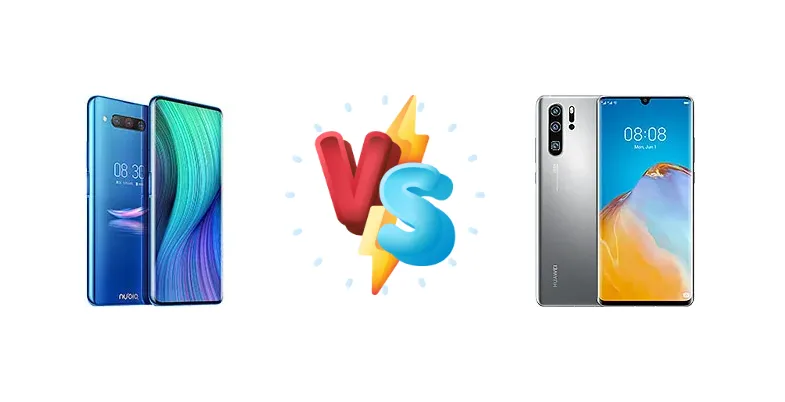
ZTE nubia Z20 vs Huawei P30 Pro New Edition: A Detailed Comparison
| Phones Images | |||||
|---|---|---|---|---|---|
|
🏆 Quick Verdict
For the average user prioritizing all-around performance and future-proofing, the ZTE nubia Z20 emerges as the stronger choice. Its Snapdragon 855+ chipset delivers superior processing power. However, the Huawei P30 Pro New Edition excels in charging speed and offers a more polished software experience, making it ideal for users who value convenience and camera versatility.
| PHONES | ||
|---|---|---|
| Phone Names | ZTE nubia Z20 | Huawei P30 Pro New Edition |
| Network | ||
|---|---|---|
| 2G bands | GSM 850 / 900 / 1800 / 1900 | GSM 850 / 900 / 1800 / 1900 |
| 3G bands | HSDPA 850 / 900 / 1700(AWS) / 1900 / 2100 | HSDPA 800 / 850 / 900 / 1700(AWS) / 1900 / 2100 |
| 4G bands | 1, 2, 3, 4, 5, 7, 8, 18, 19, 20, 26, 34, 38, 39, 40, 41 - EU/Asia | LTE |
| Speed | HSPA 42.2/5.76 Mbps, LTE (6CA) Cat18 1200/150 Mbps | HSPA 42.2/5.76 Mbps, LTE Cat21 1400/200 Mbps |
| Technology | GSM / CDMA / HSPA / EVDO / LTE | GSM / HSPA / LTE |
| 1, 2, 3, 4, 5, 7, 8, 12, 17, 18, 19, 20, 25, 26, 28, 30, 34, 38, 39, 40, 41, 66 - NA | - | |
| Launch | ||
|---|---|---|
| Announced | 2019, August. Released 2019, August | 2020, May 12. Released 2020, June 01 |
| Status | Discontinued | Discontinued |
| Body | ||
|---|---|---|
| Build | Glass front (Gorilla Glass 5), glass back (Gorilla Glass 5), aluminum frame | Glass front (Aluminosilicate glass), glass back (Aluminosilicate glass), aluminum frame |
| Dimensions | 158.6 x 75.3 x 9 mm (6.24 x 2.96 x 0.35 in) | 158 x 73.4 x 8.4 mm (6.22 x 2.89 x 0.33 in) |
| SIM | Nano-SIM + Nano-SIM | · Nano-SIM· Nano-SIM + Nano-SIM |
| Weight | 186 g (6.56 oz) | 192 g (6.77 oz) |
| - | IP68 dust/water resistant (up to 2m for 30 mins) | |
| Display | ||
|---|---|---|
| Protection | Corning Gorilla Glass 5 | - |
| Resolution | 1080 x 2340 pixels, 19.5:9 ratio (~401 ppi density) | 1080 x 2340 pixels, 19.5:9 ratio (~398 ppi density) |
| Size | 6.42 inches, 101.2 cm2 (~84.7% screen-to-body ratio) | 6.47 inches, 102.8 cm2 (~88.6% screen-to-body ratio) |
| Type | AMOLED, HDR10, 600 nits (typ) | OLED, HDR10 |
| Always-on display Secondary display (on the back): AMOLED, 5.1 inches, 720 x 1520 pixels, 330 nits (typ) | - | |
| Platform | ||
|---|---|---|
| CPU | Octa-core (1x2.96 GHz Kryo 485 & 3x2.42 GHz Kryo 485 & 4x1.78 GHz Kryo 485) | Octa-core (2x2.6 GHz Cortex-A76 & 2x1.92 GHz Cortex-A76 & 4x1.8 GHz Cortex-A55) |
| Chipset | Qualcomm SM8150 Snapdragon 855+ (7 nm) | Kirin 980 (7 nm) |
| GPU | Adreno 640 (700 MHz) | Mali-G76 MP10 |
| OS | Android 9.0 (Pie), Nubia UI | Android 10, EMUI 10.1, Google Play Services |
| Memory | ||
|---|---|---|
| Card slot | No | Nano Memory (uses shared SIM slot) |
| Internal | 128GB 6GB RAM, 128GB 8GB RAM, 512GB 8GB RAM | 128GB 6GB RAM, 256GB 8GB RAM |
| UFS 3.0 | UFS 3.0 | |
| Main Camera | ||
|---|---|---|
| Features | Dual-LED dual-tone flash, second soft flash, HDR, panorama | Leica optics, color spectrum sensor, dual-LED dual-tone flash, panorama, HDR |
| Triple | 48 MP, f/1.7, 26mm (wide), 1/2.0", 0.8µm, PDAF, OIS 8 MP, f/2.4, (telephoto), 3x optical zoom 16 MP, f/2.2, 12mm (ultrawide), 1/3.1", 1.0µm, AF | 40 MP, f/1.6, 27mm (wide), 1/1.7", PDAF, OIS 8 MP, f/3.4, 125mm (periscope telephoto), 1/4.0", PDAF, OIS, 5x optical zoom, 10x hybrid zoom 20 MP, f/2.2, 16mm (ultrawide), 1/2.7", PDAF TOF 3D, (depth) |
| Video | 8K@15fps, 4K@30/60fps, 1080p@30/60fps, 720p@1920fps | 4K@30fps, 1080p@60fps, 1080p@30fps (gyro-EIS), 720p@960fps |
| Selfie camera | ||
|---|---|---|
| Features | Dual-LED dual-tone flash, HDR, panorama | HDR |
| Single | - | 32 MP, f/2.0, 26mm (wide), 1/2.8", 0.8µm |
| Triple | Uses main cameras | - |
| Video | 8K@15fps, 4K@30/60fps, 1080p@30/60fps, 720p@1920fps | 1080p@30fps |
| Sound | ||
|---|---|---|
| 3.5mm jack | No | No |
| 35mm jack | No | No |
| Loudspeaker | Yes | Yes |
| 32-bit/384kHz audio | 32-bit/384kHz audio | |
| Comms | ||
|---|---|---|
| Bluetooth | 5.1, A2DP, LE | 5.0, A2DP, aptX HD, LE |
| Infrared port | - | Yes |
| NFC | No | Yes |
| Positioning | GPS (L1+L5), GLONASS, BDS, GALILEO | GPS (L1+L5), GLONASS (L1), BDS (B1), GALILEO (E1+E5a), QZSS (L1+L5) |
| Radio | No | No |
| USB | USB Type-C, OTG | USB Type-C 3.1 |
| WLAN | Wi-Fi 802.11 b/g/n/ac, dual-band, Wi-Fi Direct, DLNA | Wi-Fi 802.11 a/b/g/n/ac, dual-band, Wi-Fi Direct |
| Features | ||
|---|---|---|
| Sensors | Dual fingerprint (side-mounted), accelerometer, gyro, proximity, compass | Fingerprint (under display, optical), accelerometer, gyro, proximity, compass |
| Battery | ||
|---|---|---|
| Charging | 27W wired, PD2.0 | 40W wired, 70% in 30 min 15W wireless Reverse wireless |
| Type | Li-Po 4000 mAh, non-removable | Li-Po 4200 mAh |
| Misc | ||
|---|---|---|
| Colors | Twilight Blue, Diamond Black | Aurora, Black, Silver Frost |
| Models | NX627J | - |
| Price | About 550 EUR | About 820 EUR |
| Tests | ||
|---|---|---|
| Battery life | Endurance rating 100h | - |
| Camera | Photo / Video | - |
| Display | Contrast ratio: Infinite (nominal) | - |
| Loudspeaker | Voice 71dB / Noise 73dB / Ring 74dB | - |
| Performance | AnTuTu: 371150 (v7), 355478 (v8) GeekBench: 10101 (v4.4) GFXBench: 37fps (ES 3.1 onscreen) | - |
ZTE nubia Z20
- Superior processing power with Snapdragon 855+
- Longer battery endurance (estimated)
- Potentially better gaming performance
- Limited camera information
- Slower charging speed compared to P30 Pro
Huawei P30 Pro New Edition
- 40W SuperCharge for incredibly fast wired charging
- 15W wireless and reverse wireless charging
- Reputation for excellent camera performance
- Kirin 980 is less powerful than Snapdragon 855+
- Software support may be limited
Display Comparison
The nubia Z20 boasts a display capable of 615 nits of peak brightness, a respectable figure for outdoor visibility. While the P30 Pro’s brightness isn’t specified, Huawei historically prioritizes color accuracy and calibration. Both displays feature an 'Infinite' (nominal) contrast ratio, typical of OLED panels. The lack of high refresh rate information for either device suggests a standard 60Hz experience, which was common for flagships in their respective release windows. The Z20’s brightness is a key advantage for users frequently exposed to direct sunlight.
Camera Comparison
Both devices are marketed with strong camera capabilities, but details are limited to 'Photo / Video' for the Z20. The P30 Pro New Edition, however, was renowned for its low-light performance and zoom capabilities, though specific sensor details aren’t provided in the context data. Given Huawei’s history, it likely features a larger main sensor and more sophisticated image processing algorithms. The absence of detailed camera specs for the Z20 makes a direct comparison difficult, but the P30 Pro’s reputation suggests a more versatile and refined camera experience, particularly for casual users.
Performance
The core difference lies in the chipsets: the ZTE nubia Z20 utilizes the Qualcomm SM8150 Snapdragon 855+ (7nm), an octa-core processor with a Kryo 485 architecture peaking at 2.96 GHz. This is pitted against the Huawei P30 Pro New Edition’s Kirin 980 (7nm), also an octa-core design but with a different core arrangement (Cortex-A76 and A55). The Snapdragon 855+ generally outperforms the Kirin 980 in sustained CPU and GPU workloads, offering a smoother experience for demanding games and multitasking. The Z20’s architecture, with its higher clock speeds, translates to a noticeable advantage in raw processing power. While both are 7nm chips, Qualcomm’s manufacturing process refinement at the time gave it an edge.
Battery Life
The nubia Z20 claims an impressive 100-hour endurance rating, suggesting a large battery capacity (though the exact mAh isn’t specified). However, the P30 Pro New Edition counters with significantly faster charging: 40W wired, capable of reaching 70% charge in just 30 minutes, alongside 15W wireless charging and reverse wireless charging. While the Z20 offers 27W wired charging with PD2.0, the P30 Pro’s charging speed is a major convenience factor. The endurance rating suggests the Z20 prioritizes longevity, while the P30 Pro prioritizes quick top-ups.
Buying Guide
Buy the ZTE nubia Z20 if you need a phone capable of handling demanding games and applications without throttling, and if you prioritize raw processing power over wireless charging or the latest software features. Buy the Huawei P30 Pro New Edition if you prefer a phone with exceptionally fast wired and wireless charging, a versatile camera system, and a more refined, established software ecosystem, even if it means sacrificing some peak performance.