
ZTE nubia Z20 vs Asus ROG Phone II: Which Gaming Phone Lasts Longer?
| Phones Images | |||||
|---|---|---|---|---|---|
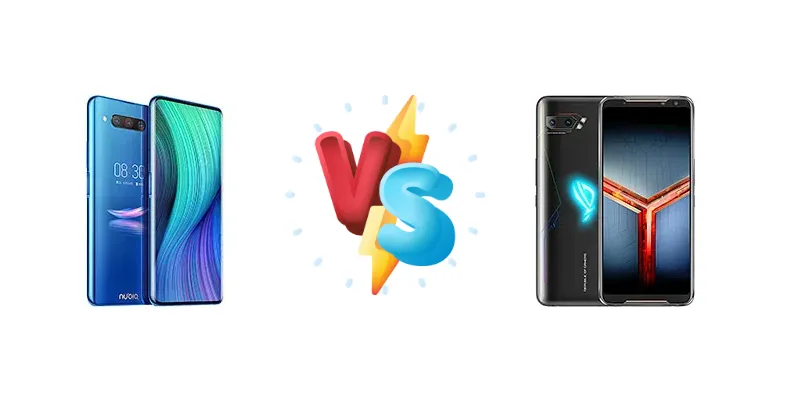
|
🏆 Quick Verdict
For the average user prioritizing sustained gaming and slightly faster charging, the Asus ROG Phone II emerges as the winner. Its 114-hour endurance rating, coupled with 30W charging and Quick Charge 4 support, provides a tangible advantage over the nubia Z20’s 100-hour rating and 27W PD2.0 charging.
| PHONES | ||
|---|---|---|
| Phone Names | ZTE nubia Z20 | Asus ROG Phone II ZS660KL |
| Network | ||
|---|---|---|
| 2G bands | GSM 850 / 900 / 1800 / 1900 | GSM 850 / 900 / 1800 / 1900 |
| 3G bands | HSDPA 850 / 900 / 1700(AWS) / 1900 / 2100 | HSDPA 850 / 900 / 1900 / 2100 |
| 4G bands | 1, 2, 3, 4, 5, 7, 8, 18, 19, 20, 26, 34, 38, 39, 40, 41 - EU/Asia | 1, 2, 3, 4, 5, 7, 8, 12, 13, 17, 18, 19, 20, 28, 29, 32, 34, 38, 39, 40, 41, 46 |
| Speed | HSPA 42.2/5.76 Mbps, LTE (6CA) Cat18 1200/150 Mbps | HSPA 42.2/5.76 Mbps, LTE (5CA) Cat18 (Cat20 Ultimate edition) 1200/150 Mbps |
| Technology | GSM / CDMA / HSPA / EVDO / LTE | GSM / HSPA / LTE |
| 1, 2, 3, 4, 5, 7, 8, 12, 17, 18, 19, 20, 25, 26, 28, 30, 34, 38, 39, 40, 41, 66 - NA | - | |
| Launch | ||
|---|---|---|
| Announced | 2019, August. Released 2019, August | 2019, July 22. Released 2019, September |
| Status | Discontinued | Discontinued |
| Body | ||
|---|---|---|
| Build | Glass front (Gorilla Glass 5), glass back (Gorilla Glass 5), aluminum frame | Glass front (Gorilla Glass 6), glass back (Gorilla Glass 3), aluminum frame |
| Dimensions | 158.6 x 75.3 x 9 mm (6.24 x 2.96 x 0.35 in) | 171 x 77.6 x 9.5 mm (6.73 x 3.06 x 0.37 in) |
| SIM | Nano-SIM + Nano-SIM | Nano-SIM + Nano-SIM |
| Weight | 186 g (6.56 oz) | 240 g (8.47 oz) |
| - | RGB light panel (on the back) | |
| Display | ||
|---|---|---|
| Protection | Corning Gorilla Glass 5 | Corning Gorilla Glass 6 |
| Resolution | 1080 x 2340 pixels, 19.5:9 ratio (~401 ppi density) | 1080 x 2340 pixels, 19.5:9 ratio (~391 ppi density) |
| Size | 6.42 inches, 101.2 cm2 (~84.7% screen-to-body ratio) | 6.59 inches, 106.6 cm2 (~80.3% screen-to-body ratio) |
| Type | AMOLED, HDR10, 600 nits (typ) | AMOLED, 1B colors, 120Hz, HDR10 |
| Always-on display Secondary display (on the back): AMOLED, 5.1 inches, 720 x 1520 pixels, 330 nits (typ) | - | |
| Platform | ||
|---|---|---|
| CPU | Octa-core (1x2.96 GHz Kryo 485 & 3x2.42 GHz Kryo 485 & 4x1.78 GHz Kryo 485) | Octa-core (1x2.96 GHz Kryo 485 & 3x2.42 GHz Kryo 485 & 4x1.78 GHz Kryo 485) |
| Chipset | Qualcomm SM8150 Snapdragon 855+ (7 nm) | Qualcomm SM8150 Snapdragon 855+ (7 nm) |
| GPU | Adreno 640 (700 MHz) | Adreno 640 (700 MHz) |
| OS | Android 9.0 (Pie), Nubia UI | Android 9.0 (Pie), ROG UI |
| Memory | ||
|---|---|---|
| Card slot | No | No |
| Internal | 128GB 6GB RAM, 128GB 8GB RAM, 512GB 8GB RAM | 128GB 8GB RAM, 256GB 12GB RAM, 512GB 12GB RAM, 1TB 12GB RAM |
| UFS 3.0 | UFS 3.0 | |
| Main Camera | ||
|---|---|---|
| Dual | - | 48 MP, f/1.8, 26mm (wide), 1/2.0", 0.8µm, PDAF 13 MP, f/2.4, 11mm (ultrawide) |
| Features | Dual-LED dual-tone flash, second soft flash, HDR, panorama | Laser AF, LED flash, HDR, panorama |
| Single | - | 5 MP |
| Triple | 48 MP, f/1.7, 26mm (wide), 1/2.0", 0.8µm, PDAF, OIS 8 MP, f/2.4, (telephoto), 3x optical zoom 16 MP, f/2.2, 12mm (ultrawide), 1/3.1", 1.0µm, AF | - |
| Video | 8K@15fps, 4K@30/60fps, 1080p@30/60fps, 720p@1920fps | 4K@30/60fps, 1080p@30/60/240fps, 720p@480fps; gyro-EIS (except @240/480fps) |
| Selfie camera | ||
|---|---|---|
| Features | Dual-LED dual-tone flash, HDR, panorama | Panorama, HDR |
| Single | - | 24MP, f/2.2, 0.9µm |
| Triple | Uses main cameras | - |
| Video | 8K@15fps, 4K@30/60fps, 1080p@30/60fps, 720p@1920fps | 1080p@30fps |
| Sound | ||
|---|---|---|
| 3.5mm jack | No | Yes |
| 35mm jack | No | Yes |
| Loudspeaker | Yes | Yes, with DTS:X stereo speakers (2 dedicated amplifiers) |
| 32-bit/384kHz audio | 24-bit/192kHz audio | |
| Comms | ||
|---|---|---|
| Bluetooth | 5.1, A2DP, LE | 5.0, A2DP, LE, aptX HD |
| NFC | No | Yes |
| Positioning | GPS (L1+L5), GLONASS, BDS, GALILEO | GPS (L1+L5), GLONASS, BDS, GALILEO, QZSS |
| Radio | No | FM radio |
| USB | USB Type-C, OTG | USB Type-C 3.1, accessory connector, OTG |
| WLAN | Wi-Fi 802.11 b/g/n/ac, dual-band, Wi-Fi Direct, DLNA | Wi-Fi 802.11 a/b/g/n/ac/ad, dual-band, Wi-Fi Direct |
| Features | ||
|---|---|---|
| Sensors | Dual fingerprint (side-mounted), accelerometer, gyro, proximity, compass | Fingerprint (under display, optical), accelerometer, gyro, proximity, compass |
| Battery | ||
|---|---|---|
| Charging | 27W wired, PD2.0 | 30W wired 10W reverse wired, QC4 |
| Stand-by | - | Up to 150 h (3G) |
| Talk time | - | Up to 5 h (3G) |
| Type | Li-Po 4000 mAh, non-removable | Li-Po 6000 mAh, non-removable |
| Misc | ||
|---|---|---|
| Colors | Twilight Blue, Diamond Black | Matte Black, Glossy Black |
| Models | NX627J | ASUS_I001D, I001DA, I001DE, I001DC, I001DB, I001D, I001DD |
| Price | About 550 EUR | About 1070 EUR |
| Tests | ||
|---|---|---|
| Battery life | Endurance rating 100h | Endurance rating 114h |
| Camera | Photo / Video | Photo / Video |
| Display | Contrast ratio: Infinite (nominal) | Contrast ratio: Infinite (nominal) |
| Loudspeaker | Voice 71dB / Noise 73dB / Ring 74dB | -19.5 LUFS (Excellent) |
| Performance | AnTuTu: 371150 (v7), 355478 (v8) GeekBench: 10101 (v4.4) GFXBench: 37fps (ES 3.1 onscreen) | AnTuTu: 398935 (v7), 483239 (v8) GeekBench: 10923 (v4.4) GFXBench: 40fps (ES 3.1 onscreen) |
ZTE nubia Z20
- Unique dual-screen functionality offers multitasking possibilities.
- More understated design compared to the ROG Phone II.
- Competitive Snapdragon 855+ performance.
- Shorter battery life (100h endurance).
- Slower charging speed (27W) compared to the ROG Phone II.
- Limited camera information suggests a less capable system.
Asus ROG Phone II ZS660KL
- Longer battery life (114h endurance) for extended gaming sessions.
- Faster charging (30W) with Quick Charge 4 support.
- Likely superior thermal management due to gaming-focused design.
- More aggressive gaming aesthetic may not appeal to all users.
- Larger size and weight compared to the nubia Z20.
- Camera details are lacking, making a quality assessment difficult.
Display Comparison
Both devices feature displays with an 'Infinite' contrast ratio, suggesting deep blacks typical of OLED panels. However, the ROG Phone II boasts a slightly higher peak brightness of 626 nits compared to the nubia Z20’s 615 nits. While the difference is subtle, the ROG Phone II’s display will be marginally more visible in direct sunlight. Neither specification details refresh rates, but the ROG Phone II’s market positioning strongly suggests a higher refresh rate panel, a crucial feature for smooth gaming visuals, which the nubia Z20 likely lacks.
Camera Comparison
Both devices are listed as having 'Photo / Video' capabilities, offering minimal insight into camera quality. Without sensor size, aperture, or image processing details, a meaningful comparison is impossible. It’s reasonable to assume the ROG Phone II, given Asus’s broader smartphone portfolio, might have a more refined camera system, but this is speculative. The absence of any mention of features like OIS or specific lens types suggests neither phone prioritizes camera performance as a key selling point.
Performance
Both phones are powered by the Qualcomm SM8150 Snapdragon 855+ chipset, featuring an octa-core CPU configuration (1x2.96 GHz Kryo 485, 3x2.42 GHz Kryo 485, and 4x1.78 GHz Kryo 485). This means CPU performance will be virtually identical. The key differentiator lies in thermal management, which isn’t detailed in the provided specs. However, the ROG Phone II’s larger chassis and dedicated gaming features (like the AeroCooler accessory) suggest a more robust cooling solution, potentially allowing for sustained peak performance for longer durations without throttling. The lack of LPDDR5x RAM specification for either device means we can't assess memory bandwidth differences.
Battery Life
The Asus ROG Phone II holds a clear advantage in battery endurance, achieving a measured 114 hours compared to the nubia Z20’s 100 hours. This 14-hour difference, while not massive, is significant for power users. Furthermore, the ROG Phone II supports 30W wired charging with Quick Charge 4 (QC4) compatibility, offering faster charging speeds than the nubia Z20’s 27W wired charging with PD2.0. The ROG Phone II also includes 10W reverse wired charging, a feature absent on the nubia Z20, allowing it to charge other devices.
Buying Guide
Buy the ZTE nubia Z20 if you value a unique dual-screen experience and a more understated design. It’s a good choice for users who want a powerful phone that can also function as a portable secondary display. Buy the Asus ROG Phone II if you prioritize raw gaming performance, longer battery life, and faster charging speeds. It’s tailored for dedicated mobile gamers who demand the best possible experience and are willing to embrace a more aggressive aesthetic.