
ZTE nubia Z20 vs. Apple iPhone 11 Pro Max: A 2024 Flagship Face-Off
| Phones Images | |||||
|---|---|---|---|---|---|
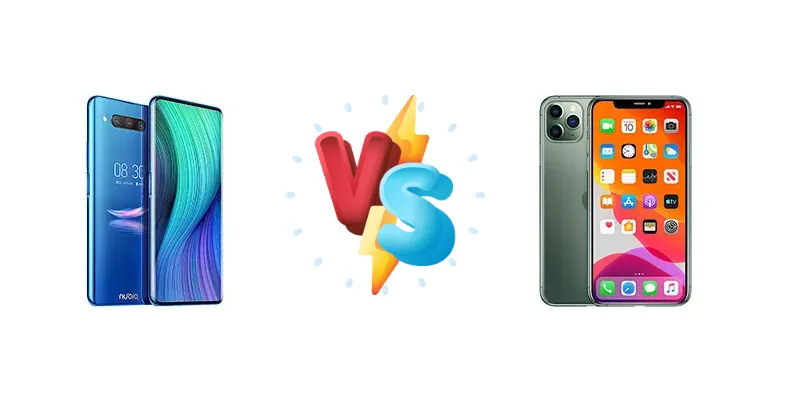
|
🏆 Quick Verdict
For the average user prioritizing a polished ecosystem and long-term software support, the iPhone 11 Pro Max remains the superior choice. However, the nubia Z20 offers impressive performance and battery life for a significantly lower price, making it ideal for budget-conscious Android enthusiasts.
| PHONES | ||
|---|---|---|
| Phone Names | ZTE nubia Z20 | Apple iPhone 11 Pro Max |
| Network | ||
|---|---|---|
| 2G bands | GSM 850 / 900 / 1800 / 1900 | GSM 850 / 900 / 1800 / 1900 |
| 3G bands | HSDPA 850 / 900 / 1700(AWS) / 1900 / 2100 | HSDPA 850 / 900 / 1700(AWS) / 1900 / 2100 |
| 4G bands | 1, 2, 3, 4, 5, 7, 8, 18, 19, 20, 26, 34, 38, 39, 40, 41 - EU/Asia | 1, 2, 3, 4, 5, 7, 8, 11, 12, 13, 17, 18, 19, 20, 21, 25, 26, 28, 29, 30, 32, 34, 38, 39, 40, 41, 42, 46, 48, 66 - A2218 |
| Speed | HSPA 42.2/5.76 Mbps, LTE (6CA) Cat18 1200/150 Mbps | HSPA, LTE 1.6 Gbps DL, EV-DO Rev.A 3.1 Mbps |
| Technology | GSM / CDMA / HSPA / EVDO / LTE | GSM / CDMA / HSPA / EVDO / LTE |
| 1, 2, 3, 4, 5, 7, 8, 12, 17, 18, 19, 20, 25, 26, 28, 30, 34, 38, 39, 40, 41, 66 - NA | 1, 2, 3, 4, 5, 7, 8, 12, 13, 14, 17, 18, 19, 20, 25, 26, 29, 30, 34, 38, 39, 40, 41, 42, 46, 48, 66, 71 - A2161, A2220 | |
| Launch | ||
|---|---|---|
| Announced | 2019, August. Released 2019, August | 2019, September 10 |
| Status | Discontinued | Available. Released 2019, September 20 |
| Body | ||
|---|---|---|
| Build | Glass front (Gorilla Glass 5), glass back (Gorilla Glass 5), aluminum frame | Glass front (Corning-made glass), glass back (Corning-made glass), stainless steel frame |
| Dimensions | 158.6 x 75.3 x 9 mm (6.24 x 2.96 x 0.35 in) | 158 x 77.8 x 8.1 mm (6.22 x 3.06 x 0.32 in) |
| SIM | Nano-SIM + Nano-SIM | · Nano-SIM + eSIM· Nano-SIM + Nano-SIM (China) |
| Weight | 186 g (6.56 oz) | 226 g (7.97 oz) |
| - | IP68 dust/water resistant (up to 4m for 30 min) Apple Pay (Visa, MasterCard, AMEX certified) | |
| Display | ||
|---|---|---|
| Protection | Corning Gorilla Glass 5 | Scratch-resistant glass |
| Resolution | 1080 x 2340 pixels, 19.5:9 ratio (~401 ppi density) | 1242 x 2688 pixels, 19.5:9 ratio (~458 ppi density) |
| Size | 6.42 inches, 101.2 cm2 (~84.7% screen-to-body ratio) | 6.5 inches, 102.9 cm2 (~83.7% screen-to-body ratio) |
| Type | AMOLED, HDR10, 600 nits (typ) | Super Retina XDR OLED, HDR10, Dolby Vision, 800 nits (HBM), 1200 nits (peak) |
| Always-on display Secondary display (on the back): AMOLED, 5.1 inches, 720 x 1520 pixels, 330 nits (typ) | - | |
| Platform | ||
|---|---|---|
| CPU | Octa-core (1x2.96 GHz Kryo 485 & 3x2.42 GHz Kryo 485 & 4x1.78 GHz Kryo 485) | Hexa-core (2x2.65 GHz Lightning + 4x1.8 GHz Thunder) |
| Chipset | Qualcomm SM8150 Snapdragon 855+ (7 nm) | Apple A13 Bionic (7 nm+) |
| GPU | Adreno 640 (700 MHz) | Apple GPU (4-core graphics) |
| OS | Android 9.0 (Pie), Nubia UI | iOS 13, upgradable to iOS 26.1 |
| Memory | ||
|---|---|---|
| Card slot | No | No |
| Internal | 128GB 6GB RAM, 128GB 8GB RAM, 512GB 8GB RAM | 64GB 4GB RAM, 256GB 4GB RAM, 512GB 4GB RAM |
| UFS 3.0 | NVMe | |
| Main Camera | ||
|---|---|---|
| Features | Dual-LED dual-tone flash, second soft flash, HDR, panorama | Dual-LED dual-tone flash, HDR (photo/panorama) |
| Single | - | 13 MP, f/2.2, PDAF |
| Triple | 48 MP, f/1.7, 26mm (wide), 1/2.0", 0.8µm, PDAF, OIS 8 MP, f/2.4, (telephoto), 3x optical zoom 16 MP, f/2.2, 12mm (ultrawide), 1/3.1", 1.0µm, AF | 12 MP, f/1.8, 26mm (wide), 1/2.55", 1.4µm, dual pixel PDAF, OIS 12 MP, f/2.0, 52mm (telephoto), 1/3.4", 1.0µm, PDAF, OIS, 2x optical zoom 12 MP, f/2.4, 120˚, 13mm (ultrawide), 1/3.6" |
| Video | 8K@15fps, 4K@30/60fps, 1080p@30/60fps, 720p@1920fps | 4K@24/25/30/60fps, 1080p@25/30/60/120/240fps, HDR, stereo sound rec. |
| Selfie camera | ||
|---|---|---|
| Features | Dual-LED dual-tone flash, HDR, panorama | HDR |
| Single | - | 12 MP, f/2.2, 23mm (wide), 1/3.6", 1.0µm SL 3D, (depth/biometrics sensor) |
| Triple | Uses main cameras | - |
| Video | 8K@15fps, 4K@30/60fps, 1080p@30/60fps, 720p@1920fps | 4K@24/25/30/60fps, 1080p@25/30/60/120fps, gyro-EIS |
| Sound | ||
|---|---|---|
| 3.5mm jack | No | No |
| 35mm jack | No | No |
| Loudspeaker | Yes | Yes, with stereo speakers |
| 32-bit/384kHz audio | - | |
| Comms | ||
|---|---|---|
| Bluetooth | 5.1, A2DP, LE | 5.0, A2DP, LE |
| NFC | No | Yes |
| Positioning | GPS (L1+L5), GLONASS, BDS, GALILEO | GPS, GLONASS, GALILEO, QZSS |
| Radio | No | No |
| USB | USB Type-C, OTG | Lightning, USB 2.0 |
| WLAN | Wi-Fi 802.11 b/g/n/ac, dual-band, Wi-Fi Direct, DLNA | Wi-Fi 802.11 a/b/g/n/ac/6, dual-band, hotspot |
| Features | ||
|---|---|---|
| Sensors | Dual fingerprint (side-mounted), accelerometer, gyro, proximity, compass | Face ID, accelerometer, gyro, proximity, compass, barometer |
| - | Ultra Wideband (UWB) support | |
| Battery | ||
|---|---|---|
| Charging | 27W wired, PD2.0 | Wired, PD2.0, 50% in 30 min Wireless (Qi) |
| Type | Li-Po 4000 mAh, non-removable | Li-Ion 3969 mAh, non-removable (15.04 Wh) |
| Misc | ||
|---|---|---|
| Colors | Twilight Blue, Diamond Black | Matte Space Gray, Matte Silver, Matte Gold, Matte Midnight Green |
| Models | NX627J | A2218, A2161, A2220, iPhone12,5 |
| Price | About 550 EUR | $ 233.00 / C$ 369.75 / £ 226.95 / € 249.00 |
| SAR | - | 1.16 W/kg (head) 1.17 W/kg (body) |
| SAR EU | - | 0.95 W/kg (head) 0.99 W/kg (body) |
| Pricing | ||
|---|---|---|
| 256GB 4GB RAM | - | $ 874.46 |
| 512GB 4GB RAM | - | $ 1,004.31 |
| 64GB 4GB RAM | - | $ 435.00 |
| RENEWED | - | $ 485.00 |
| Tests | ||
|---|---|---|
| Audio quality | - | Noise -94.3dB / Crosstalk -81.5dB |
| Battery life | Endurance rating 100h | Endurance rating 102h |
| Camera | Photo / Video | Photo / Video |
| Display | Contrast ratio: Infinite (nominal) | Contrast ratio: Infinite (nominal) |
| Loudspeaker | Voice 71dB / Noise 73dB / Ring 74dB | -25.6 LUFS (Very good) |
| Performance | AnTuTu: 371150 (v7), 355478 (v8) GeekBench: 10101 (v4.4) GFXBench: 37fps (ES 3.1 onscreen) | AnTuTu: 459713 (v7), 536883 (v8) GeekBench: 13870 (v4.4), 3503 (v5.1) GFXBench: 57fps (ES 3.1 onscreen) |
ZTE nubia Z20
- Significantly lower price point
- High-performance Snapdragon 855+ chipset
- Excellent battery endurance
- Less refined software experience
- No wireless charging support
Apple iPhone 11 Pro Max
- Superior camera performance and consistency
- Seamless iOS ecosystem and long-term software support
- Wireless charging and faster charging speeds
- Higher price tag
- Less customization options compared to Android
Display Comparison
The iPhone 11 Pro Max boasts a significantly brighter display at 820 nits compared to the nubia Z20’s 615 nits. This translates to better outdoor visibility, especially in direct sunlight. Both displays share an infinite (nominal) contrast ratio, typical of OLED panels, but the iPhone’s higher peak brightness provides a more vibrant and punchy image. While neither specifies refresh rate, the iPhone’s color accuracy is generally considered superior due to Apple’s calibration process.
Camera Comparison
Both phones offer capable photo and video recording, but the iPhone 11 Pro Max benefits from Apple’s renowned image processing pipeline, delivering consistently pleasing results with accurate colors and excellent dynamic range. While specific sensor sizes aren't provided, the iPhone’s computational photography excels in low-light conditions. The nubia Z20 likely relies more heavily on software processing to compensate for potential sensor limitations. The absence of detailed camera specs for the Z20 makes a direct comparison difficult, but Apple’s consistent camera performance is a key advantage.
Performance
The nubia Z20’s Qualcomm Snapdragon 855+ chipset, with its octa-core configuration (1x2.96 GHz Kryo 485, 3x2.42 GHz Kryo 485, 4x1.78 GHz Kryo 485), delivers strong performance, but the Apple A13 Bionic (2x2.65 GHz Lightning + 4x1.8 GHz Thunder) in the iPhone 11 Pro Max consistently outperforms it in both single-core and multi-core benchmarks. The A13’s architecture, built on a 7nm+ process, offers greater efficiency and sustained performance, meaning less throttling during extended gaming sessions. While the nubia Z20 has more cores, the A13’s superior IPC (Instructions Per Clock) gives it the edge.
Battery Life
Both devices achieve a remarkably similar endurance rating of around 100-102 hours, indicating comparable battery life. The iPhone 11 Pro Max supports 50% charge in 30 minutes with wired PD2.0 charging and also offers Qi wireless charging, a feature absent on the nubia Z20. The nubia Z20 utilizes 27W wired PD2.0 charging. While the wattage difference exists, the overall battery endurance is similar, suggesting efficient power management on both sides.
Buying Guide
Buy the ZTE nubia Z20 if you need maximum performance-per-dollar, prefer Android's customization options, and aren't heavily invested in the Apple ecosystem. Buy the Apple iPhone 11 Pro Max if you prioritize a seamless user experience, excellent camera consistency, and guaranteed software updates for years to come, even at a higher price point.