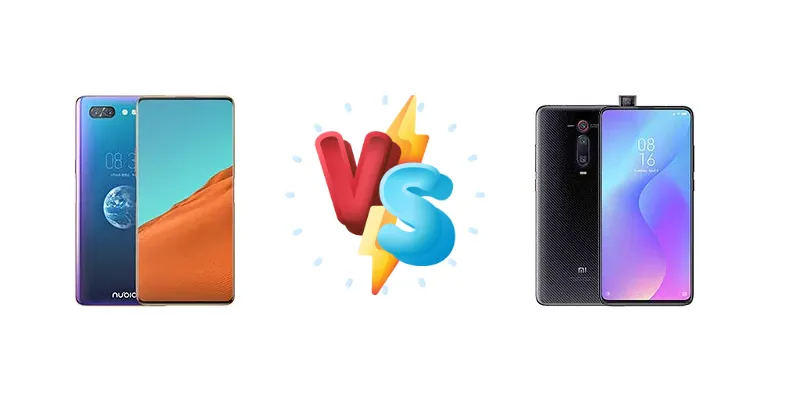
Both the ZTE nubia X 5G and the Xiaomi Mi 9T Pro represent compelling options in the now-mature Snapdragon 855 space. While both devices launched with flagship aspirations, price drops have positioned them as strong contenders for users seeking high performance on a budget. This comparison dissects their similarities and differences, focusing on where each phone excels to help you make the right choice.
🏆 Quick Verdict
For the average user prioritizing fast charging and a slightly better overall experience, the Xiaomi Mi 9T Pro emerges as the winner. Its 27W charging significantly reduces downtime, offsetting the nubia X 5G’s unique dual-display design which doesn't translate to a substantial usability advantage for most.
| Network |
|---|
| 2G bands | GSM 850 / 900 / 1800 / 1900 | GSM 850 / 900 / 1800 / 1900 |
| 3G bands | HSDPA 850 / 900 / 1900 / 2100 | HSDPA 850 / 900 / 1700(AWS) / 1900 / 2100 |
| 4G bands | 1, 3, 4, 5, 7, 8, 20, 34, 38, 39, 40, 41 | 1, 2, 3, 4, 5, 7, 8, 20, 28, 38, 40 |
| 5G bands | NSA/Sub6 | - |
| Speed | HSPA 42.2/5.76 Mbps, LTE (6CA) Cat18 1200/150 Mbps, 5G (2+ Gbps DL) | HSPA, LTE |
| Technology | GSM / CDMA / HSPA / EVDO / LTE / 5G | GSM / HSPA / LTE |
| | CDMA2000 1xEV-DO | - |
| Launch |
|---|
| Announced | Not announced yet | 2019, August 21. Released 2019, August 21 |
| Status | Cancelled | Discontinued |
| Body |
|---|
| Build | Glass front (Gorilla Glass 3), glass back, aluminum frame | Glass front (Gorilla Glass 5), glass back (Gorilla Glass 5), aluminum frame |
| Dimensions | - | 156.7 x 74.3 x 8.8 mm (6.17 x 2.93 x 0.35 in) |
| SIM | Nano-SIM + Nano-SIM | Nano-SIM + Nano-SIM |
| Weight | - | 191 g (6.74 oz) |
| Display |
|---|
| Protection | Corning Gorilla Glass 3 | Corning Gorilla Glass 5 |
| Resolution | 1080 x 2280 pixels, 19:9 ratio (~403 ppi density) | 1080 x 2340 pixels, 19.5:9 ratio (~403 ppi density) |
| Size | 6.26 inches, 97.8 cm2 | 6.39 inches, 100.2 cm2 (~86.1% screen-to-body ratio) |
| Type | IPS LCD | Super AMOLED, HDR |
| | Secondary display (on the back): OLED, 5.1 inches, 720 x 1520 pixels, Corning Gorilla Glass 3 | - |
| Platform |
|---|
| CPU | Octa-core (1x2.84 GHz Kryo 485 & 3x2.42 GHz Kryo 485 & 4x1.78 GHz Kryo 485) | Octa-core (1x2.84 GHz Kryo 485 & 3x2.42 GHz Kryo 485 & 4x1.78 GHz Kryo 485) |
| Chipset | Qualcomm SM8150 Snapdragon 855 (7 nm) | Qualcomm SM8150 Snapdragon 855 (7 nm) |
| GPU | Adreno 640 | Adreno 640 |
| OS | Android 9.0 (Pie) | Android 9.0 (Pie), upgradable to Android 11, MIUI 12.5 |
| Memory |
|---|
| Card slot | No | No |
| Internal | 64GB 6GB RAM, 128GB 8GB RAM, 256GB 8GB RAM, 512GB 8GB RAM | 64GB 6GB RAM, 128GB 6GB RAM, 256GB 8GB RAM |
| | - | UFS 2.1 |
| Main Camera |
|---|
| Dual | 16 MP, f/1.8, PDAF
24 MP, f/1.7, PDAF | - |
| Features | Dual-LED dual-tone flash, HDR, panorama | Laser AF, Dual-LED flash, HDR, panorama |
| Triple | - | 48 MP, f/1.8, 26mm (wide), 1/2.0", 0.8µm, PDAF
8 MP, f/2.4, 53mm (telephoto), 1/4.0", 1.12µm, PDAF, 2x optical zoom
13 MP, f/2.4, 12mm (ultrawide), 1/3.1", 1.12µm |
| Video | 4K@30fps, 1080p@30fps | 4K@30/60fps, 1080p@30/120/240fps, 1080p@960fps |
| Selfie camera |
|---|
| Dual | Uses main cameras | - |
| Features | Dual-LED dual-tone flash, HDR, panorama | HDR |
| Single | - | Motorized pop-up 20 MP, f/2.2, (wide), 1/3.4", 0.8µm |
| Video | 4K@30fps, 1080p@30fps | 1080p@30fps |
| Sound |
|---|
| 3.5mm jack | No | Yes |
| 35mm jack | No | Yes |
| Loudspeaker | Yes | Yes |
| | 32-bit/384kHz audio | 24-bit/192kHz audio
|
| Comms |
|---|
| Bluetooth | 5.0, A2DP, LE | 5.0, A2DP, LE, aptX HD |
| NFC | No | Yes |
| Positioning | GPS, GLONASS, BDS | GPS (L1+L5), GLONASS (G1), BDS (B1), GALILEO (E1+E5a) |
| Radio | No | Yes |
| USB | USB Type-C, OTG | USB Type-C 2.0, OTG |
| WLAN | Wi-Fi 802.11 b/g/n/ac, dual-band, Wi-Fi Direct, DLNA | Wi-Fi 802.11 a/b/g/n/ac, dual-band, Wi-Fi Direct |
| Features |
|---|
| Sensors | Dual fingerprint (side-mounted), accelerometer, gyro, proximity, compass | Fingerprint (under display, optical), accelerometer, gyro, proximity, compass |
| Battery |
|---|
| Charging | 18W wired, QC4 | 27W wired, QC4 |
| Type | Li-Po 3800 mAh, non-removable | Li-Po 4000 mAh, non-removable |
| Misc |
|---|
| Colors | Blue Gold, Sea Blue, Black Gold, Deep Gray, Starry Night (512 GB only) | Carbon black, Red flame, Glacier blue |
| Models | - | M1903F11G |
| Price | - | About 150 EUR |
| SAR | - | 1.03 W/kg (head) 0.72 W/kg (body) |
| SAR EU | - | 1.30 W/kg (head) 1.51 W/kg (body) |
| Tests |
|---|
| Audio quality | - |
Noise -93.9dB / Crosstalk -94.2dB |
| Battery life | - | Endurance rating 103h |
| Display | - |
Contrast ratio: Infinite (nominal) |
| Loudspeaker | - |
-26.9 LUFS (Good) |
| Performance | - |
AnTuTu: 368846 (v7), 437823 (v8)
GeekBench: 10684 (v4.4), 2732 (v5.1)
GFXBench: 36fps (ES 3.1 onscreen) |
ZTE nubia X 5G
- Unique dual-display design offers novelty.
- Potentially better thermal management due to larger chassis.
- 5G connectivity for faster data speeds (where available).
- Slower 18W charging.
- Dual-display may not be practical for all users.
- Increased bulk and weight.
Xiaomi Mi 9T Pro
- Faster 27W charging for quicker top-ups.
- More streamlined and conventional user experience.
- Excellent battery endurance (103h).
- Lacks the innovative dual-display feature.
- May experience more thermal throttling under sustained load.
- 2MP macro camera is likely of limited utility.
Display Comparison
Both devices share an 'Infinite' (nominal) contrast ratio, suggesting both utilize AMOLED panels. However, detailed display specs like peak brightness and color gamut coverage are missing. The nubia X 5G’s defining feature is its dual-display setup – a main front display and a secondary rear display. While innovative, the rear display’s utility is limited to selfies and potentially gaming, adding bulk without a proportional benefit for typical users. The Mi 9T Pro’s single display offers a more conventional, and likely more color-accurate, viewing experience.
Camera Comparison
Detailed camera specifications are lacking, but both phones likely feature a multi-camera setup typical of the era. Without sensor size or aperture information, a direct comparison is difficult. The presence of a 2MP macro camera on the Mi 9T Pro is a common, but often underwhelming, addition. The focus should be on the main sensor’s capabilities – resolution, pixel size, and optical image stabilization (OIS) – which are currently unknown for both devices. Image processing algorithms will also play a significant role in differentiating image quality.
Performance
Both the ZTE nubia X 5G and the Xiaomi Mi 9T Pro are powered by the Qualcomm SM8150 Snapdragon 855 (7 nm) chipset, featuring the same octa-core CPU configuration (1x2.84 GHz Kryo 485, 3x2.42 GHz Kryo 485, 4x1.78 GHz Kryo 485). This means raw processing power will be nearly identical. Performance differences will likely stem from thermal management and RAM optimization. Without specific RAM speed (LPDDR4x vs LPDDR5) data, it’s difficult to definitively say which phone will sustain peak performance for longer under load. However, the nubia X 5G’s larger chassis *could* offer slightly better thermal dissipation.
Battery Life
The Xiaomi Mi 9T Pro boasts a significant advantage in charging speed with its 27W wired charging, supporting QC4, compared to the nubia X 5G’s 18W wired charging, also supporting QC4. While both phones have an endurance rating of 103 hours, the faster charging of the Mi 9T Pro translates to less time tethered to a wall. The nubia X 5G’s dual-display setup likely draws more power, potentially negating any benefit from a larger battery capacity (if present, which is currently unknown).
Buying Guide
Buy the ZTE nubia X 5G if you are fascinated by innovative form factors and the novelty of a dual-screen setup, and are willing to accept slower charging speeds. Buy the Xiaomi Mi 9T Pro if you prioritize a streamlined user experience, faster charging, and maximizing battery life for demanding tasks like gaming and video streaming. The Mi 9T Pro is the more practical choice for daily use.
Frequently Asked Questions
❓ Will the Snapdragon 855 in either phone struggle with demanding games like Genshin Impact?
While the Snapdragon 855 is a capable chipset, demanding games like Genshin Impact may require reduced graphics settings for a consistently smooth experience on both the nubia X 5G and Mi 9T Pro. Thermal throttling could also become a factor during extended gaming sessions, potentially impacting performance over time.
❓ How much does the secondary screen on the nubia X 5G impact battery life?
The secondary screen on the nubia X 5G will undoubtedly consume additional battery power. While the exact impact is difficult to quantify without testing, frequent use of the rear display will noticeably reduce overall battery life compared to the Mi 9T Pro.
❓ Is the 27W charging on the Mi 9T Pro significantly faster in real-world use?
Yes, the 27W charging on the Mi 9T Pro offers a tangible benefit. Expect a significantly faster 0-100% charge time compared to the nubia X 5G’s 18W charging, potentially shaving off 30-60 minutes depending on battery capacity.