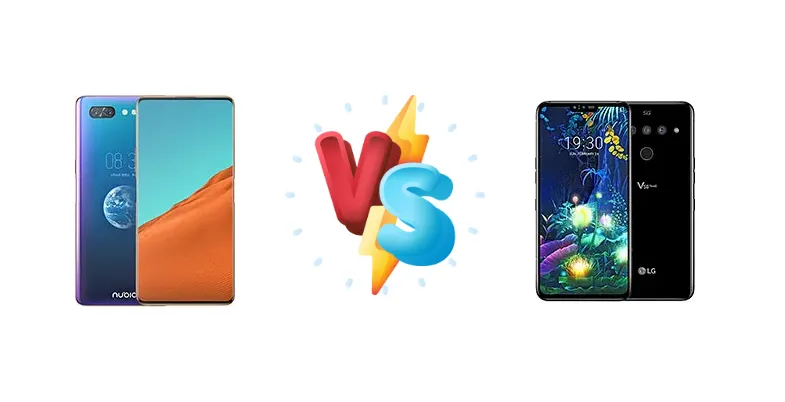
Released in the early days of 5G, both the ZTE nubia X 5G and LG V50 ThinQ 5G represented ambitious attempts at pushing smartphone boundaries. Now, with prices significantly reduced, they offer compelling value. This comparison dissects their similarities and differences, focusing on how their core specs translate to real-world performance and usability in 2024.
🏆 Quick Verdict
For the average user prioritizing longevity and consistent performance, the LG V50 ThinQ 5G emerges as the better choice. Its impressive 96-hour endurance rating, coupled with faster and more versatile charging options (including wireless), outweighs the nubia X 5G’s slightly faster wired charging.
| Network |
|---|
| 2G bands | GSM 850 / 900 / 1800 / 1900 | GSM 850 / 900 / 1800 / 1900 |
| 3G bands | HSDPA 850 / 900 / 1900 / 2100 | HSDPA 850 / 900 / 1700(AWS) / 1900 / 2100 - USA |
| 4G bands | 1, 3, 4, 5, 7, 8, 20, 34, 38, 39, 40, 41 | 1, 2, 3, 4, 5, 7, 8, 12, 13, 17, 20, 25, 26, 28, 40, 41, 46, 66, 71 - USA |
| 5G bands | NSA/Sub6 | 41, 260, 261 NSA |
| Speed | HSPA 42.2/5.76 Mbps, LTE (6CA) Cat18 1200/150 Mbps, 5G (2+ Gbps DL) | HSPA 42.2/5.76 Mbps, LTE (6CA) Cat18 1200/75 Mbps, 5G (2+ Gbps DL) |
| Technology | GSM / CDMA / HSPA / EVDO / LTE / 5G | GSM / CDMA / HSPA / EVDO / LTE / 5G |
| | CDMA2000 1xEV-DO | CDMA2000 1xEV-DO |
| Launch |
|---|
| Announced | Not announced yet | 2019, February 24. Released 2019, April 19 |
| Status | Cancelled | Discontinued |
| Body |
|---|
| Build | Glass front (Gorilla Glass 3), glass back, aluminum frame | Glass front (Gorilla Glass 5), glass back (Gorilla Glass 6), aluminum frame |
| Dimensions | - | 159.2 x 76.1 x 8.3 mm (6.27 x 3.00 x 0.33 in) |
| SIM | Nano-SIM + Nano-SIM | · Nano-SIM· Nano-SIM + Nano-SIM |
| Weight | - | 183 g (6.46 oz) |
| | - | IP68 dust/water resistant (up to 1.5m for 30 min)
MIL-STD-810G compliant*
*does not guarantee ruggedness or use in extreme conditions |
| Display |
|---|
| Protection | Corning Gorilla Glass 3 | Corning Gorilla Glass 5 |
| Resolution | 1080 x 2280 pixels, 19:9 ratio (~403 ppi density) | 1440 x 3120 pixels, 19.5:9 ratio (~538 ppi density) |
| Size | 6.26 inches, 97.8 cm2 | 6.4 inches, 100.2 cm2 (~82.7% screen-to-body ratio) |
| Type | IPS LCD | P-OLED, HDR10 |
| | Secondary display (on the back): OLED, 5.1 inches, 720 x 1520 pixels, Corning Gorilla Glass 3 | Always-on display |
| Platform |
|---|
| CPU | Octa-core (1x2.84 GHz Kryo 485 & 3x2.42 GHz Kryo 485 & 4x1.78 GHz Kryo 485) | Octa-core (1x2.84 GHz Kryo 485 & 3x2.42 GHz Kryo 485 & 4x1.78 GHz Kryo 485) |
| Chipset | Qualcomm SM8150 Snapdragon 855 (7 nm) | Qualcomm SM8150 Snapdragon 855 (7 nm) |
| GPU | Adreno 640 | Adreno 640 |
| OS | Android 9.0 (Pie) | Android 9.0 (Pie), upgradable to Android 11 |
| Memory |
|---|
| Card slot | No | microSDXC (dedicated slot) |
| Internal | 64GB 6GB RAM, 128GB 8GB RAM, 256GB 8GB RAM, 512GB 8GB RAM | 128GB 6GB RAM |
| | - | UFS 2.1 |
| Main Camera |
|---|
| Dual | 16 MP, f/1.8, PDAF
24 MP, f/1.7, PDAF | - |
| Features | Dual-LED dual-tone flash, HDR, panorama | LED flash, HDR, panorama |
| Triple | - | 12 MP, 27mm (wide), f/1.5, 1/2.55", 1.4µm, dual pixel PDAF, 3-axis OIS
12 MP, 52mm (telephoto), f/2.4, 1/3.4", 1.0µm, 2x optical zoom, PDAF, OIS
16 MP, 16mm (ultrawide), f/1.9, 1/3.1", 1.0µm, no AF |
| Video | 4K@30fps, 1080p@30fps | 4K@30/60fps, 1080p@30/60/240fps, 24-bit/192kHz stereo sound rec., HDR10 video, gyro-EIS |
| Selfie camera |
|---|
| Dual | Uses main cameras | 8 MP, f/1.9, 26mm (wide), 1/4.0", 1.12µm
5 MP, 21mm (wide), f/2.2, 1/5.0", 1.12µm |
| Features | Dual-LED dual-tone flash, HDR, panorama | HDR |
| Video | 4K@30fps, 1080p@30fps | 1080p@60fps |
| Sound |
|---|
| 3.5mm jack | No | Yes |
| 35mm jack | No | Yes |
| Loudspeaker | Yes | Yes, with stereo speakers |
| | 32-bit/384kHz audio | 32-bit/192kHz audio
24-bit/192kHz audio recording
Tuned with Meridian Audio |
| Comms |
|---|
| Bluetooth | 5.0, A2DP, LE | 5.0, A2DP, LE, aptX HD |
| NFC | No | Yes |
| Positioning | GPS, GLONASS, BDS | GPS, GLONASS, GALILEO |
| Radio | No | FM radio |
| USB | USB Type-C, OTG | USB Type-C 3.1 |
| WLAN | Wi-Fi 802.11 b/g/n/ac, dual-band, Wi-Fi Direct, DLNA | Wi-Fi 802.11 a/b/g/n/ac, dual-band, Wi-Fi Direct, DLNA |
| Features |
|---|
| Sensors | Dual fingerprint (side-mounted), accelerometer, gyro, proximity, compass | Fingerprint (rear-mounted), accelerometer, gyro, proximity, compass, barometer |
| Battery |
|---|
| Charging | 18W wired, QC4 | 18W wired, PD2.0, QC3, 50% in 36 min
10W wireless (Qi) |
| Type | Li-Po 3800 mAh, non-removable | Li-Po 4000 mAh, non-removable |
| Misc |
|---|
| Colors | Blue Gold, Sea Blue, Black Gold, Deep Gray, Starry Night (512 GB only) | New Aurora Black |
| Models | - | LM-V500, LM-V500N, LM-V500EM, LM-V500XM, LM-V450PM, LM-V450 |
| Price | - | About 550 EUR |
| Tests |
|---|
| Audio quality | - |
Noise -92.5dB / Crosstalk -92.6dB |
| Battery life | - |
Endurance rating 96h
|
| Camera | - |
Photo / Video |
| Display | - |
Contrast ratio: 194000:1 (nominal) |
| Loudspeaker | - |
-25.2 LUFS (Very good)
|
| Performance | - |
AnTuTu: 343758 (v7), 421934 (v8)
GeekBench: 10928 (v4.4), 2672 (v5.1)
GFXBench: 22fps (ES 3.1 onscreen) |
ZTE nubia X 5G
- Potentially lower price point
- QC4 fast charging support
- Snapdragon 855 5G connectivity
- Unknown battery capacity
- Limited charging versatility
- Missing display specifications
LG V50 ThinQ 5G
- Exceptional 96-hour battery life
- Versatile charging options (wired, wireless, PD2.0, QC3)
- High contrast ratio display (194000:1)
- Older chipset generation
- Peak brightness limited to 533 nits
- Camera specs are vague
Display Comparison
Both phones lack detailed display specifications beyond the LG V50’s measured 533 nits of peak brightness and a remarkable 194000:1 contrast ratio. This high contrast ratio suggests deeper blacks and a more vibrant image, benefiting video playback and gaming. The nubia X 5G’s display details are absent, but given its market positioning, it likely prioritizes refresh rate over peak brightness. Users heavily invested in HDR content will likely prefer the LG V50’s superior contrast.
Camera Comparison
Both devices are listed as having 'Photo / Video' capabilities, offering minimal insight. Without sensor size or aperture details, a direct comparison is difficult. However, LG historically focused on versatile camera systems with strong video recording capabilities. The nubia X 5G, while potentially offering competitive image quality, likely lacks the refined software processing found in LG’s flagship models. The absence of specific camera specs suggests neither phone will compete with modern smartphone camera technology.
Performance
Both the ZTE nubia X 5G and LG V50 ThinQ 5G are powered by the Qualcomm SM8150 Snapdragon 855 (7 nm) chipset, featuring an identical octa-core CPU configuration. This means raw processing power will be nearly indistinguishable between the two. However, the LG V50’s thermal management, while not explicitly detailed, benefits from LG’s history of robust cooling solutions in their flagship devices. This could translate to slightly less throttling during sustained workloads like gaming. Both rely on the Snapdragon 855’s integrated 5G modem, offering comparable 5G connectivity speeds.
Battery Life
The LG V50 ThinQ 5G boasts a significant advantage in battery life, achieving an impressive 96-hour endurance rating. While the nubia X 5G’s battery capacity is unknown, the LG V50’s longevity is a major selling point for power users. Charging speeds are comparable with both supporting 18W wired charging, but the LG V50 adds PD2.0, QC3, and 10W wireless charging (Qi), offering greater flexibility. The LG V50 can reach 50% charge in 36 minutes, a slight edge over the nubia X 5G’s QC4-enabled charging.
Buying Guide
Buy the ZTE nubia X 5G if you prioritize a potentially lower price point and are comfortable with a phone that may require more frequent charging. Buy the LG V50 ThinQ 5G if you value exceptional battery life, faster and more flexible charging options, and a higher contrast display for media consumption.
Frequently Asked Questions
❓ Does the LG V50 ThinQ 5G still receive software updates?
LG has ceased major software updates for the V50 ThinQ 5G. However, it still receives security patches, ensuring a reasonable level of security. Expect the phone to remain functional for several years, but without the latest Android features.
❓ Is the 18W charging speed on both phones considered slow by today's standards?
Yes, 18W charging is relatively slow compared to modern smartphones that often support 25W, 45W, or even 65W charging. However, the LG V50’s wireless charging and PD2.0 support offer some flexibility, while both phones will still charge overnight without issue.
❓ Will the Snapdragon 855 in either phone struggle with demanding games in 2024?
While the Snapdragon 855 remains a capable chipset, it will likely exhibit some throttling during extended gaming sessions, especially with graphically intensive titles. Lowering graphics settings can mitigate this issue. The LG V50’s potentially better thermal management might offer a slight advantage.
❓ What 5G bands does the LG V50 ThinQ 5G support?
The LG V50 ThinQ 5G supports a wide range of 5G bands, including n2, n5, n66, n71, and others, ensuring compatibility with most 5G networks in North America and Europe. Specific band support varies by carrier and region.