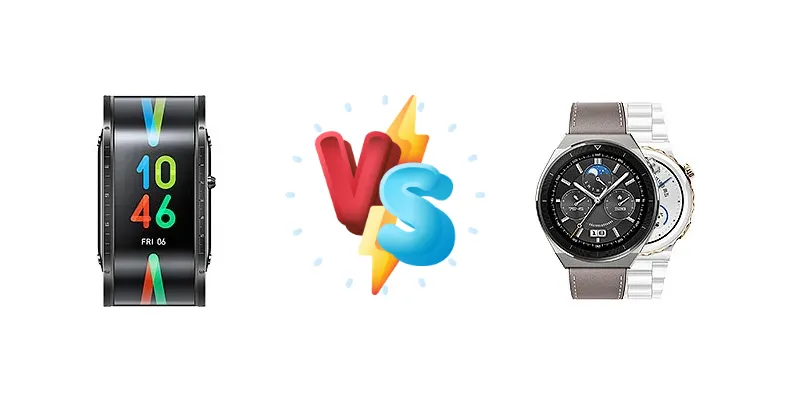
The smartwatch market offers a spectrum of choices, from fully-featured Wear OS devices to those running proprietary operating systems. We pit the ZTE nubia Watch, powered by the older Qualcomm Snapdragon Wear 2100, against the Huawei Watch GT 3 Pro, a device prioritizing battery life and a refined user experience within Huawei’s ecosystem. This comparison focuses on the trade-offs between app availability and raw performance versus optimized efficiency and health tracking.
🏆 Quick Verdict
For the average user prioritizing long battery life and a polished, streamlined experience, the Huawei Watch GT 3 Pro is the better choice. However, the ZTE nubia Watch offers the flexibility of Wear OS, albeit an older version, for those deeply invested in Google’s app ecosystem.
| Network |
|---|
| 2G bands | GSM 1800 | N/A |
| 3G bands | HSDPA 2100 | N/A |
| 4G bands | 1, 3, 38, 39, 40, 41 | N/A |
| EDGE | No | No |
| GPRS | Class 10 | No |
| Speed | HSPA, LTE | No |
| Technology | GSM / HSPA / LTE | No cellular connectivity |
| Launch |
|---|
| Announced | 2020, July 28. Released 2020, August 05 | 2022, April 28 |
| Status | Discontinued | Available. Released 2022, May 05 |
| Body |
|---|
| Build | Plastic front (display), stainless steel 316L & aluminum alloy frame | Sapphire crystal front, titanium frame or ceramic frame, ceramic back |
| Dimensions | 125 x 41.5 x 14.2 mm (4.92 x 1.63 x 0.56 in) | 46.6 x 46.6 x 10.9 mm (1.83 x 1.83 x 0.43 in) |
| SIM | eSIM | No |
| Weight | 98 g (3.46 oz) | 50 g (43mm) / 54 g (46mm) (1.76 oz) |
| | - | 30m water resistant
5 ATM
IP68
Compatible with standard 22mm straps (46mm model), 20mm straps (43mm model)
ECG certified |
| Display |
|---|
| Protection | Corning Gorilla Glass | - |
| Resolution | 192 x 960 pixels (~244 ppi density) | 466 x 466 pixels (~326 ppi density) |
| Size | 4.01 inches | 1.43 inches |
| Type | AMOLED | AMOLED |
| Platform |
|---|
| CPU | Quad-core 1.1 GHz Cortex-A7 | - |
| Chipset | Qualcomm MSM8909W Snapdragon Wear 2100 | - |
| GPU | Adreno 304 | - |
| OS | Proprietary OS | HarmonyOS 2.0, upgradable to 3.0 |
| Memory |
|---|
| Call records | Yes | - |
| Card slot | No | No |
| Internal | 8GB 1GB RAM | 32GB |
| Phonebook | 500 entries | - |
| | eMMC 4.5 | - |
| Main Camera |
|---|
| Single | Yes | - |
| Video | No | - |
| Sound |
|---|
| 3.5mm jack | No | No |
| 35mm jack | No | No |
| Loudspeaker | Yes | Yes |
| Comms |
|---|
| Bluetooth | 5.0, A2DP, LE | 5.2, A2DP, LE |
| NFC | No | Yes |
| Positioning | GPS | GPS (L1+L5), GLONASS, BDS, GALILEO, QZSS |
| Radio | No | No |
| USB | No | No |
| WLAN | Wi-Fi 802.11 b/g/n | No |
| Features |
|---|
| Browser | WAP 2.0/xHTML | - |
| Games | Downloadable | - |
| Java | No | - |
| Messaging | SMS, MMS | - |
| Sensors | Accelerometer, gyro, heart rate, compass | Accelerometer, gyro, heart rate, barometer, compass, SpO2, thermometer (body temperature) |
| | MP3 player
Photo/video viewer
Voice dial/commands | - |
| Battery |
|---|
| Charging | - | Wireless |
| Stand-by | Up to 240 h | - |
| Talk time | Up to 3h | - |
| Type | Li-Ion 420 mAh | Li-Po 530 mAh |
| Misc |
|---|
| Colors | Black, Red, Green | Silver |
| Models | - | ODN-B19, FRG-B19 |
| Price | About 220 EUR | About 200 EUR |
ZTE nubia Watch
- Access to Wear OS app ecosystem
- Potential for custom watch faces and complications
- More open platform for developers
- Outdated Snapdragon Wear 2100 chipset
- Poor battery life compared to competitors
- Slower performance and potential lag
Huawei Watch GT 3 Pro
- Exceptional battery life
- Wireless charging convenience
- Optimized and responsive user interface
- Limited app ecosystem compared to Wear OS
- Reliance on Huawei’s proprietary OS
- Potential concerns regarding data privacy
Display Comparison
Context data lacks display specifics for both devices. However, given the nubia Watch’s age, it likely utilizes an older AMOLED panel with a standard refresh rate. The GT 3 Pro, being a more recent premium offering, likely features a higher-resolution AMOLED display, potentially with LTPO technology for adaptive refresh rates, resulting in improved power efficiency and smoother animations. Bezels are likely thinner on the GT 3 Pro, contributing to a more modern aesthetic.
Camera Comparison
Neither device is marketed for its camera capabilities, and context data provides no information. Smartwatches generally feature low-resolution cameras primarily for quick scans or remote control functionality. It’s safe to assume any camera performance difference will be minimal and not a deciding factor for most users.
Performance
The ZTE nubia Watch’s Qualcomm MSM8909W Snapdragon Wear 2100, with its quad-core 1.1 GHz Cortex-A7 CPU, represents a significant generational gap compared to the processing capabilities within the Huawei Watch GT 3 Pro. While Huawei doesn’t disclose the chipset details, their proprietary OS is heavily optimized for the hardware, resulting in a smoother, more responsive experience than the Wear 2100 can deliver. The Wear 2100 struggles with demanding apps and animations, while the GT 3 Pro prioritizes efficiency. The nubia Watch’s performance will be noticeably slower when launching apps or navigating complex interfaces.
Battery Life
Context data lacks battery capacity for both devices. However, the Huawei Watch GT 3 Pro’s focus on battery life, coupled with its optimized OS, strongly suggests a significantly longer runtime between charges than the ZTE nubia Watch. The nubia Watch, running Wear OS, is known for its comparatively poor battery performance. Furthermore, the GT 3 Pro’s inclusion of wireless charging offers a convenient charging experience, while the nubia Watch likely relies on a traditional charging cradle.
Buying Guide
Buy the ZTE nubia Watch if you absolutely require access to the broader Wear OS app library and are comfortable with potentially slower performance and shorter battery life. Buy the Huawei Watch GT 3 Pro if you prioritize exceptional battery life, a refined user interface, and comprehensive health tracking features, and are willing to operate within Huawei’s app ecosystem.
Frequently Asked Questions
❓ Is the Snapdragon Wear 2100 in the ZTE nubia Watch powerful enough for everyday use?
The Snapdragon Wear 2100 is a dated chipset. While it can handle basic notifications and simple apps, expect noticeable lag when launching apps, navigating complex interfaces, or using demanding features. It’s sufficient for core smartwatch functions but won’t provide a fluid, modern experience.
❓ How does Huawei’s proprietary OS compare to Wear OS in terms of app availability?
Huawei’s OS has a significantly smaller app ecosystem than Wear OS. While it offers essential apps for health tracking, notifications, and basic functions, you won’t find the same breadth of third-party apps available on Wear OS. This is a key trade-off for the GT 3 Pro’s improved battery life and performance.
❓ Does the Huawei Watch GT 3 Pro require a Huawei phone to function fully?
No, the Huawei Watch GT 3 Pro can connect to both Android and iOS devices via Bluetooth. However, some features, such as seamless app syncing and certain health data integrations, may be more limited when paired with a non-Huawei phone.