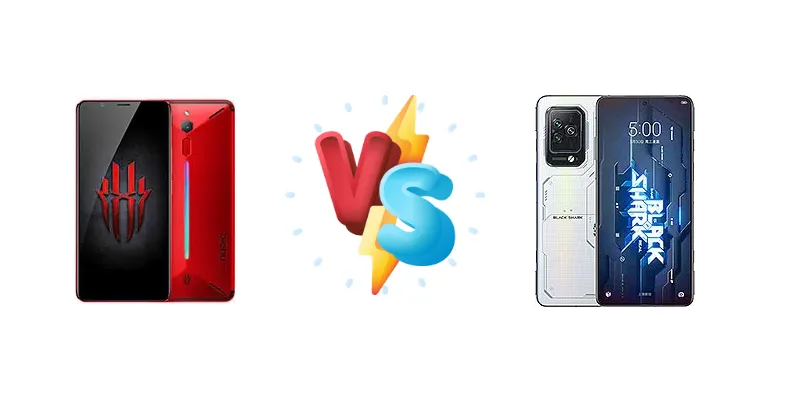
The gaming phone market has matured, but two brands consistently deliver: ZTE's nubia RedMagic and Xiaomi's Black Shark. We're pitting the RedMagic, powered by the older Snapdragon 835, against the Black Shark 5 Pro, boasting the latest Snapdragon 8 Gen 1, to determine which offers the best experience for mobile gamers, especially considering the significant price differences often seen between these generations.
🏆 Quick Verdict
For the average gamer prioritizing raw performance and future-proofing, the Xiaomi Black Shark 5 Pro is the clear winner. Its Snapdragon 8 Gen 1 chipset and 120W charging drastically outperform the RedMagic's aging hardware. However, the RedMagic remains a viable option for budget-conscious gamers who don't demand the absolute latest technology.
| Network |
|---|
| 2G bands | GSM 850 / 900 / 1800 / 1900 | GSM 850 / 900 / 1800 / 1900 |
| 3G bands | HSDPA 850 / 900 / 1900 / 2100 | HSDPA 800 / 850 / 900 / 1700(AWS) / 1900 / 2100 |
| 4G bands | 1, 3, 5, 7, 8, 20, 34, 38, 39, 40, 41 | 1, 2, 3, 4, 5, 7, 8, 12, 17, 18, 19, 26, 28, 34, 38, 39, 40, 41 |
| 5G bands | - | 1, 3, 8, 28, 41, 77, 78, 79 SA/NSA |
| Speed | HSPA 42.2/5.76 Mbps, LTE (5CA) Cat16 1024/150 Mbps | HSPA, LTE, 5G |
| Technology | GSM / CDMA / HSPA / EVDO / LTE | GSM / CDMA / HSPA / EVDO / LTE / 5G |
| Launch |
|---|
| Announced | 2018, April. Released 2018, April | 2022, March 30 |
| Status | Discontinued | Available. Released 2022, April 04 |
| Body |
|---|
| Build | Glass front (Dinorex T2X-1), aluminum back, aluminum frame | - |
| Dimensions | 158.1 x 74.9 x 9.5 mm (6.22 x 2.95 x 0.37 in) | 163.9 x 76.5 x 9.5 mm (6.45 x 3.01 x 0.37 in) |
| SIM | Nano-SIM + Nano-SIM | Nano-SIM + Nano-SIM |
| Weight | 185 g (6.53 oz) | 220 g (7.76 oz) |
| Display |
|---|
| Protection | Dinorex T2X-1 scratch/shock resistant glass | - |
| Resolution | 1080 x 2160 pixels, 18:9 ratio (~402 ppi density) | 1080 x 2400 pixels, 20:9 ratio (~395 ppi density) |
| Size | 6.0 inches, 92.9 cm2 (~78.5% screen-to-body ratio) | 6.67 inches, 107.4 cm2 (~85.7% screen-to-body ratio) |
| Type | IPS LCD | OLED, 1B colors, 144Hz, HDR10+ |
| Platform |
|---|
| CPU | Octa-core (4x2.35 GHz Kryo & 4x1.9 GHz Kryo) | Octa-core (1x3.00 GHz Cortex-X2 & 3x2.50 GHz Cortex-A710 & 4x1.80 GHz Cortex-A510) |
| Chipset | Qualcomm MSM8998 Snapdragon 835 (10 nm) | Qualcomm SM8450 Snapdragon 8 Gen 1 (4 nm) |
| GPU | Adreno 540 | Adreno 730 |
| OS | Android 8.1 (Oreo), Redmagic 1.0 | Android 12, Joy UI 13 |
| Memory |
|---|
| Card slot | No | No |
| Internal | 64GB 6GB RAM, 128GB 8GB RAM | 128GB 8GB RAM, 256GB 8GB RAM, 256GB 12GB RAM, 512GB 16GB RAM |
| Main Camera |
|---|
| Features | LED flash, HDR, panorama | LED flash, HDR, panorama |
| Single | 24 MP, f/1.7, PDAF | 16 MP, (wide), 1/3.06", 1.0µm |
| Triple | - | 108 MP, f/1.8, (wide), 1/1.52", 0.7µm, PDAF
13 MP, f/2.4, 120˚ (ultrawide), 1/3.06", 1.12µm
5 MP, f/2.4, (telephoto macro), AF |
| Video | 4K@30fps, 1080p@30fps | 4K@30/60fps, 1080p@30/60/240fps, 1080p@960fps; HDR10+ |
| Selfie camera |
|---|
| Features | - | HDR |
| Single | 8 MP, f/2.0 | 16 MP, (wide), 1/3.06", 1.0µm |
| Video | 1080p@30fps | 1080p@30fps |
| Sound |
|---|
| 3.5mm jack | - | No |
| 35mm jack | Yes | No |
| Loudspeaker | Yes | Yes, with stereo speakers |
| Comms |
|---|
| Bluetooth | 5.0, A2DP, aptX, LE | 5.2, A2DP, LE, aptX HD, aptX Adaptive |
| NFC | No | Yes |
| Positioning | GPS, GLONASS, BDS | GPS, GLONASS, GALILEO, QZSS, BDS |
| Radio | No | No |
| USB | USB Type-C, OTG | USB Type-C 2.0, video output |
| WLAN | Wi-Fi 802.11 a/b/g/n/ac, dual-band, Wi-Fi Direct | Wi-Fi 802.11 a/b/g/n/ac/6, dual-band, Wi-Fi Direct |
| Features |
|---|
| Sensors | Fingerprint (rear-mounted), accelerometer, gyro, proximity, compass | Fingerprint (side-mounted), accelerometer, gyro, proximity, compass, barometer (China only) |
| Battery |
|---|
| Charging | 18W wired | 120W wired, 100% in 15 min |
| Type | Li-Po 3800 mAh, non-removable | Li-Po 4650 mAh |
| Misc |
|---|
| Colors | Black, Red, Flame Red | Black, White |
| Models | NX609J | SHARK KTUS-H0 |
| Price | About 400 EUR | About 720 EUR |
| Tests |
|---|
| Battery life | - |
Endurance rating 83h
|
| Camera | - |
Photo / Video |
| Display | - |
Contrast ratio: Infinite (nominal) |
| Performance | - |
AnTuTu: 876704 (v8), 1007133 (v9)
GeekBench: 3665 (v5.1)
GFXBench: 82fps (ES 3.1 onscreen) |
ZTE nubia RedMagic
- More affordable price point (typically)
- Functional gaming features for casual use
- Established gaming brand reputation
- Outdated Snapdragon 835 chipset
- Slow 18W charging
- Limited display specifications
Xiaomi Black Shark 5 Pro
- Cutting-edge Snapdragon 8 Gen 1 performance
- Ultra-fast 120W charging (15 minutes to full)
- Brighter and higher contrast display
- Higher price tag
- Potential for thermal throttling under extreme load (though mitigated by 4nm process)
- Larger size and weight
Display Comparison
The Black Shark 5 Pro boasts a significantly brighter display at 682 nits, offering superior visibility in outdoor conditions compared to the RedMagic, whose brightness is not specified. While both phones offer a 'Photo/Video' capable camera, the display's infinite contrast ratio on the Black Shark 5 Pro suggests a superior viewing experience for gaming content. The RedMagic's display specifications are limited, making a direct comparison of color accuracy and panel technology difficult, but the Black Shark 5 Pro's modern panel is likely to offer a more vibrant and immersive experience.
Camera Comparison
Both devices list 'Photo/Video' capabilities, but detailed camera specifications are lacking for the RedMagic. The Black Shark 5 Pro likely benefits from the newer image signal processor (ISP) within the Snapdragon 8 Gen 1, enabling improved image processing and potentially better low-light performance. Without specific sensor details for the RedMagic, it's difficult to assess its camera quality, but the Black Shark 5 Pro is expected to deliver a more versatile and capable camera system.
Performance
The performance gap is substantial. The Xiaomi Black Shark 5 Pro's Snapdragon 8 Gen 1 (4nm) is a generational leap over the ZTE nubia RedMagic's Snapdragon 835 (10nm). The 8 Gen 1 features a Cortex-X2 prime core clocked at 3.00 GHz, alongside Cortex-A710 and A510 cores, offering significantly improved CPU and GPU performance. The 4nm process node also translates to better thermal efficiency, potentially mitigating throttling during extended gaming sessions – a common issue with the older 835. While the RedMagic was a flagship in its time, the Black Shark 5 Pro offers a demonstrably smoother and more responsive gaming experience.
Battery Life
Both phones achieve an endurance rating of 83 hours, suggesting comparable battery life under similar usage scenarios. However, the Black Shark 5 Pro's 120W wired charging is a game-changer, achieving a full charge in just 15 minutes. The RedMagic's 18W charging is significantly slower, requiring considerably more time to replenish the battery. This difference in charging speed is a major convenience factor for gamers who need to quickly get back into the action.
Buying Guide
Buy the ZTE nubia RedMagic if you need a functional gaming phone on a strict budget and are willing to compromise on processing power and charging speed. It's ideal for casual gamers or those playing less demanding titles. Buy the Xiaomi Black Shark 5 Pro if you prioritize top-tier performance, lightning-fast charging, and a smoother overall gaming experience, and are willing to invest more for the latest technology. This is the phone for competitive mobile gamers and those who want a device that will remain powerful for years to come.
Frequently Asked Questions
❓ Will the Snapdragon 835 in the RedMagic struggle with demanding games like Genshin Impact?
Yes, the Snapdragon 835 is likely to struggle with graphically intensive games like Genshin Impact, especially at higher settings. You'll likely need to lower graphics settings and resolution to achieve a playable framerate, and may still experience occasional stuttering. The Black Shark 5 Pro's Snapdragon 8 Gen 1 will handle these games with ease.
❓ Does the Black Shark 5 Pro get excessively hot during long gaming sessions?
While the Snapdragon 8 Gen 1 is a powerful chip, it can generate significant heat. The Black Shark 5 Pro incorporates advanced cooling solutions to mitigate thermal throttling. However, prolonged gaming at maximum settings may still result in some heat buildup and potential performance throttling, though less so than the RedMagic due to the more efficient 4nm process.
❓ Is the 120W charging on the Black Shark 5 Pro safe for the battery's long-term health?
Xiaomi implements various safety measures to protect the battery during fast charging. While concerns about fast charging degrading battery health exist, the Black Shark 5 Pro's charging system is designed to minimize these effects. The convenience of a full charge in 15 minutes often outweighs the potential for minor long-term battery degradation.