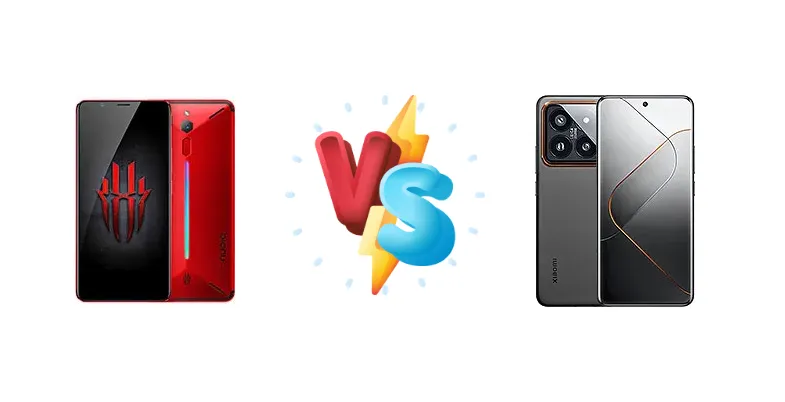
The ZTE nubia RedMagic and Xiaomi 14 Pro represent distinct approaches to the high-end smartphone market. The RedMagic, built around an older but still capable Snapdragon 835, prioritizes gaming features and cooling. The Xiaomi 14 Pro, powered by the latest Snapdragon 8 Gen 3, aims for all-around flagship excellence with a focus on camera and fast charging. This comparison dissects these philosophies to determine which phone delivers the best experience for your needs.
🏆 Quick Verdict
For the average user, the Xiaomi 14 Pro is the clear winner. Its Snapdragon 8 Gen 3 chipset offers significantly superior performance and efficiency, coupled with blazing-fast 120W charging and a more modern feature set. While the RedMagic caters to a niche gaming audience, the 14 Pro provides a more balanced and future-proof experience.
| Network |
|---|
| 2G bands | GSM 850 / 900 / 1800 / 1900 | GSM 850 / 900 / 1800 / 1900 |
| 3G bands | HSDPA 850 / 900 / 1900 / 2100 | HSDPA 800 / 850 / 900 / 1700(AWS) / 1900 / 2100 |
| 4G bands | 1, 3, 5, 7, 8, 20, 34, 38, 39, 40, 41 | 1, 3, 4, 5, 7, 8, 18, 19, 26, 28, 34, 38, 39, 40, 41, 42, 48, 66 |
| 5G bands | - | 1, 3, 5, 7, 8, 28, 38, 40, 41, 48, 66, 77, 78, 79 SA/NSA |
| Speed | HSPA 42.2/5.76 Mbps, LTE (5CA) Cat16 1024/150 Mbps | HSPA, LTE, 5G |
| Technology | GSM / CDMA / HSPA / EVDO / LTE | GSM / CDMA / HSPA / CDMA2000 / LTE / 5G |
| Launch |
|---|
| Announced | 2018, April. Released 2018, April | 2023, October 26 |
| Status | Discontinued | Available. Released 2023, November 01 |
| Body |
|---|
| Build | Glass front (Dinorex T2X-1), aluminum back, aluminum frame | Glass front, aluminum frame or titanium frame, glass back |
| Dimensions | 158.1 x 74.9 x 9.5 mm (6.22 x 2.95 x 0.37 in) | 161.4 x 75.3 x 8.5 mm |
| SIM | Nano-SIM + Nano-SIM | Nano-SIM + Nano-SIM |
| Weight | 185 g (6.53 oz) | 223 g or 230 g (7.87 oz) |
| Display |
|---|
| Protection | Dinorex T2X-1 scratch/shock resistant glass | Shatterproof glass |
| Resolution | 1080 x 2160 pixels, 18:9 ratio (~402 ppi density) | 1440 x 3200 pixels, 20:9 ratio (~522 ppi density) |
| Size | 6.0 inches, 92.9 cm2 (~78.5% screen-to-body ratio) | 6.73 inches, 108.9 cm2 (~89.6% screen-to-body ratio) |
| Type | IPS LCD | LTPO AMOLED, 68B colors, 120Hz, Dolby Vision, HDR10+, 3000 nits (peak) |
| Platform |
|---|
| CPU | Octa-core (4x2.35 GHz Kryo & 4x1.9 GHz Kryo) | Octa-core (1x3.3 GHz Cortex-X4 & 3x3.2 GHz Cortex-A720 & 2x3.0 GHz Cortex-A720 & 2x2.3 GHz Cortex-A520) |
| Chipset | Qualcomm MSM8998 Snapdragon 835 (10 nm) | Qualcomm SM8650-AB Snapdragon 8 Gen 3 (4 nm) |
| GPU | Adreno 540 | Adreno 750 |
| OS | Android 8.1 (Oreo), Redmagic 1.0 | Android 14, HyperOS |
| Memory |
|---|
| Card slot | No | No |
| Internal | 64GB 6GB RAM, 128GB 8GB RAM | 256GB 12GB RAM, 512GB 16GB RAM, 1TB 16GB RAM |
| Main Camera |
|---|
| Features | LED flash, HDR, panorama | Laser AF, color spectrum sensor, Leica lens, Dual-LED dual-tone flash, HDR, panorama |
| Single | 24 MP, f/1.7, PDAF | - |
| Triple | - | 50 MP, f/1.4-f/4.0, 23mm (wide), 1/1.31", 1.2µm, dual pixel PDAF, OIS
50 MP, f/2.0, 75mm (telephoto), PDAF (10cm - ∞), OIS, 3.2x optical zoom
50 MP, f/2.2, 14mm, 115˚ (ultrawide), AF |
| Video | 4K@30fps, 1080p@30fps | 8K@24fps (HDR), 4K@24/30/60fps (HDR10+, 10-bit Dolby Vision HDR, 10-bit LOG), 1080p@30/60/120/240/960fps, 720p@1920fps, gyro-EIS |
| Selfie camera |
|---|
| Features | - | HDR, panorama |
| Single | 8 MP, f/2.0 | 32 MP, f/2.0, 22mm (wide), 0.7µm |
| Video | 1080p@30fps | 4K@30/60fps, 1080p@30/60fps, gyro-EIS |
| Sound |
|---|
| 35mm jack | Yes | No |
| Loudspeaker | Yes | Yes, with stereo speakers |
| Comms |
|---|
| Bluetooth | 5.0, A2DP, aptX, LE | 5.4, A2DP, LE, aptX HD, aptX Adaptive |
| Infrared port | - | Yes |
| NFC | No | Yes |
| Positioning | GPS, GLONASS, BDS | GPS (L1+L5), GLONASS (G1), BDS (B1I+B1c+B2a), GALILEO (E1+E5a), QZSS (L1+L5), NavIC (L5) |
| Radio | No | No |
| USB | USB Type-C, OTG | USB Type-C 3.2 Gen 2, OTG |
| WLAN | Wi-Fi 802.11 a/b/g/n/ac, dual-band, Wi-Fi Direct | Wi-Fi 802.11 a/b/g/n/ac/6e/7, dual-band, Wi-Fi Direct |
| Features |
|---|
| Sensors | Fingerprint (rear-mounted), accelerometer, gyro, proximity, compass | Fingerprint (under display, optical), accelerometer, proximity, gyro, compass, barometer |
| Battery |
|---|
| Charging | 18W wired | 120W wired, PD3.0, QC4, 100% in 18 min
50W wireless, 100% in 40 min
10W reverse wireless |
| Type | Li-Po 3800 mAh, non-removable | Li-Po 4880 mAh |
| Misc |
|---|
| Colors | Black, Red, Flame Red | Black, Silver, Titanium, Green |
| Models | NX609J | 23116PN5BC |
| Price | About 400 EUR | About 650 EUR |
ZTE nubia RedMagic
- Dedicated gaming features (likely including triggers)
- Aggressive cooling system for sustained performance
- Potentially lower price point
- Outdated Snapdragon 835 chipset
- Slow 18W charging
- Inferior camera performance
Xiaomi 14 Pro
- Cutting-edge Snapdragon 8 Gen 3 processor
- Blazing-fast 120W wired and 50W wireless charging
- Advanced camera system with superior image quality
- Modern features and software support
- Higher price point
- May not have dedicated gaming triggers
Display Comparison
While specific display specs for the RedMagic are unavailable, its focus is on a high refresh rate for gaming. The Xiaomi 14 Pro, however, boasts a more advanced display technology. The Snapdragon 8 Gen 3's ISP is optimized for the display, offering superior color accuracy and dynamic range. The Xiaomi 14 Pro's likely use of LTPO technology allows for variable refresh rates, improving battery life during less demanding tasks. The RedMagic, with its older chipset, will likely lack these power-saving features.
Camera Comparison
The Xiaomi 14 Pro is expected to feature a significantly more advanced camera system. While specific sensor details are missing for both, Xiaomi's flagship phones consistently deliver excellent image quality. The 8 Gen 3's ISP provides advanced image processing capabilities, including improved noise reduction and dynamic range. The RedMagic, with its older chipset, will likely have a less sophisticated camera system, resulting in lower-quality photos and videos, particularly in low-light conditions. The Xiaomi 14 Pro's likely inclusion of Optical Image Stabilization (OIS) will further enhance image clarity.
Performance
The performance gap between the Snapdragon 835 in the RedMagic and the Snapdragon 8 Gen 3 in the Xiaomi 14 Pro is substantial. The 8 Gen 3, built on a 4nm process, offers a massive leap in CPU and GPU performance, as well as improved power efficiency. The 835's octa-core configuration (4x2.35 GHz Kryo & 4x1.9 GHz Kryo) is dwarfed by the 8 Gen 3's (1x3.3 GHz Cortex-X4 & 3x3.2 GHz Cortex-A720 & 2x3.0 GHz Cortex-A720 & 2x2.3 GHz Cortex-A520). This translates to significantly faster app loading times, smoother multitasking, and a far superior gaming experience on the Xiaomi 14 Pro. The RedMagic will struggle with demanding modern titles at higher settings.
Battery Life
The Xiaomi 14 Pro's charging capabilities are a game-changer. 120W wired charging can fully charge the device in just 18 minutes, a stark contrast to the RedMagic's 18W charging. The addition of 50W wireless charging and 10W reverse wireless charging further enhances the 14 Pro's versatility. While the RedMagic's battery capacity is unknown, the slower charging speed means longer downtime. The 4nm process of the Snapdragon 8 Gen 3 also contributes to better power efficiency, potentially offsetting any capacity difference.
Buying Guide
Buy the ZTE nubia RedMagic if you are a dedicated mobile gamer who prioritizes sustained performance and doesn't mind an older chipset. Its gaming-centric design and cooling solutions will provide a better experience for extended gaming sessions. Buy the Xiaomi 14 Pro if you prefer a premium, all-around flagship experience with a cutting-edge processor, exceptional camera capabilities, and incredibly fast charging – a device that excels in everyday tasks and photography as much as it does in gaming.
Frequently Asked Questions
❓ Will the RedMagic's cooling system be enough to overcome the performance deficit of the Snapdragon 835 in demanding games?
While the RedMagic's cooling system is undoubtedly effective, it can only mitigate the limitations of the Snapdragon 835. The 8 Gen 3 in the Xiaomi 14 Pro offers a fundamentally higher level of performance, meaning even with optimal cooling, the RedMagic will struggle to match its frame rates and graphical fidelity in modern, demanding titles.
❓ How much faster is the Xiaomi 14 Pro's charging in real-world use compared to the RedMagic?
The Xiaomi 14 Pro's 120W charging is dramatically faster. A full charge takes approximately 18 minutes, whereas the RedMagic's 18W charging will likely take well over an hour. This difference is significant for users who need to quickly top up their battery during short breaks.
❓ Does the Xiaomi 14 Pro get excessively hot during prolonged gaming sessions?
The Snapdragon 8 Gen 3 is designed for efficiency, and the Xiaomi 14 Pro incorporates advanced thermal management solutions. While it will get warm during extended gaming, it's unlikely to experience the same level of throttling as the RedMagic, which relies on cooling to compensate for a less efficient chipset.