
ZTE nubia RedMagic vs. vivo iQOO 12 Pro: A Generational Leap in Mobile Gaming
| Phones Images | |||||
|---|---|---|---|---|---|
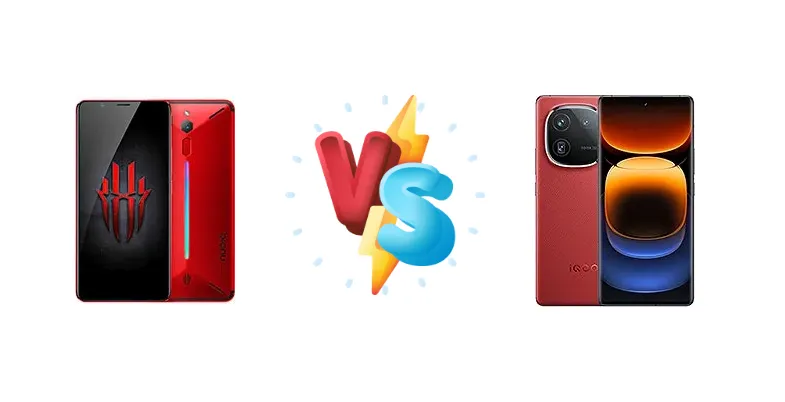
|
🏆 Quick Verdict
For the average user prioritizing raw performance, future-proofing, and charging speed, the vivo iQOO 12 Pro is the clear winner. Its Snapdragon 8 Gen 3 delivers a substantial performance uplift over the RedMagic’s Snapdragon 835, while 120W charging drastically reduces downtime. The RedMagic remains a viable option for budget-conscious gamers.
| PHONES | ||
|---|---|---|
| Phone Names | ZTE nubia RedMagic | vivo iQOO 12 Pro |
| Network | ||
|---|---|---|
| 2G bands | GSM 850 / 900 / 1800 / 1900 | GSM 850 / 900 / 1800 / 1900 |
| 3G bands | HSDPA 850 / 900 / 1900 / 2100 | HSDPA 800 / 850 / 900 / 1700(AWS) / 1900 / 2100 |
| 4G bands | 1, 3, 5, 7, 8, 20, 34, 38, 39, 40, 41 | 1, 2, 3, 4, 5, 7, 8, 12, 17, 18, 19, 20, 25, 26, 28, 34, 38, 39, 40, 41, 42, 66 |
| 5G bands | - | 1, 2, 3, 5, 7, 8, 12, 20, 25, 26, 28, 66, 38, 40, 41, 77, 78 SA/NSA |
| Speed | HSPA 42.2/5.76 Mbps, LTE (5CA) Cat16 1024/150 Mbps | HSPA, LTE, 5G |
| Technology | GSM / CDMA / HSPA / EVDO / LTE | GSM / CDMA / HSPA / CDMA2000 / LTE / 5G |
| Launch | ||
|---|---|---|
| Announced | 2018, April. Released 2018, April | 2023, November 07 |
| Status | Discontinued | Available. Released 2023, November 14 |
| Body | ||
|---|---|---|
| Build | Glass front (Dinorex T2X-1), aluminum back, aluminum frame | - |
| Dimensions | 158.1 x 74.9 x 9.5 mm (6.22 x 2.95 x 0.37 in) | 164.6 x 75.4 x 8.6 mm or 8.8 mm |
| SIM | Nano-SIM + Nano-SIM | Nano-SIM + Nano-SIM |
| Weight | 185 g (6.53 oz) | 205 g or 210 g (7.23 oz) |
| Display | ||
|---|---|---|
| Protection | Dinorex T2X-1 scratch/shock resistant glass | - |
| Resolution | 1080 x 2160 pixels, 18:9 ratio (~402 ppi density) | 1440 x 3200 pixels, 20:9 ratio (~518 ppi density) |
| Size | 6.0 inches, 92.9 cm2 (~78.5% screen-to-body ratio) | 6.78 inches, 111.0 cm2 (~89.4% screen-to-body ratio) |
| Type | IPS LCD | LTPO AMOLED, 1B colors, 144Hz, HDR10+, 1600 nits (HBM), 3000 nits (peak) |
| Platform | ||
|---|---|---|
| CPU | Octa-core (4x2.35 GHz Kryo & 4x1.9 GHz Kryo) | Octa-core (1x3.3 GHz Cortex-X4 & 3x3.2 GHz Cortex-A720 & 2x3.0 GHz Cortex-A720 & 2x2.3 GHz Cortex-A520) |
| Chipset | Qualcomm MSM8998 Snapdragon 835 (10 nm) | Qualcomm SM8650-AB Snapdragon 8 Gen 3 (4 nm) |
| GPU | Adreno 540 | Adreno 750 |
| OS | Android 8.1 (Oreo), Redmagic 1.0 | Android 14, up to 2 major Android upgrades, Funtouch 14 (International), OriginOS 4 (China) |
| Memory | ||
|---|---|---|
| Card slot | No | No |
| Internal | 64GB 6GB RAM, 128GB 8GB RAM | 256GB 16GB RAM, 512GB 16GB RAM, 1TB 16GB RAM |
| Main Camera | ||
|---|---|---|
| Features | LED flash, HDR, panorama | Color spectrum sensor, Dual-LED flash, HDR, panorama |
| Single | 24 MP, f/1.7, PDAF | - |
| Triple | - | 50 MP, f/1.7, 23mm (wide), 1/1.3", 1.2µm, ulti-directional PDAF, OIS 64 MP, f/2.6, 70mm (periscope telephoto), 1/2.0", PDAF, OIS, 3x optical zoom 50 MP, f/2.0, 15mm, 119˚ (ultrawide), AF |
| Video | 4K@30fps, 1080p@30fps | 8K@30fps, 4K@24/30/60fps, 1080p@30/60/120/240fps, gyro-EIS |
| Selfie camera | ||
|---|---|---|
| Features | - | HDR |
| Single | 8 MP, f/2.0 | 16 MP, f/2.5, (wide) |
| Video | 1080p@30fps | 1080p@30fps, gyro-EIS |
| Sound | ||
|---|---|---|
| 35mm jack | Yes | No |
| Loudspeaker | Yes | Yes, with stereo speakers |
| Comms | ||
|---|---|---|
| Bluetooth | 5.0, A2DP, aptX, LE | 5.4, A2DP, LE, aptX HD, aptX Adaptive, aptX Lossless |
| Infrared port | - | Yes |
| NFC | No | Yes |
| Positioning | GPS, GLONASS, BDS | GPS (L1+L5), GLONASS (G1), BDS (B1I+B1c+B2a), GALILEO (E1+E5a), QZSS (L1+L5) |
| Radio | No | No |
| USB | USB Type-C, OTG | USB Type-C 2.0, OTG |
| WLAN | Wi-Fi 802.11 a/b/g/n/ac, dual-band, Wi-Fi Direct | Wi-Fi 802.11 a/b/g/n/ac/6/7, tri-band, Wi-Fi Direct |
| Features | ||
|---|---|---|
| Sensors | Fingerprint (rear-mounted), accelerometer, gyro, proximity, compass | Fingerprint (under display, ultrasonic), accelerometer, gyro, proximity, compass |
| Battery | ||
|---|---|---|
| Charging | 18W wired | 120W wired 50W wireless 10W reverse wireless |
| Type | Li-Po 3800 mAh, non-removable | 5100 mAh |
| Misc | ||
|---|---|---|
| Colors | Black, Red, Flame Red | Black, Red, White (BMW M branding) |
| Models | NX609J | V2329A |
| Price | About 400 EUR | About 650 EUR |
ZTE nubia RedMagic
- Dedicated gaming features (likely including triggers)
- More affordable price point
- Potentially larger battery capacity
- Outdated Snapdragon 835 chipset
- Slow 18W charging
- Inferior camera system
vivo iQOO 12 Pro
- Cutting-edge Snapdragon 8 Gen 3 performance
- Blazing-fast 120W wired charging
- Advanced camera system
- Wireless and reverse wireless charging
- Higher price tag
- May prioritize overall experience over purely gaming-centric features
Display Comparison
While specific display specs for the RedMagic are unavailable, its focus is on a high refresh rate for gaming. The iQOO 12 Pro, benefiting from newer technology, likely features an LTPO panel allowing for dynamic refresh rate scaling (1-120Hz) for improved power efficiency. The Snapdragon 8 Gen 3’s display engine also supports higher resolutions and color depths. The RedMagic, being an older model, will likely exhibit wider bezels and potentially lower peak brightness compared to the iQOO 12 Pro’s modern display.
Camera Comparison
The RedMagic’s camera capabilities are likely secondary to its gaming focus, potentially featuring a mid-range sensor. The iQOO 12 Pro, as a flagship, is expected to boast a significantly more advanced camera system, potentially including a large 50MP or higher main sensor with OIS. The Snapdragon 8 Gen 3’s ISP (Image Signal Processor) provides superior image processing capabilities, resulting in better dynamic range, noise reduction, and overall image quality. While details are missing, the iQOO 12 Pro will likely offer more versatile shooting modes and superior low-light performance.
Performance
The core difference lies in the chipsets. The iQOO 12 Pro’s Snapdragon 8 Gen 3 (4nm) represents a massive leap over the RedMagic’s Snapdragon 835 (10nm). The Gen 3’s new Cortex-X4 prime core, clocked at 3.3 GHz, offers significantly improved single-core performance. The iQOO 12 Pro also benefits from faster LPDDR5x RAM, enhancing data transfer speeds. The 10nm process of the 835 is less efficient, leading to higher temperatures and potential throttling during sustained gaming. The iQOO 12 Pro’s advanced thermal management system, coupled with the 4nm process, will maintain higher sustained performance.
Battery Life
The RedMagic’s 18W wired charging is comparatively slow. The iQOO 12 Pro’s 120W wired charging is a game-changer, capable of fully charging the battery in under 20 minutes. The addition of 50W wireless and 10W reverse wireless charging further enhances the iQOO 12 Pro’s convenience. While the RedMagic may have a larger battery capacity to compensate for slower charging, the iQOO 12 Pro’s efficiency gains from the 4nm process and optimized software will likely result in comparable or even better real-world battery life, despite potentially having a smaller battery.
Buying Guide
Buy the ZTE nubia RedMagic if you need a dedicated gaming experience on a tight budget and appreciate a phone specifically designed for extended gaming sessions, even if it means sacrificing cutting-edge processing power. Buy the vivo iQOO 12 Pro if you prefer a flagship-level smartphone with exceptional performance across all tasks, incredibly fast charging, and a more versatile feature set beyond just gaming.