
ZTE nubia RedMagic vs Asus ROG Phone 8 Pro: A Deep Dive for Mobile Gamers
| Phones Images | |||||
|---|---|---|---|---|---|
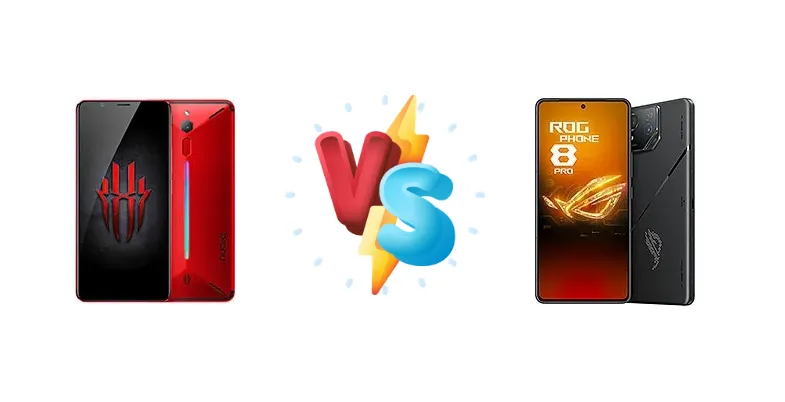
|
🏆 Quick Verdict
For the average gamer prioritizing future-proofing and top-tier performance, the Asus ROG Phone 8 Pro is the clear winner. Its Snapdragon 8 Gen 3 chipset, coupled with a brighter display and significantly faster charging, delivers a superior experience. However, the RedMagic remains a compelling option for budget-minded gamers who don't need the absolute latest technology.
| PHONES | ||
|---|---|---|
| Phone Names | ZTE nubia RedMagic | Asus ROG Phone 8 Pro |
| Network | ||
|---|---|---|
| 2G bands | GSM 850 / 900 / 1800 / 1900 | GSM 850 / 900 / 1800 / 1900 |
| 3G bands | HSDPA 850 / 900 / 1900 / 2100 | HSDPA 850 / 900 / 1700(AWS) / 1800 / 1900 / 2100 - International |
| 4G bands | 1, 3, 5, 7, 8, 20, 34, 38, 39, 40, 41 | 1, 2, 3, 4, 5, 7, 8, 12, 17, 18, 19, 20, 25, 26, 28, 32, 34, 38, 39, 40, 41, 42, 43, 48, 66 - International |
| 5G bands | - | 1, 2, 3, 5, 7, 8, 12, 18, 20, 25, 26, 28, 38, 40, 41, 48, 66, 77, 78, 79 SA/NSA/Sub6 - International |
| Speed | HSPA 42.2/5.76 Mbps, LTE (5CA) Cat16 1024/150 Mbps | HSPA, LTE (Up to 7CA), 5G |
| Technology | GSM / CDMA / HSPA / EVDO / LTE | GSM / CDMA / HSPA / LTE / 5G |
| Launch | ||
|---|---|---|
| Announced | 2018, April. Released 2018, April | 2024, January 08 |
| Status | Discontinued | Available. Released 2024, January 18 |
| Body | ||
|---|---|---|
| Build | Glass front (Dinorex T2X-1), aluminum back, aluminum frame | Glass front (Gorilla Glass Victus 2), glass back (Gorilla Glass), aluminum frame |
| Dimensions | 158.1 x 74.9 x 9.5 mm (6.22 x 2.95 x 0.37 in) | 163.8 x 76.8 x 8.9 mm (6.45 x 3.02 x 0.35 in) |
| SIM | Nano-SIM + Nano-SIM | Nano-SIM + Nano-SIM |
| Weight | 185 g (6.53 oz) | 225 g (7.94 oz) |
| Display | ||
|---|---|---|
| Protection | Dinorex T2X-1 scratch/shock resistant glass | Corning Gorilla Glass Victus 2 |
| Resolution | 1080 x 2160 pixels, 18:9 ratio (~402 ppi density) | 1080 x 2400 pixels, 20:9 ratio (~388 ppi density) |
| Size | 6.0 inches, 92.9 cm2 (~78.5% screen-to-body ratio) | 6.78 inches, 111.0 cm2 (~88.2% screen-to-body ratio) |
| Type | IPS LCD | LTPO AMOLED, 1B colors, 165Hz, HDR10, 1600 nits (HBM), 2500 nits (peak) |
| Platform | ||
|---|---|---|
| CPU | Octa-core (4x2.35 GHz Kryo & 4x1.9 GHz Kryo) | Octa-core (1x3.3 GHz Cortex-X4 & 3x3.2 GHz Cortex-A720 & 2x3.0 GHz Cortex-A720 & 2x2.3 GHz Cortex-A520) |
| Chipset | Qualcomm MSM8998 Snapdragon 835 (10 nm) | Qualcomm SM8650-AB Snapdragon 8 Gen 3 (4 nm) |
| GPU | Adreno 540 | Adreno 750 |
| OS | Android 8.1 (Oreo), Redmagic 1.0 | Android 14, up to 2 major Android upgrades |
| Memory | ||
|---|---|---|
| Card slot | No | No |
| Internal | 64GB 6GB RAM, 128GB 8GB RAM | 512GB 16GB RAM, 1TB 24GB RAM |
| Main Camera | ||
|---|---|---|
| Features | LED flash, HDR, panorama | LED flash, HDR, panorama |
| Single | 24 MP, f/1.7, PDAF | - |
| Triple | - | 50 MP, f/1.9, 24mm (wide), 1/1.56", 1.0µm, PDAF, gimbal OIS 32 MP, f/2.4, (telephoto), 1/3.2", 0.7µm, PDAF, OIS, 3x optical zoom 13 MP, f/2.2, 13mm, 120˚ (ultrawide) |
| Video | 4K@30fps, 1080p@30fps | 8K@24fps, 4K@30/60fps, 1080p@30/60/120/240fps, 720p@480fps; gyro-EIS, HDR10+ |
| Selfie camera | ||
|---|---|---|
| Features | - | Panorama, HDR |
| Single | 8 MP, f/2.0 | 32 MP, f/2.5, 22mm (wide), 1/3.2", 0.7µm |
| Video | 1080p@30fps | 1080p@30fps |
| Sound | ||
|---|---|---|
| 35mm jack | Yes | Yes |
| Loudspeaker | Yes | Yes, with stereo speakers |
| Comms | ||
|---|---|---|
| Bluetooth | 5.0, A2DP, aptX, LE | 5.4, A2DP, LE, aptX HD, aptX Adaptive, aptX Lossless |
| NFC | No | Yes |
| Positioning | GPS, GLONASS, BDS | GPS (L1+L5), BDS (B1I+B1c+B2a), GALILEO (E1+E5a), QZSS (L1+L5), NavIC (L5), GLONASS |
| Radio | No | No |
| USB | USB Type-C, OTG | USB Type-C (side), DisplayPort 1.4; USB Type-C (bottom), OTG |
| WLAN | Wi-Fi 802.11 a/b/g/n/ac, dual-band, Wi-Fi Direct | Wi-Fi 802.11 a/b/g/n/ac/6e/7, tri-band, Wi-Fi Direct |
| Features | ||
|---|---|---|
| Sensors | Fingerprint (rear-mounted), accelerometer, gyro, proximity, compass | Fingerprint (under display, optical), accelerometer, gyro, proximity, compass |
| Battery | ||
|---|---|---|
| Charging | 18W wired | 65W wired, PD3.0, PPS, QC5, 100% in 39 min - International 30W wired, PD3.0, PPS - India 15W wireless (Qi) 10W reverse wired |
| Type | Li-Po 3800 mAh, non-removable | 5500 mAh |
| Misc | ||
|---|---|---|
| Colors | Black, Red, Flame Red | Phantom Black |
| Models | NX609J | AI2401, AI2401_A, AI2401_D |
| Price | About 400 EUR | $ 1,157.98 / £ 1,693.75 / € 632.66 |
ZTE nubia RedMagic
- Significantly lower price point
- Potentially more compact design (speculation based on brand history)
- Adequate performance for less demanding games
- Outdated Snapdragon 835 chipset
- Slow 18W charging
- Inferior display technology (likely)
Asus ROG Phone 8 Pro
- Cutting-edge Snapdragon 8 Gen 3 performance
- Extremely fast 65W charging (International)
- Bright and vibrant display (1765 nits)
- Higher price tag
- Larger size and weight (typical for ROG Phones)
- Potential for software bloat (common with gaming phones)
Display Comparison
The Asus ROG Phone 8 Pro boasts a significantly brighter display, reaching a measured 1765 nits, compared to the RedMagic’s unspecified brightness. This translates to superior visibility in direct sunlight. While the RedMagic’s panel details are unavailable, the ROG Phone 8 Pro likely utilizes a more advanced panel technology, potentially LTPO, enabling variable refresh rates for improved power efficiency. The ROG Phone 8 Pro’s higher brightness and likely superior color accuracy will provide a more immersive and visually appealing gaming experience.
Camera Comparison
The context data for the RedMagic’s camera is limited, but the ROG Phone 8 Pro offers a more comprehensive camera system. While specific details are missing, the ROG Phone 8 Pro’s camera is designed for both photo and video capture, suggesting a more versatile setup. The ROG Phone 8 Pro likely features larger sensors and advanced image processing algorithms, resulting in better image quality, especially in low-light conditions. The RedMagic’s camera is likely adequate for casual use but won’t compete with the ROG Phone 8 Pro’s capabilities.
Performance
The performance gap between these devices is substantial. The Asus ROG Phone 8 Pro’s Snapdragon 8 Gen 3 (4nm) is a generational leap ahead of the RedMagic’s Snapdragon 835 (10nm). The 8 Gen 3’s octa-core configuration, featuring a Cortex-X4 prime core clocked at 3.3 GHz, offers significantly improved CPU and GPU performance. The 4nm process node also provides superior thermal efficiency, meaning the ROG Phone 8 Pro is less likely to throttle under sustained load. The RedMagic, while still capable, will struggle with demanding modern titles and multitasking.
Battery Life
The Asus ROG Phone 8 Pro demonstrates a clear advantage in battery endurance, achieving 14 hours and 43 minutes of active use. While the RedMagic’s battery capacity is unknown, its 18W wired charging is significantly slower than the ROG Phone 8 Pro’s 65W wired charging (International) or even 30W (India). The ROG Phone 8 Pro can reach 100% charge in just 39 minutes (International), minimizing downtime. The addition of 15W wireless charging and 10W reverse wired charging on the ROG Phone 8 Pro further enhances its versatility.
Buying Guide
Buy the ZTE nubia RedMagic if you need a capable gaming phone on a tight budget and are willing to compromise on processing power and charging speed. It's ideal for players of less demanding titles or those who prioritize value. Buy the Asus ROG Phone 8 Pro if you demand the absolute best performance, a stunning display, and rapid charging, and are willing to pay a premium for a flagship gaming experience. This is the phone for competitive gamers and those who want a device that will remain powerful for years to come.