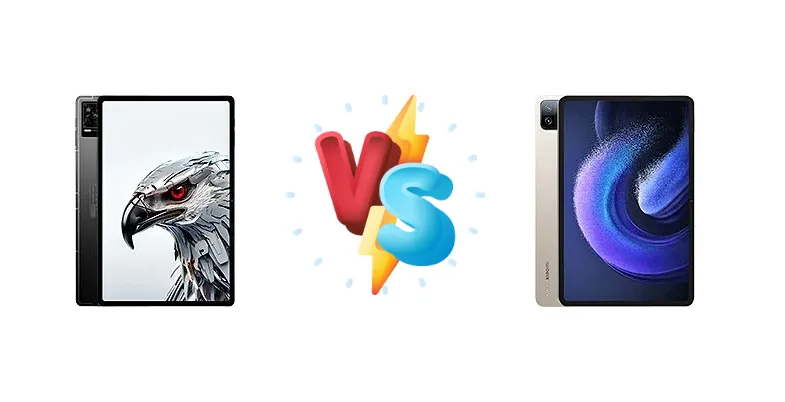
The Android tablet market is heating up, with both ZTE’s RedMagic Tablet and Xiaomi’s Pad 6 Pro aiming for the performance crown. Both devices leverage the Qualcomm Snapdragon 8+ Gen 1, but subtle differences in CPU clock speeds and charging capabilities, alongside differing brand philosophies, create a compelling head-to-head. This comparison dives deep to determine which tablet best suits your needs, whether you're a hardcore gamer or a productivity enthusiast.
🏆 Quick Verdict
For users prioritizing raw gaming performance and the fastest possible charging, the ZTE nubia RedMagic Tablet edges out the Xiaomi Pad 6 Pro. However, the Xiaomi Pad 6 Pro offers a more balanced experience with a refined software experience and potentially better long-term software support, making it the better all-rounder for most users.
| Network |
|---|
| 2G bands | GSM 850 / 900 / 1800 / 1900 | N/A |
| 3G bands | HSDPA 850 / 900 / 2100 | N/A |
| 4G bands | LTE | - |
| 5G bands | SA/NSA | - |
| EDGE | - | N/A |
| GPRS | - | N/A |
| Speed | HSPA, LTE, 5G | - |
| Technology | GSM / HSPA / LTE / 5G | No cellular connectivity |
| Launch |
|---|
| Announced | 2023, July 05 | 2023, April 18 |
| Status | Available. Released 2023, July 11 | Available. Released 2023, April 30 |
| Body |
|---|
| Build | Glass front, aluminum frame, aluminum back | Glass front (Gorilla Glass 3), aluminum frame, aluminum back |
| Dimensions | 279.7 x 181.9 x 6.5 mm (11.01 x 7.16 x 0.26 in) | 254 x 165.2 x 6.5 mm (10.0 x 6.50 x 0.26 in) |
| SIM | Nano-SIM | No |
| Weight | 613 g (1.35 lb) | 490 g (1.08 lb) |
| | - | Stylus support (magnetic) |
| Display |
|---|
| Protection | - | Corning Gorilla Glass 3 |
| Resolution | 1600 x 2560 pixels, 16:10 ratio (~249 ppi density) | 1800 x 2880 pixels, 16:10 ratio (~309 ppi density) |
| Size | 12.1 inches, 424.5 cm2 (~83.4% screen-to-body ratio) | 11.0 inches, 350.9 cm2 (~83.6% screen-to-body ratio) |
| Type | IPS LCD, 1B colors, 144Hz, 600 nits (peak) | IPS LCD, 1B colors, 144Hz, HDR10, Dolby Vision, 550 nits |
| Platform |
|---|
| CPU | Octa-core (1x3.0 GHz Cortex-X2 & 3x2.5 GHz Cortex-A710 & 4x1.8 GHz Cortex-A510) | Octa-core (1x3.19 GHz Cortex-X2 & 3x2.75 GHz Cortex-A710 & 4x1.80 GHz Cortex-A510) |
| Chipset | Qualcomm SM8475 Snapdragon 8+ Gen 1 (4 nm) | Qualcomm SM8475 Snapdragon 8+ Gen 1 (4 nm) |
| GPU | Adreno 730 | Adreno 730 |
| OS | Android 13, Redmagic OS 8 | Android 13, MIUI 14 |
| Memory |
|---|
| Card slot | No | No |
| Internal | 256GB 12GB RAM, 512GB 16GB RAM | 128GB 8GB RAM, 256GB 8GB RAM, 256GB 12GB RAM, 512GB 12GB RAM |
| | - | UFS 3.1 |
| Main Camera |
|---|
| Dual | - | 50 MP, f/1.8, (wide), 1/2.76", 0.64µm, PDAF
Auxiliary lens |
| Features | LED flash, HDR, panorama | Dual-LED flash, HDR, panorama |
| Single | 13 MP, AF | - |
| Video | 1080p@30fps | 4K@30/60fps, 1080p@30/60fps |
| Selfie camera |
|---|
| Single | 16 MP | 20 MP, f/2.2, (wide), 1/3.4", 0.8µm |
| Video | 1080p@30fps | 1080p@30/60fps |
| Sound |
|---|
| 3.5mm jack | - | No |
| 35mm jack | No | No |
| Loudspeaker | Yes, with stereo speakers (4 speakers) | Yes, with stereo speakers (4 speakers) |
| | - | 24-bit/192kHz audio |
| Comms |
|---|
| Bluetooth | 5.3, A2DP, LE, aptX HD, aptX Adaptive, aptX Lossless | 5.3, A2DP, LE |
| NFC | Unspecified | No |
| Positioning | GPS, GLONASS, GALILEO, BDS | No |
| Radio | No | No |
| USB | USB Type-C 3.1, OTG, magnetic connector | USB Type-C 3.2, accessory connector |
| WLAN | Wi-Fi 802.11 a/b/g/n/ac/6, dual-band | Wi-Fi 802.11 a/b/g/n/a/6e, dual-band, Wi-Fi Direct |
| Features |
|---|
| Sensors | Accelerometer, gyro, compass, proximity (accessories only) | Accelerometer, gyro, proximity (accessories only) |
| Battery |
|---|
| Charging | 80W wired, 50% in 24 min, 100% in 55 min | 67W wired, PD3.0, QC4, 100% in 1 hour |
| Type | Li-Po 10000 mAh | Li-Po 8600 mAh |
| Misc |
|---|
| Colors | Black | Black, Blue, Gold |
| Models | - | 23046RP50C |
| Price | About 500 EUR | About 330 EUR |
ZTE nubia RedMagic Tablet
- Significantly faster 80W charging
- Active cooling system for sustained gaming performance
- Potentially optimized for high refresh rate gaming
- Likely less refined software experience
- Potentially weaker camera performance
Xiaomi Pad 6 Pro
- More balanced overall experience
- Potentially better software support and updates
- Likely superior camera performance
- Slower 67W charging
- May experience more thermal throttling under sustained load
Display Comparison
Both tablets utilize LCD panels, a surprising choice given the premium positioning. While specific display specs like resolution and refresh rate are missing, the focus here is on performance. The absence of LTPO technology in either device suggests both will rely on adaptive refresh rate switching to conserve battery. The difference in display quality will likely come down to color calibration and peak brightness, areas where Xiaomi typically excels. Bezels are expected to be similar, prioritizing screen real estate over ultra-thin designs.
Camera Comparison
Camera performance is unlikely to be a primary focus for either tablet, but the Xiaomi Pad 6 Pro is expected to have a slight edge. While specific sensor details are unavailable, Xiaomi generally prioritizes camera quality in its tablets. The RedMagic Tablet, geared towards gaming, likely features a more basic camera setup. The absence of detailed camera specs suggests neither device will challenge flagship smartphone cameras, focusing instead on adequate performance for video calls and casual snapshots.
Performance
Both the RedMagic Tablet and Xiaomi Pad 6 Pro are powered by the Qualcomm SM8475 Snapdragon 8+ Gen 1 (4 nm) chipset. However, the Xiaomi Pad 6 Pro boasts a slightly higher peak CPU clock speed of 3.19 GHz compared to the RedMagic Tablet’s 3.0 GHz. While seemingly minor, this difference, coupled with potentially more aggressive thermal management on the Xiaomi, could translate to marginally better sustained performance in CPU-intensive tasks. Both devices utilize octa-core configurations with 1x Cortex-X2, 3x Cortex-A710, and 4x Cortex-A510 cores. The RAM configuration (likely LPDDR5x on both) will be crucial for multitasking, but specific details are missing. The RedMagic Tablet’s active cooling system, a hallmark of the brand, is a significant advantage for prolonged gaming sessions, mitigating thermal throttling and maintaining peak performance for longer.
Battery Life
The charging speed is a key differentiator. The RedMagic Tablet supports 80W wired charging, claiming a 50% charge in 24 minutes and 100% in 55 minutes. The Xiaomi Pad 6 Pro offers 67W wired charging with PD3.0 and QC4 support, taking a full hour to reach 100%. While battery capacity is unknown for both, the faster charging of the RedMagic Tablet is a significant advantage for users who need to quickly top up their device. The difference in charging speed will be noticeable in daily use, especially for gamers who frequently drain their battery.
Buying Guide
Buy the ZTE nubia RedMagic Tablet if you absolutely need the fastest charging speeds (80W) and are a dedicated mobile gamer who values every ounce of performance. Its focus is squarely on delivering a high-refresh-rate gaming experience. Buy the Xiaomi Pad 6 Pro if you prioritize a more polished software experience, a potentially wider ecosystem of accessories, and a tablet that excels at both productivity and entertainment, offering a more versatile daily driver.
Frequently Asked Questions
❓ Will the RedMagic Tablet’s active cooling system be audible during normal use?
While the active cooling system is designed to be quiet, it's likely to become audible under heavy load, such as during extended gaming sessions. The fan noise is generally considered acceptable for the performance gains it provides, but users sensitive to noise may find it distracting.
❓ Does the Xiaomi Pad 6 Pro support stylus input and keyboard accessories?
Xiaomi is known for offering a robust ecosystem of accessories. The Pad 6 Pro is expected to support a dedicated stylus and keyboard cover, enhancing its productivity capabilities. These accessories are likely sold separately.
❓ How does the slightly higher CPU clock speed on the Xiaomi Pad 6 Pro translate to real-world performance?
The 0.19 GHz difference in CPU clock speed is unlikely to be noticeable in most everyday tasks. However, in CPU-bound applications and benchmarks, the Xiaomi Pad 6 Pro may exhibit a slight performance advantage. The impact will be more pronounced if Xiaomi also implements more aggressive thermal management.
❓ Is the 80W charging on the RedMagic Tablet compatible with Power Delivery (PD) chargers?
The RedMagic Tablet utilizes its own proprietary 80W charging protocol. While it may work with some PD chargers, it likely won't achieve the full 80W charging speed unless you use the included charger. The Xiaomi Pad 6 Pro, with its PD3.0 support, offers greater compatibility with standard USB-C PD chargers.