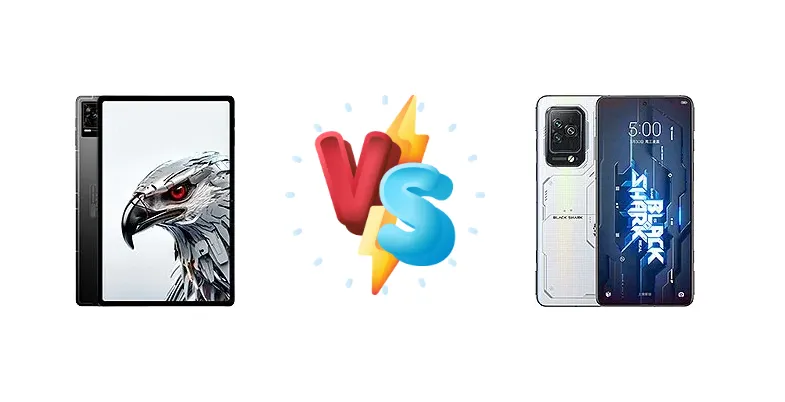
The mobile gaming landscape is diversifying. While phones like the Xiaomi Black Shark 5 Pro have long dominated, larger-format gaming is emerging with devices like the ZTE nubia RedMagic Tablet. This comparison pits the focused power of a flagship gaming phone against the expansive screen and potential of a dedicated gaming tablet, analyzing which offers the best experience for demanding gamers.
🏆 Quick Verdict
For the average gamer prioritizing raw speed and portability, the Xiaomi Black Shark 5 Pro edges out the RedMagic Tablet. Its 120W charging, achieving a full charge in just 15 minutes, is a significant advantage. However, the RedMagic Tablet’s larger display and slightly newer chipset make it compelling for those valuing immersive visuals and sustained performance.
| Network |
|---|
| 2G bands | GSM 850 / 900 / 1800 / 1900 | GSM 850 / 900 / 1800 / 1900 |
| 3G bands | HSDPA 850 / 900 / 2100 | HSDPA 800 / 850 / 900 / 1700(AWS) / 1900 / 2100 |
| 4G bands | LTE | 1, 2, 3, 4, 5, 7, 8, 12, 17, 18, 19, 26, 28, 34, 38, 39, 40, 41 |
| 5G bands | SA/NSA | 1, 3, 8, 28, 41, 77, 78, 79 SA/NSA |
| Speed | HSPA, LTE, 5G | HSPA, LTE, 5G |
| Technology | GSM / HSPA / LTE / 5G | GSM / CDMA / HSPA / EVDO / LTE / 5G |
| Launch |
|---|
| Announced | 2023, July 05 | 2022, March 30 |
| Status | Available. Released 2023, July 11 | Available. Released 2022, April 04 |
| Body |
|---|
| Build | Glass front, aluminum frame, aluminum back | - |
| Dimensions | 279.7 x 181.9 x 6.5 mm (11.01 x 7.16 x 0.26 in) | 163.9 x 76.5 x 9.5 mm (6.45 x 3.01 x 0.37 in) |
| SIM | Nano-SIM | Nano-SIM + Nano-SIM |
| Weight | 613 g (1.35 lb) | 220 g (7.76 oz) |
| Display |
|---|
| Resolution | 1600 x 2560 pixels, 16:10 ratio (~249 ppi density) | 1080 x 2400 pixels, 20:9 ratio (~395 ppi density) |
| Size | 12.1 inches, 424.5 cm2 (~83.4% screen-to-body ratio) | 6.67 inches, 107.4 cm2 (~85.7% screen-to-body ratio) |
| Type | IPS LCD, 1B colors, 144Hz, 600 nits (peak) | OLED, 1B colors, 144Hz, HDR10+ |
| Platform |
|---|
| CPU | Octa-core (1x3.0 GHz Cortex-X2 & 3x2.5 GHz Cortex-A710 & 4x1.8 GHz Cortex-A510) | Octa-core (1x3.00 GHz Cortex-X2 & 3x2.50 GHz Cortex-A710 & 4x1.80 GHz Cortex-A510) |
| Chipset | Qualcomm SM8475 Snapdragon 8+ Gen 1 (4 nm) | Qualcomm SM8450 Snapdragon 8 Gen 1 (4 nm) |
| GPU | Adreno 730 | Adreno 730 |
| OS | Android 13, Redmagic OS 8 | Android 12, Joy UI 13 |
| Memory |
|---|
| Card slot | No | No |
| Internal | 256GB 12GB RAM, 512GB 16GB RAM | 128GB 8GB RAM, 256GB 8GB RAM, 256GB 12GB RAM, 512GB 16GB RAM |
| Main Camera |
|---|
| Features | LED flash, HDR, panorama | LED flash, HDR, panorama |
| Single | 13 MP, AF | 16 MP, (wide), 1/3.06", 1.0µm |
| Triple | - | 108 MP, f/1.8, (wide), 1/1.52", 0.7µm, PDAF
13 MP, f/2.4, 120˚ (ultrawide), 1/3.06", 1.12µm
5 MP, f/2.4, (telephoto macro), AF |
| Video | 1080p@30fps | 4K@30/60fps, 1080p@30/60/240fps, 1080p@960fps; HDR10+ |
| Selfie camera |
|---|
| Features | - | HDR |
| Single | 16 MP | 16 MP, (wide), 1/3.06", 1.0µm |
| Video | 1080p@30fps | 1080p@30fps |
| Sound |
|---|
| 3.5mm jack | - | No |
| 35mm jack | No | No |
| Loudspeaker | Yes, with stereo speakers (4 speakers) | Yes, with stereo speakers |
| Comms |
|---|
| Bluetooth | 5.3, A2DP, LE, aptX HD, aptX Adaptive, aptX Lossless | 5.2, A2DP, LE, aptX HD, aptX Adaptive |
| NFC | Unspecified | Yes |
| Positioning | GPS, GLONASS, GALILEO, BDS | GPS, GLONASS, GALILEO, QZSS, BDS |
| Radio | No | No |
| USB | USB Type-C 3.1, OTG, magnetic connector | USB Type-C 2.0, video output |
| WLAN | Wi-Fi 802.11 a/b/g/n/ac/6, dual-band | Wi-Fi 802.11 a/b/g/n/ac/6, dual-band, Wi-Fi Direct |
| Features |
|---|
| Sensors | Accelerometer, gyro, compass, proximity (accessories only) | Fingerprint (side-mounted), accelerometer, gyro, proximity, compass, barometer (China only) |
| Battery |
|---|
| Charging | 80W wired, 50% in 24 min, 100% in 55 min | 120W wired, 100% in 15 min |
| Type | Li-Po 10000 mAh | Li-Po 4650 mAh |
| Misc |
|---|
| Colors | Black | Black, White |
| Models | - | SHARK KTUS-H0 |
| Price | About 500 EUR | About 720 EUR |
| Tests |
|---|
| Battery life | - |
Endurance rating 83h
|
| Camera | - |
Photo / Video |
| Display | - |
Contrast ratio: Infinite (nominal) |
| Performance | - |
AnTuTu: 876704 (v8), 1007133 (v9)
GeekBench: 3665 (v5.1)
GFXBench: 82fps (ES 3.1 onscreen) |
ZTE nubia RedMagic Tablet
- More powerful Snapdragon 8+ Gen 1 chipset for potentially better sustained performance.
- Larger display for a more immersive gaming experience.
- Tablet form factor offers versatility for media consumption and productivity.
- Slower 80W charging compared to the Black Shark 5 Pro.
- Tablet form factor less portable than a smartphone.
- Display specifications (resolution, panel type) are unknown.
Xiaomi Black Shark 5 Pro
- Ultra-fast 120W charging for minimal downtime.
- More portable smartphone form factor.
- High peak brightness (682 nits) for outdoor visibility.
- Older Snapdragon 8 Gen 1 chipset may throttle more under sustained load.
- Smaller display compared to the RedMagic Tablet.
- Camera performance likely not a primary focus.
Display Comparison
The Xiaomi Black Shark 5 Pro boasts a measured peak brightness of 682 nits, ensuring visibility even in bright environments. While the RedMagic Tablet’s display specifications are not provided, its larger size inherently offers a more expansive viewing experience. The Black Shark 5 Pro’s infinite contrast ratio (nominal) suggests a strong OLED panel, likely offering deep blacks and vibrant colors. The RedMagic Tablet, being a tablet, will likely have a higher resolution to maintain pixel density across a larger screen, but without specific details, it's difficult to assess color accuracy or panel technology (LTPO is not confirmed on either).
Camera Comparison
Camera performance is listed as 'Photo / Video' for both devices, indicating a functional but likely not class-leading camera system. The Black Shark 5 Pro’s 682 nits of brightness will aid in outdoor photography. Without specific sensor details, it’s difficult to assess image quality. It’s reasonable to assume both prioritize gaming features over advanced camera capabilities, and any included macro cameras (often 2MP) are unlikely to be a significant selling point.
Performance
Both devices utilize Qualcomm’s flagship Snapdragon platforms, but with a key difference: the RedMagic Tablet features the Snapdragon 8+ Gen 1 (SM8475), while the Black Shark 5 Pro uses the Snapdragon 8 Gen 1 (SM8450). The ‘+’ variant in the RedMagic Tablet represents a refinement of the 4nm process, offering improved thermal efficiency and slightly higher clock speeds (3.0 GHz Cortex-X2 vs 3.00 GHz on the Black Shark). Both CPUs share the same core configuration (1x Cortex-X2, 3x Cortex-A710, 4x Cortex-A510). While the CPU performance is similar, the 8+ Gen 1’s efficiency gains could translate to less throttling during extended gaming sessions. RAM specifications are not provided for either device, but both are expected to utilize LPDDR5x for fast memory access.
Battery Life
The Xiaomi Black Shark 5 Pro has an endurance rating of 83 hours, suggesting solid battery life. However, its true advantage lies in its 120W wired charging, capable of a full charge in just 15 minutes. The RedMagic Tablet, with 80W charging, takes 55 minutes for a full charge, and 24 minutes to reach 50%. While the RedMagic Tablet’s battery capacity is unknown, the larger form factor allows for a potentially larger battery, offsetting the slower charging speed. The faster charging of the Black Shark 5 Pro is a significant convenience factor for gamers who need to quickly top up their device between sessions.
Buying Guide
Buy the ZTE nubia RedMagic Tablet if you need a larger screen for a more immersive gaming experience, prioritize longer gaming sessions due to potentially better thermal dissipation from the larger chassis, and value the flexibility of a tablet form factor for media consumption. Buy the Xiaomi Black Shark 5 Pro if you prefer a more pocketable device, demand the absolute fastest charging speeds (120W), and prioritize a proven track record of gaming-centric features in a smartphone package.
Frequently Asked Questions
❓ Will the Snapdragon 8 Gen 1 in the Black Shark 5 Pro overheat during prolonged gaming sessions?
The Snapdragon 8 Gen 1 is known to generate significant heat under sustained load. Xiaomi likely implemented cooling solutions (vapor chamber, etc.) to mitigate throttling, but the RedMagic Tablet’s 8+ Gen 1, with its improved efficiency, is expected to maintain higher performance for longer periods.
❓ Does the RedMagic Tablet support external controllers or accessories?
Given its focus on gaming, the RedMagic Tablet likely supports Bluetooth controllers and potentially proprietary accessories like a gamepad attachment. However, specific compatibility details would require further investigation.
❓ How does the 120W charging on the Black Shark 5 Pro affect battery health over time?
While 120W charging is incredibly fast, modern charging algorithms are designed to protect battery health. Xiaomi likely incorporates features like trickle charging and temperature monitoring to minimize degradation. However, consistently using ultra-fast charging *may* contribute to slightly faster battery wear over several years compared to slower charging methods.
❓ Is the larger screen of the RedMagic Tablet a disadvantage for competitive mobile gaming?
The larger screen can be both an advantage and a disadvantage. It offers greater visibility and immersion, but may require more hand movement and reaction time. Competitive gamers may prefer the more compact and responsive feel of the Black Shark 5 Pro.