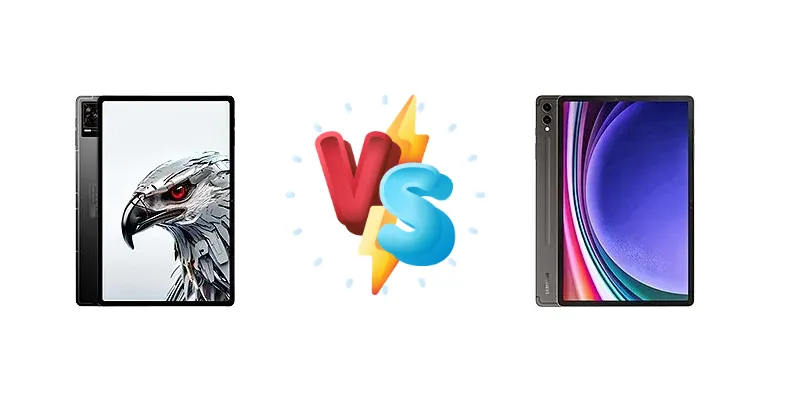
The Android tablet market is heating up, with two distinct contenders vying for dominance: the ZTE nubia RedMagic Tablet, aggressively focused on gaming performance, and the Samsung Galaxy Tab S9+, a more broadly capable device aiming for premium productivity and entertainment. This comparison dissects their core components to determine which tablet best suits your needs.
🏆 Quick Verdict
For dedicated mobile gamers, the ZTE nubia RedMagic Tablet offers a compelling package with its Snapdragon 8+ Gen 1 and rapid 80W charging. However, the Samsung Galaxy Tab S9+ emerges as the superior all-rounder, leveraging the more efficient Snapdragon 8 Gen 2 and Samsung’s refined software experience for a smoother, more versatile user experience.
| Network |
|---|
| 2G bands | GSM 850 / 900 / 1800 / 1900 | GSM 850 / 900 / 1800 / 1900 |
| 3G bands | HSDPA 850 / 900 / 2100 | HSDPA 850 / 900 / 1700(AWS) / 1900 / 2100 |
| 4G bands | LTE | 1, 2, 3, 4, 5, 7, 8, 12, 13, 17, 20, 25, 26, 28, 32, 38, 40, 41, 66 |
| 5G bands | SA/NSA | 1, 3, 5, 7, 8, 20, 28, 38, 40, 41, 66, 77, 78 SA/NSA/Sub6 |
| Speed | HSPA, LTE, 5G | HSPA, LTE, 5G - cellular model only |
| Technology | GSM / HSPA / LTE / 5G | GSM / HSPA / LTE / 5G |
| Launch |
|---|
| Announced | 2023, July 05 | 2023, July 26 |
| Status | Available. Released 2023, July 11 | Available. Released 2023, August 11 |
| Body |
|---|
| Build | Glass front, aluminum frame, aluminum back | Glass front, aluminum frame, aluminum back |
| Dimensions | 279.7 x 181.9 x 6.5 mm (11.01 x 7.16 x 0.26 in) | 285.4 x 185.4 x 5.7 mm (11.24 x 7.30 x 0.22 in) |
| SIM | Nano-SIM | Nano-SIM + eSIM (cellular model only) |
| Weight | 613 g (1.35 lb) | 586 g (581 g Wi-Fi) (1.29 lb) |
| Display |
|---|
| Protection | - | Corning Gorilla Glass |
| Resolution | 1600 x 2560 pixels, 16:10 ratio (~249 ppi density) | 1752 x 2800 pixels, 16:10 ratio (~266 ppi density) |
| Size | 12.1 inches, 424.5 cm2 (~83.4% screen-to-body ratio) | 12.4 inches, 446.1 cm2 (~84.3% screen-to-body ratio) |
| Type | IPS LCD, 1B colors, 144Hz, 600 nits (peak) | Dynamic AMOLED 2X, 120Hz, HDR10+ |
| Platform |
|---|
| CPU | Octa-core (1x3.0 GHz Cortex-X2 & 3x2.5 GHz Cortex-A710 & 4x1.8 GHz Cortex-A510) | Octa-core (1x3.36 GHz Cortex-X3 & 2x2.8 GHz Cortex-A715 & 2x2.8 GHz Cortex-A710 & 3x2.0 GHz Cortex-A510) |
| Chipset | Qualcomm SM8475 Snapdragon 8+ Gen 1 (4 nm) | Qualcomm SM8550-AC Snapdragon 8 Gen 2 (4 nm) |
| GPU | Adreno 730 | Adreno 740 |
| OS | Android 13, Redmagic OS 8 | Android 13, up to 4 major Android upgrades, One UI 6 |
| Memory |
|---|
| Card slot | No | microSDXC (dedicated slot) |
| Internal | 256GB 12GB RAM, 512GB 16GB RAM | 256GB 12GB RAM, 512GB 12GB RAM |
| Main Camera |
|---|
| Dual | - | 13 MP, f/2.0, 26mm (wide), 1/3.4", 1.0µm, AF
8 MP, f/2.2, (ultrawide) |
| Features | LED flash, HDR, panorama | LED flash, HDR, panorama |
| Single | 13 MP, AF | - |
| Video | 1080p@30fps | 4K@30fps, 1080p@30fps |
| Selfie camera |
|---|
| Features | - | HDR |
| Single | 16 MP | 12 MP, f/2.4, 120˚ (ultrawide) |
| Video | 1080p@30fps | 4K@30fps, 1080p@30fps |
| Sound |
|---|
| 35mm jack | No | No |
| Loudspeaker | Yes, with stereo speakers (4 speakers) | Yes, with stereo speakers (4 speakers) |
| Comms |
|---|
| Bluetooth | 5.3, A2DP, LE, aptX HD, aptX Adaptive, aptX Lossless | 5.3, A2DP, LE |
| NFC | Unspecified | No |
| Positioning | GPS, GLONASS, GALILEO, BDS | GPS, GLONASS, BDS, GALILEO - cellular model only |
| Radio | No | No |
| USB | USB Type-C 3.1, OTG, magnetic connector | USB Type-C 3.2, magnetic connector |
| WLAN | Wi-Fi 802.11 a/b/g/n/ac/6, dual-band | Wi-Fi 802.11 a/b/g/n/ac/6e, tri-band, Wi-Fi Direct |
| Features |
|---|
| Sensors | Accelerometer, gyro, compass, proximity (accessories only) | Fingerprint (under display, optical), accelerometer, gyro, proximity, compass |
| Battery |
|---|
| Charging | 80W wired, 50% in 24 min, 100% in 55 min | 45W wired |
| Type | Li-Po 10000 mAh | Li-Po 10090 mAh |
| Misc |
|---|
| Colors | Black | Beige, Graphite |
| Models | - | SM-X810, SM-X816B |
| Price | About 500 EUR | About 1000 EUR |
| SAR EU | - | 1.35 W/kg (body) |
ZTE nubia RedMagic Tablet
- Significantly faster 80W charging
- Potentially lower price point
- Optimized for gaming performance
- Older Snapdragon 8+ Gen 1 chipset
- Likely less refined software experience
- Potentially weaker camera system
Samsung Galaxy Tab S9+
- More powerful Snapdragon 8 Gen 2 chipset
- Superior software experience and ecosystem
- Likely better camera performance
- Slower 45W charging
- Higher price point
- May prioritize versatility over raw gaming power
Display Comparison
While both tablets likely feature high-quality LCD panels (specific panel tech is not provided), the focus shifts to performance. The Samsung Tab S9+ benefits from Samsung’s display expertise, likely offering superior color accuracy and potentially higher peak brightness. The RedMagic Tablet, geared towards gaming, may prioritize refresh rate over absolute color fidelity. Bezels are a key consideration; a smaller bezel-to-screen ratio on the Tab S9+ would enhance the premium feel. The absence of LTPO information makes it difficult to assess power efficiency gains on either device.
Camera Comparison
Given the focus of the RedMagic Tablet, camera performance is likely a secondary consideration. The Tab S9+ will almost certainly offer a more refined camera experience, benefiting from Samsung’s image processing algorithms and potentially larger sensor sizes. Without specific sensor details, it’s difficult to make a precise comparison, but the Tab S9+ is expected to deliver superior image quality, particularly in low-light conditions. The RedMagic Tablet’s camera is likely adequate for basic tasks but won’t compete with the Tab S9+’s capabilities.
Performance
The core difference lies in the chipsets. The Samsung Galaxy Tab S9+ boasts the Qualcomm SM8550-AC Snapdragon 8 Gen 2 (4nm), a generational leap over the ZTE nubia RedMagic Tablet’s Snapdragon 8+ Gen 1 (4nm). The 8 Gen 2’s Cortex-X3 prime core, clocked at 3.36 GHz, provides a significant performance advantage over the 8+ Gen 1’s Cortex-X2 at 3.0 GHz. Furthermore, the 8 Gen 2’s improved Cortex-A715 and A710 cores offer better efficiency. While both utilize a 4nm process, the architectural improvements in the 8 Gen 2 translate to superior sustained performance and reduced thermal throttling during extended gaming sessions. The Tab S9+’s likely use of faster LPDDR5x RAM further enhances its performance edge.
Battery Life
The ZTE nubia RedMagic Tablet’s 80W wired charging is a standout feature, promising a 50% charge in 24 minutes and a full charge in 55 minutes. This significantly outpaces the Samsung Galaxy Tab S9+’s 45W charging. However, battery capacity isn’t specified. If the Tab S9+ has a larger battery, the faster charging of the RedMagic Tablet might not fully offset the capacity difference. The 8 Gen 2’s superior efficiency in the Tab S9+ could also lead to longer real-world battery life despite the slower charging speed.
Buying Guide
Buy the ZTE nubia RedMagic Tablet if you prioritize raw gaming performance, need the fastest possible charging speeds, and are willing to trade some software polish for a lower price. Buy the Samsung Galaxy Tab S9+ if you value a premium build quality, a more refined software experience, broader feature set, and a tablet that excels at both productivity and entertainment.
Frequently Asked Questions
❓ Will the Snapdragon 8+ Gen 1 in the RedMagic Tablet struggle with demanding games after prolonged use?
The Snapdragon 8+ Gen 1 is a capable chipset, but the Snapdragon 8 Gen 2 in the Tab S9+ is more thermally efficient. This means the RedMagic Tablet may experience more noticeable throttling during extended gaming sessions, potentially leading to frame rate drops. However, the RedMagic Tablet's cooling system may mitigate this to some extent.
❓ Does the Samsung Galaxy Tab S9+ support DeX mode for a desktop-like experience?
Yes, the Samsung Galaxy Tab S9+ fully supports Samsung DeX, allowing you to connect it to an external monitor, keyboard, and mouse for a desktop-like experience. This significantly enhances productivity and makes the Tab S9+ a viable laptop replacement for many users.
❓ Is the 45W charging on the Tab S9+ slow compared to the RedMagic Tablet's 80W?
While 45W is slower than 80W, the Snapdragon 8 Gen 2's efficiency means the Tab S9+ may not require as frequent charging. Furthermore, Samsung's charging optimization algorithms can help minimize charging time. The difference in real-world usage may not be as significant as the wattage gap suggests.