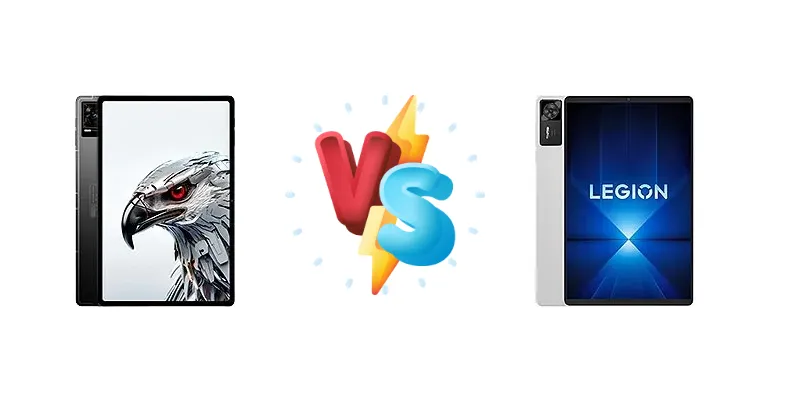
The Android gaming tablet space is heating up, with the ZTE nubia RedMagic Tablet and Lenovo Legion Y700 (Gen 4) leading the charge. While both aim to deliver a console-like experience on the go, they take distinctly different approaches. The RedMagic prioritizes raw cooling and a larger form factor, while the Legion Y700 focuses on a more compact design and the latest Snapdragon 8 Elite silicon. This comparison dissects the key differences to help you choose the right tablet for your gaming needs.
🏆 Quick Verdict
For the average gamer prioritizing peak performance and future-proofing, the Lenovo Legion Y700 (Gen 4) emerges as the winner. Its Snapdragon 8 Elite chipset, built on a 3nm process, offers a significant architectural advantage over the RedMagic Tablet’s Snapdragon 8+ Gen 1, despite the latter’s aggressive cooling. However, the RedMagic Tablet remains a compelling option for those who value a larger screen and potentially longer sustained performance due to its superior thermal design.
| Network |
|---|
| 2G bands | GSM 850 / 900 / 1800 / 1900 | N/A |
| 3G bands | HSDPA 850 / 900 / 2100 | N/A |
| 4G bands | LTE | N/A |
| 5G bands | SA/NSA | - |
| EDGE | - | No |
| GPRS | - | No |
| Speed | HSPA, LTE, 5G | - |
| Technology | GSM / HSPA / LTE / 5G | No cellular connectivity |
| Launch |
|---|
| Announced | 2023, July 05 | 2025, May 08 |
| Status | Available. Released 2023, July 11 | Available. Released 2025, May |
| Body |
|---|
| Build | Glass front, aluminum frame, aluminum back | Glass front, aluminum frame, aluminum back |
| Dimensions | 279.7 x 181.9 x 6.5 mm (11.01 x 7.16 x 0.26 in) | 7 mm thickness |
| SIM | Nano-SIM | No |
| Weight | 613 g (1.35 lb) | 340 g (11.99 oz) |
| Display |
|---|
| Resolution | 1600 x 2560 pixels, 16:10 ratio (~249 ppi density) | 1904 x 3040 pixels, 16:10 ratio (~408 ppi density) |
| Size | 12.1 inches, 424.5 cm2 (~83.4% screen-to-body ratio) | 8.8 inches, 224.8 cm2 |
| Type | IPS LCD, 1B colors, 144Hz, 600 nits (peak) | IPS LCD, 68B colors, 165Hz, HDR, 600 nits (typ) |
| Platform |
|---|
| CPU | Octa-core (1x3.0 GHz Cortex-X2 & 3x2.5 GHz Cortex-A710 & 4x1.8 GHz Cortex-A510) | Octa-core (2x4.32 GHz Oryon V2 Phoenix L + 6x3.53 GHz Oryon V2 Phoenix M) |
| Chipset | Qualcomm SM8475 Snapdragon 8+ Gen 1 (4 nm) | Qualcomm SM8750-AB Snapdragon 8 Elite (3 nm) |
| GPU | Adreno 730 | Adreno 830 |
| OS | Android 13, Redmagic OS 8 | Android 15 |
| Memory |
|---|
| Card slot | No | microSDXC |
| Internal | 256GB 12GB RAM, 512GB 16GB RAM | 256GB 12GB RAM, 512GB 16GB RAM, 1TB 16GB RAM |
| Main Camera |
|---|
| Features | LED flash, HDR, panorama | LED flash |
| Single | 13 MP, AF | 50 MP, (wide), PDAF |
| Video | 1080p@30fps | Yes |
| Selfie camera |
|---|
| Single | 16 MP | 8 MP |
| Video | 1080p@30fps | 1080p@30fps |
| Sound |
|---|
| 35mm jack | No | No |
| Loudspeaker | Yes, with stereo speakers (4 speakers) | Yes, with stereo speakers |
| Comms |
|---|
| Bluetooth | 5.3, A2DP, LE, aptX HD, aptX Adaptive, aptX Lossless | Yes |
| NFC | Unspecified | No |
| Positioning | GPS, GLONASS, GALILEO, BDS | No |
| Radio | No | Unspecified |
| USB | USB Type-C 3.1, OTG, magnetic connector | 1x USB Type-C 2.0 & 1x USB Type-C 3.2 Gen2, DisplayPort 1.4 |
| WLAN | Wi-Fi 802.11 a/b/g/n/ac/6, dual-band | Yes |
| Features |
|---|
| Sensors | Accelerometer, gyro, compass, proximity (accessories only) | Unspecified |
| Battery |
|---|
| Charging | 80W wired, 50% in 24 min, 100% in 55 min | 68W wired
Bypass charging |
| Type | Li-Po 10000 mAh | Li-Po 7600 mAh |
| Misc |
|---|
| Colors | Black | Black, White |
| Models | - | TB322FC, ZAG40002CN |
| Price | About 500 EUR | About 400 EUR |
ZTE nubia RedMagic Tablet
- Faster wired charging speed (80W)
- Potentially better sustained performance due to larger size and cooling
- Likely more affordable price point
- Older generation chipset (Snapdragon 8+ Gen 1)
- Less power efficient than Snapdragon 8 Elite
- Larger form factor may be less portable
Lenovo Legion Y700 (Gen 4)
- Latest generation chipset (Snapdragon 8 Elite)
- More power efficient 3nm process
- Bypass charging for cooler gaming while charging
- Slightly slower wired charging speed (68W)
- Potentially more prone to thermal throttling without effective cooling
- Likely higher price point
Display Comparison
While both tablets likely feature high refresh rate displays (data not provided), the core difference lies in the processing power driving them. The RedMagic Tablet’s Snapdragon 8+ Gen 1 (4nm) is a proven performer, but the Legion Y700’s Snapdragon 8 Elite (3nm) represents a generational leap. The 3nm process inherently offers better power efficiency, potentially leading to less heat generation and more consistent frame rates. The absence of display specs like peak brightness and panel type makes a direct comparison difficult, but the Legion Y700’s chipset advantage suggests a more visually responsive experience, especially in demanding titles.
Camera Comparison
Neither tablet is positioned as a photography powerhouse. Given the focus on gaming, camera specs are likely secondary. Without detailed information on sensor sizes or image processing capabilities, it’s difficult to draw conclusions. However, it’s reasonable to assume both will offer adequate cameras for casual use and video calls, but not compete with dedicated camera phones. The absence of information suggests neither device prioritizes camera quality as a key selling point.
Performance
The heart of the matter: the chipsets. The Snapdragon 8+ Gen 1 in the RedMagic Tablet utilizes an octa-core configuration with a Cortex-X2 prime core clocked at 3.0 GHz. This is a strong CPU, but the Legion Y700’s Snapdragon 8 Elite, featuring Oryon V2 Phoenix cores clocked up to 4.32 GHz, represents a significant architectural upgrade. The Oryon cores are designed for higher single-core performance, crucial for many mobile games. Furthermore, the 3nm fabrication process of the Snapdragon 8 Elite translates to improved thermal efficiency, potentially mitigating throttling during extended gaming sessions. The RedMagic Tablet will rely heavily on its cooling system to maintain performance.
Battery Life
The RedMagic Tablet boasts 80W wired charging, claiming a 50% charge in 24 minutes and 100% in 55 minutes. The Legion Y700 (Gen 4) offers 68W wired charging, but crucially includes 'bypass charging,' allowing the tablet to be powered directly from the charger while in use, reducing heat buildup and potentially extending battery life during long gaming sessions. While the RedMagic Tablet charges slightly faster on paper, the Legion Y700’s bypass charging is a significant advantage for gamers who want to play while charging.
Buying Guide
Buy the ZTE nubia RedMagic Tablet if you need a larger display for immersive gaming, prioritize sustained performance over short bursts of peak power, and appreciate a more affordable price point. Buy the Lenovo Legion Y700 (Gen 4) if you prefer a more portable form factor, demand the absolute latest in mobile processing power with the Snapdragon 8 Elite, and value faster charging with bypass charging capabilities.
Frequently Asked Questions
❓ Will the Snapdragon 8+ Gen 1 in the RedMagic Tablet struggle with demanding games at high settings?
The Snapdragon 8+ Gen 1 is still a very capable chipset, and will handle most Android games at high settings. However, the Snapdragon 8 Elite in the Legion Y700 offers a performance advantage, particularly in newer titles optimized for the Oryon cores. The RedMagic Tablet will rely on its cooling system to maintain consistent performance, but may experience some throttling during extended gaming sessions.
❓ How much of a difference does bypass charging make on the Lenovo Legion Y700 (Gen 4)?
Bypass charging is a significant benefit for gamers. By powering the tablet directly from the charger, it reduces heat buildup in the battery, which is a common cause of thermal throttling. This allows the Legion Y700 to maintain higher performance for longer periods while plugged in, and also extends the overall lifespan of the battery.
❓ Is the cooling system on the RedMagic Tablet effective enough to prevent throttling?
The RedMagic Tablet is known for its aggressive cooling solutions. While effective, it's unlikely to completely eliminate throttling under sustained heavy load. The Snapdragon 8+ Gen 1 generates more heat than the Snapdragon 8 Elite, meaning the cooling system has more work to do. Expect some performance dips during prolonged gaming sessions, but the cooling should prevent catastrophic overheating.