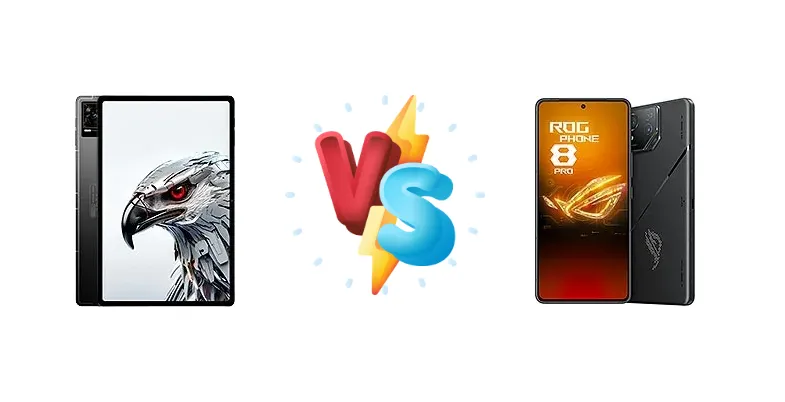
The mobile gaming landscape is diversifying. While phones like the Asus ROG Phone 8 Pro continue to refine the flagship gaming experience, devices like the ZTE nubia RedMagic Tablet are challenging the status quo by prioritizing screen real estate and sustained performance. This comparison dissects these two approaches, revealing which device best suits your gaming needs and lifestyle.
🏆 Quick Verdict
For dedicated, competitive mobile gamers prioritizing raw power and a large display, the ZTE nubia RedMagic Tablet is the clear winner. However, the Asus ROG Phone 8 Pro offers a more versatile, pocketable experience with superior battery life and a more refined camera system, making it ideal for everyday use alongside gaming.
| Network |
|---|
| 2G bands | GSM 850 / 900 / 1800 / 1900 | GSM 850 / 900 / 1800 / 1900 |
| 3G bands | HSDPA 850 / 900 / 2100 | HSDPA 850 / 900 / 1700(AWS) / 1800 / 1900 / 2100 - International |
| 4G bands | LTE | 1, 2, 3, 4, 5, 7, 8, 12, 17, 18, 19, 20, 25, 26, 28, 32, 34, 38, 39, 40, 41, 42, 43, 48, 66 - International |
| 5G bands | SA/NSA | 1, 2, 3, 5, 7, 8, 12, 18, 20, 25, 26, 28, 38, 40, 41, 48, 66, 77, 78, 79 SA/NSA/Sub6 - International |
| Speed | HSPA, LTE, 5G | HSPA, LTE (Up to 7CA), 5G |
| Technology | GSM / HSPA / LTE / 5G | GSM / CDMA / HSPA / LTE / 5G |
| Launch |
|---|
| Announced | 2023, July 05 | 2024, January 08 |
| Status | Available. Released 2023, July 11 | Available. Released 2024, January 18 |
| Body |
|---|
| Build | Glass front, aluminum frame, aluminum back | Glass front (Gorilla Glass Victus 2), glass back (Gorilla Glass), aluminum frame |
| Dimensions | 279.7 x 181.9 x 6.5 mm (11.01 x 7.16 x 0.26 in) | 163.8 x 76.8 x 8.9 mm (6.45 x 3.02 x 0.35 in) |
| SIM | Nano-SIM | Nano-SIM + Nano-SIM |
| Weight | 613 g (1.35 lb) | 225 g (7.94 oz) |
| Display |
|---|
| Protection | - | Corning Gorilla Glass Victus 2 |
| Resolution | 1600 x 2560 pixels, 16:10 ratio (~249 ppi density) | 1080 x 2400 pixels, 20:9 ratio (~388 ppi density) |
| Size | 12.1 inches, 424.5 cm2 (~83.4% screen-to-body ratio) | 6.78 inches, 111.0 cm2 (~88.2% screen-to-body ratio) |
| Type | IPS LCD, 1B colors, 144Hz, 600 nits (peak) | LTPO AMOLED, 1B colors, 165Hz, HDR10, 1600 nits (HBM), 2500 nits (peak) |
| Platform |
|---|
| CPU | Octa-core (1x3.0 GHz Cortex-X2 & 3x2.5 GHz Cortex-A710 & 4x1.8 GHz Cortex-A510) | Octa-core (1x3.3 GHz Cortex-X4 & 3x3.2 GHz Cortex-A720 & 2x3.0 GHz Cortex-A720 & 2x2.3 GHz Cortex-A520) |
| Chipset | Qualcomm SM8475 Snapdragon 8+ Gen 1 (4 nm) | Qualcomm SM8650-AB Snapdragon 8 Gen 3 (4 nm) |
| GPU | Adreno 730 | Adreno 750 |
| OS | Android 13, Redmagic OS 8 | Android 14, up to 2 major Android upgrades |
| Memory |
|---|
| Card slot | No | No |
| Internal | 256GB 12GB RAM, 512GB 16GB RAM | 512GB 16GB RAM, 1TB 24GB RAM |
| Main Camera |
|---|
| Features | LED flash, HDR, panorama | LED flash, HDR, panorama |
| Single | 13 MP, AF | - |
| Triple | - | 50 MP, f/1.9, 24mm (wide), 1/1.56", 1.0µm, PDAF, gimbal OIS
32 MP, f/2.4, (telephoto), 1/3.2", 0.7µm, PDAF, OIS, 3x optical zoom
13 MP, f/2.2, 13mm, 120˚ (ultrawide) |
| Video | 1080p@30fps | 8K@24fps, 4K@30/60fps, 1080p@30/60/120/240fps, 720p@480fps; gyro-EIS, HDR10+ |
| Selfie camera |
|---|
| Features | - | Panorama, HDR |
| Single | 16 MP | 32 MP, f/2.5, 22mm (wide), 1/3.2", 0.7µm |
| Video | 1080p@30fps | 1080p@30fps |
| Sound |
|---|
| 35mm jack | No | Yes |
| Loudspeaker | Yes, with stereo speakers (4 speakers) | Yes, with stereo speakers |
| Comms |
|---|
| Bluetooth | 5.3, A2DP, LE, aptX HD, aptX Adaptive, aptX Lossless | 5.4, A2DP, LE, aptX HD, aptX Adaptive, aptX Lossless |
| NFC | Unspecified | Yes |
| Positioning | GPS, GLONASS, GALILEO, BDS | GPS (L1+L5), BDS (B1I+B1c+B2a), GALILEO (E1+E5a), QZSS (L1+L5), NavIC (L5), GLONASS |
| Radio | No | No |
| USB | USB Type-C 3.1, OTG, magnetic connector | USB Type-C (side), DisplayPort 1.4; USB Type-C (bottom), OTG |
| WLAN | Wi-Fi 802.11 a/b/g/n/ac/6, dual-band | Wi-Fi 802.11 a/b/g/n/ac/6e/7, tri-band, Wi-Fi Direct |
| Features |
|---|
| Sensors | Accelerometer, gyro, compass, proximity (accessories only) | Fingerprint (under display, optical), accelerometer, gyro, proximity, compass |
| Battery |
|---|
| Charging | 80W wired, 50% in 24 min, 100% in 55 min | 65W wired, PD3.0, PPS, QC5, 100% in 39 min - International
30W wired, PD3.0, PPS - India
15W wireless (Qi)
10W reverse wired |
| Type | Li-Po 10000 mAh | 5500 mAh |
| Misc |
|---|
| Colors | Black | Phantom Black |
| Models | - | AI2401, AI2401_A, AI2401_D |
| Price | About 500 EUR | $ 1,157.98 / £ 1,693.75 / € 632.66 |
ZTE nubia RedMagic Tablet
- Larger screen for immersive gaming
- Potentially better thermal management due to size
- Faster wired charging (80W)
- Older chipset (Snapdragon 8+ Gen 1)
- Limited camera information suggests a weaker system
- Lower portability due to tablet form factor
Asus ROG Phone 8 Pro
- Latest Snapdragon 8 Gen 3 chipset for superior performance
- Excellent battery life (14:43h active use)
- Brighter display (1765 nits)
- Slower wired charging than RedMagic Tablet (65W)
- Smaller screen size compared to the tablet
- Higher price point likely
Display Comparison
The Asus ROG Phone 8 Pro boasts a significantly brighter display, reaching a measured 1765 nits, ensuring excellent visibility even in direct sunlight. While the RedMagic Tablet’s display specs are not provided, the ROG Phone’s brightness advantage is substantial. The ROG Phone 8 Pro’s panel likely utilizes LTPO technology for adaptive refresh rates, conserving battery life. The RedMagic Tablet’s larger form factor inherently offers a more immersive viewing experience, but without knowing its peak brightness or refresh rate capabilities, it’s difficult to assess its overall quality relative to the ROG Phone.
Camera Comparison
The context data for the RedMagic Tablet lacks camera specifications, suggesting it’s not a primary focus. The Asus ROG Phone 8 Pro, while not a camera-centric phone, offers a more comprehensive camera system. Details on the ROG Phone 8 Pro’s camera are limited, but it’s reasonable to expect features like OIS and a capable main sensor. The ROG Phone 8 Pro’s camera is likely geared towards social media sharing and casual photography, while the RedMagic Tablet’s camera is likely a basic offering for video calls and quick snapshots.
Performance
The Asus ROG Phone 8 Pro’s Snapdragon 8 Gen 3 chipset represents a generational leap over the RedMagic Tablet’s Snapdragon 8+ Gen 1. The Gen 3 features the newer Cortex-X4 prime core clocked at 3.3 GHz, alongside improved Cortex-A720 performance cores, resulting in a substantial performance uplift in both CPU and GPU tasks. While the 8+ Gen 1 remains a capable performer, the Gen 3’s architectural improvements and higher clock speeds translate to smoother frame rates and faster loading times. The ROG Phone 8 Pro also benefits from faster LPDDR5x RAM, further enhancing performance. The RedMagic Tablet’s larger size may offer better thermal headroom, potentially allowing for sustained performance, but the ROG Phone 8 Pro’s superior chipset provides a fundamental advantage.
Battery Life
The Asus ROG Phone 8 Pro demonstrates impressive battery life, achieving 14:43 hours of active use. While the RedMagic Tablet’s battery capacity is unknown, the ROG Phone’s endurance is a significant advantage. The ROG Phone 8 Pro supports 65W wired charging (international variant) and 30W in India, reaching 100% in 39 minutes (international). It also offers 15W wireless charging and 10W reverse wired charging. The RedMagic Tablet’s 80W charging is faster, reaching 100% in 55 minutes, but the ROG Phone’s longer battery life and wireless charging options provide greater flexibility.
Buying Guide
Buy the ZTE nubia RedMagic Tablet if you need a dedicated gaming machine with a large screen for immersive gameplay, and prioritize sustained performance over portability. Buy the Asus ROG Phone 8 Pro if you prefer a flagship smartphone experience with gaming enhancements, excellent battery life, and a capable camera system for all-around use. The ROG Phone 8 Pro is the better choice for users who want a single device for work, play, and everything in between.
Frequently Asked Questions
❓ Does the Snapdragon 8+ Gen 1 in the RedMagic Tablet throttle under sustained gaming loads?
While the Snapdragon 8+ Gen 1 is a capable chip, it's known to throttle under prolonged, intensive gaming sessions. The RedMagic Tablet's larger form factor *may* mitigate this through improved heat dissipation, but it's unlikely to match the sustained performance of the ROG Phone 8 Pro's newer Snapdragon 8 Gen 3.
❓ How does the ROG Phone 8 Pro's AirTriggers enhance the gaming experience?
The ROG Phone 8 Pro features AirTriggers, customizable ultrasonic buttons on the side of the device. These can be mapped to in-game actions, providing a tactile advantage and faster response times, particularly in competitive titles. This feature is absent on the RedMagic Tablet.
❓ Is the 30W charging speed in the Indian variant of the ROG Phone 8 Pro a significant drawback?
The 30W charging speed in the Indian variant is considerably slower than the 65W offered in other regions. While still usable, it will take noticeably longer to fully charge the device, potentially impacting convenience for users who frequently game and need quick top-ups.
❓ What type of cooling system does the RedMagic Tablet employ?
While specific details aren't provided, RedMagic is known for its advanced cooling solutions. The tablet likely features a vapor chamber and potentially active cooling (fan) to manage heat generated during gaming. However, without specifics, it's difficult to compare its effectiveness to the ROG Phone 8 Pro's cooling system.