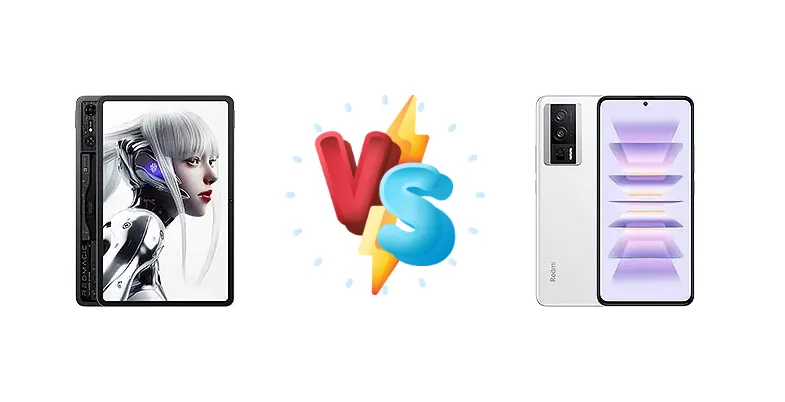
The ZTE nubia RedMagic Nova and Xiaomi Redmi K60 Pro represent compelling options in the increasingly competitive flagship space. The RedMagic Nova arrives with the latest Snapdragon 8 Gen 3, aiming for peak performance, while the K60 Pro leverages the still-potent Snapdragon 8 Gen 2 and focuses on a well-rounded experience with exceptionally fast charging. This comparison dissects their strengths and weaknesses to determine which device best suits your needs.
🏆 Quick Verdict
For users prioritizing raw processing power and sustained gaming performance, the ZTE nubia RedMagic Nova is the clear winner thanks to its Snapdragon 8 Gen 3. However, the Xiaomi Redmi K60 Pro offers a more balanced package with significantly faster charging and a competitive price, making it ideal for everyday users.
| Network |
|---|
| 2G bands | N/A | GSM 850 / 900 / 1800 / 1900 |
| 3G bands | N/A | HSDPA 800 / 850 / 900 / 1700(AWS) / 2100 |
| 4G bands | N/A | 1, 3, 4, 5, 8, 18, 19, 26, 34, 38, 39, 40, 41, 42 |
| 5G bands | - | 1, 3, 5, 8, 28, 38, 41, 77, 78 SA/NSA |
| EDGE | No | - |
| GPRS | No | - |
| Speed | - | HSPA, LTE, 5G |
| Technology | No cellular connectivity | GSM / CDMA / HSPA / CDMA2000 / LTE / 5G |
| | - | CDMA2000 1x |
| Launch |
|---|
| Announced | 2024, September 05 | 2022, December 27 |
| Status | Available. Released 2024, September 05 | Available. Released 2023, January 01 |
| Body |
|---|
| Build | Glass front, aluminum frame, aluminum back | - |
| Dimensions | 253.3 x 164.6 x 7.3 mm (9.97 x 6.48 x 0.29 in) | 162.8 x 75.4 x 8.6 mm or 8.9 mm |
| SIM | No | Nano-SIM + Nano-SIM |
| Weight | 530 g (1.17 lb) | 201 g or 205 g (7.09 oz) |
| Display |
|---|
| Resolution | 1800 x 2880 pixels, 16:10 ratio (~312 ppi density) | 1440 x 3200 pixels, 20:9 ratio (~526 ppi density) |
| Size | 10.9 inches, 344.5 cm2 (~82.6% screen-to-body ratio) | 6.67 inches, 107.4 cm2 (~87.5% screen-to-body ratio) |
| Type | IPS LCD, 144Hz, 550 nits | OLED, 68B colors, 120Hz, Dolby Vision, HDR10+, 1400 nits (peak) |
| Platform |
|---|
| CPU | 8-core (1x3.4GHz Cortex-X4 & 3x3.1GHz Cortex-A720 & 2x2.9GHz Cortex-A720 & 2x2.2GHz Cortex-A520) | Octa-core (1x3.2 GHz Cortex-X3 & 2x2.8 GHz Cortex-A715 & 2x2.8 GHz Cortex-A710 & 3x2.0 GHz Cortex-A510) |
| Chipset | Qualcomm SM8650-AC Snapdragon 8 Gen 3 (4 nm) | Qualcomm SM8550-AB Snapdragon 8 Gen 2 (4 nm) |
| GPU | Adreno 750 (1 GHz) | Adreno 740 |
| OS | Android 14, Redmagic OS 9.5 | Android 13, MIUI 14 |
| Memory |
|---|
| Card slot | No | No |
| Internal | 256GB 12GB RAM, 512GB 16GB RAM, 1TB 24GB RAM | 128GB 8GB RAM, 256GB 8GB RAM, 256GB 12GB RAM, 512GB 12GB RAM, 512GB 16GB RAM |
| | - | UFS 4.0
UFS 3.1 - 128GB only |
| Main Camera |
|---|
| Features | LED flash, HDR, panorama | Color spectrum sensor, Dual-LED dual-tone flash, HDR, panorama |
| Single | 50 MP, f/1.8, 26mm (wide) | - |
| Triple | - | 54 MP, f/1.9, (wide), 1/1.49", 1.0µm, PDAF, OIS
8 MP, 118˚ (ultrawide), 1/4.0", 1.12µm
2 MP (macro) |
| Video | 4K@30fps, 1080p@30fps | 8K@24fps, 4K@30/60fps, 1080p@30/60/120/240/960fps, 720p@1920fps, gyro-EIS |
| Selfie camera |
|---|
| Features | - | HDR |
| Single | 20 MP, f/2.0, 26mm (wide) | 16 MP, (wide), 1/3.06", 1.0µm |
| Video | 1080p@30fps | 1080p@30/60/120fps |
| Sound |
|---|
| 3.5mm jack | - | No |
| 35mm jack | No | No |
| Loudspeaker | Yes, with stereo speakers (4 speakers) | Yes, with stereo speakers |
| | - | 24-bit/192kHz audio |
| Comms |
|---|
| Bluetooth | 5.4, A2DP, LE | 5.3, A2DP, LE |
| Infrared port | - | Yes |
| NFC | Yes (no payments support) | Yes |
| Positioning | No | GPS (L1+L5), GLONASS (G1), BDS (B1I+B2a+Bc), GALILEO (E1+E5a), QZSS (L1+L5), NavIC |
| Radio | No | Unspecified |
| USB | USB Type-C 3.1 Gen2, video output, magnetic connector pins | USB Type-C 2.0, OTG |
| WLAN | Wi-Fi 802.11 a/b/g/n/ac/6, dual-band | Wi-Fi 802.11 a/b/g/n/ac/6e, dual-band, Wi-Fi Direct |
| Features |
|---|
| Sensors | Fingerprint (side-mounted), accelerometer, gyro, proximity, compass | Fingerprint (under display, optical), accelerometer, gyro, proximity, compass |
| Battery |
|---|
| Charging | 80W wired, 100% in 55 min - International model
120W wired, 50% in 15 min, 100% in 45 min - China model | 120W wired, PD3.0, QC3+, 100% in 19 min
30W wireless |
| Type | 10100 mAh | Li-Po 5000 mAh |
| Misc |
|---|
| Colors | Cyclone, Snowfall, Midnight | Black, White, Mint, Champion Black |
| Models | - | 22127RK46C |
| Price | About 500 EUR | About 460 EUR |
ZTE nubia RedMagic Nova
- Latest Snapdragon 8 Gen 3 for top-tier performance
- Solid battery life with 10:51h active use
- Fast charging options (80W/120W)
- Likely optimized for gaming with advanced cooling
- No wireless charging
- Display brightness may be lower than competitors
Xiaomi Redmi K60 Pro
- Incredibly fast 120W wired charging (19 minutes to full)
- 30W wireless charging for added convenience
- Excellent color accuracy and display quality
- Balanced performance with Snapdragon 8 Gen 2
- Older Snapdragon 8 Gen 2 chipset
- May not match the RedMagic Nova in sustained gaming performance
Display Comparison
The Xiaomi Redmi K60 Pro and ZTE nubia RedMagic Nova both feature high refresh rate displays, but differ in peak brightness. The RedMagic Nova reaches 517 nits, which is respectable, but may struggle in direct sunlight compared to displays exceeding 1000 nits. While panel technology details are missing for the RedMagic Nova, the K60 Pro is known for its excellent color accuracy. The absence of LTPO on the RedMagic Nova suggests a less dynamically adaptive refresh rate, potentially impacting battery life during static content viewing. Bezels are likely similar, given both phones target a premium aesthetic, but detailed measurements are unavailable.
Camera Comparison
Detailed camera specifications are absent, but we can infer some differences. Both phones likely employ a multi-camera system, but the Redmi K60 Pro is known for its strong main sensor and image processing. The RedMagic Nova, geared towards gaming, may prioritize video recording capabilities. Without sensor size or aperture information, a direct comparison is difficult. It's reasonable to assume the K60 Pro offers a more refined and versatile camera experience, while the RedMagic Nova focuses on capturing gameplay footage.
Performance
The core differentiator here is the chipset: the RedMagic Nova boasts the Qualcomm SM8650-AC Snapdragon 8 Gen 3 (4nm) versus the K60 Pro’s SM8550-AB Snapdragon 8 Gen 2 (4nm). The Gen 3 features a new CPU architecture with a Cortex-X4 prime core clocked at 3.4GHz, a significant upgrade over the K60 Pro’s Cortex-X3 at 3.2GHz. This translates to faster single-core performance and improved efficiency. The RedMagic Nova’s CPU configuration (1+3+2+2) also differs from the K60 Pro’s (1+2+2+3), potentially impacting multi-core workloads. Both utilize LPDDR5x RAM, but thermal management will be crucial; the Gen 3’s higher performance demands a robust cooling solution, which the RedMagic Nova likely prioritizes given its gaming focus.
Battery Life
The RedMagic Nova achieves a solid 10:51h active use score, indicating good battery life despite the power-hungry Snapdragon 8 Gen 3. Charging speeds are a key distinction. The RedMagic Nova offers 80W wired charging (International) or 120W (China), reaching 100% in 55 minutes or 45 minutes respectively. The K60 Pro, however, excels with 120W wired charging, achieving a full charge in just 19 minutes. Furthermore, the K60 Pro adds 30W wireless charging, a feature absent on the RedMagic Nova. This makes the K60 Pro significantly more convenient for users who frequently top up their battery.
Buying Guide
Buy the ZTE nubia RedMagic Nova if you demand the absolute best Android performance for demanding games and applications, and are willing to prioritize that over wireless charging or potentially slightly shorter battery life. Buy the Xiaomi Redmi K60 Pro if you value a balanced experience with incredibly fast wired and wireless charging, a vibrant display, and a more mainstream software experience, all at a potentially lower price point.
Frequently Asked Questions
❓ Does the Snapdragon 8 Gen 3 in the RedMagic Nova get noticeably hotter than the 8 Gen 2 in the K60 Pro during extended gaming sessions?
The Snapdragon 8 Gen 3 is more powerful, and therefore generates more heat. The RedMagic Nova likely incorporates a more aggressive cooling system to mitigate this, but sustained high-intensity gaming will likely result in higher temperatures compared to the K60 Pro. However, effective cooling prevents throttling, maintaining performance.
❓ Is the 120W charging on the Redmi K60 Pro compatible with all USB-PD chargers?
The Redmi K60 Pro supports 120W wired charging using proprietary protocols and USB-PD. While it will charge with standard USB-PD chargers, you won't achieve the full 120W speed unless you use a compatible charger that supports the correct Power Delivery profile. Using the included charger is recommended for optimal charging speeds.
❓ How does the software experience differ between the RedMagic Nova and the Redmi K60 Pro?
The RedMagic Nova runs a customized version of Android geared towards gaming, with features like game space and performance optimization tools. The Redmi K60 Pro runs Xiaomi's MIUI, a more mainstream Android skin with a wider range of features and customization options. MIUI is known for its extensive feature set but can also be more resource-intensive.