
RedMagic Mars vs Black Shark 2 Pro: A Deep Dive into Gaming Phone Performance
| Phones Images | |||||
|---|---|---|---|---|---|
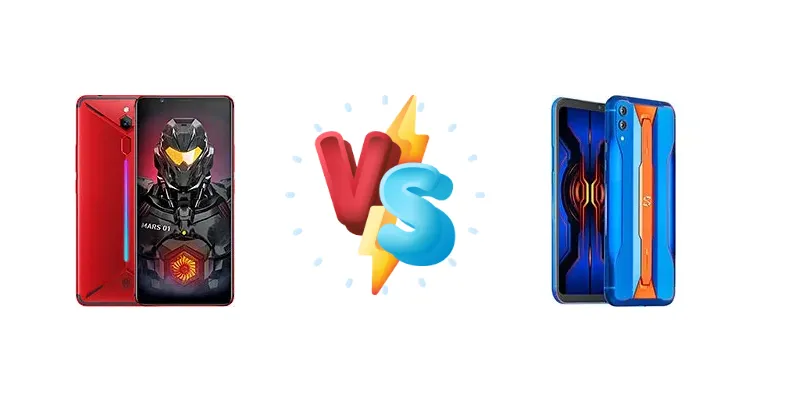
|
🏆 Quick Verdict
For the average gamer prioritizing raw performance and future-proofing, the Xiaomi Black Shark 2 Pro is the clear winner. Its Snapdragon 855+ offers a significant performance uplift over the RedMagic Mars’ Snapdragon 845, coupled with faster 27W charging. However, the RedMagic Mars remains a compelling option for budget-conscious gamers.
| PHONES | ||
|---|---|---|
| Phone Names | ZTE nubia RedMagic Mars | Xiaomi Black Shark 2 Pro |
| Network | ||
|---|---|---|
| 2G bands | GSM 850 / 900 / 1800 / 1900 | GSM 850 / 900 / 1800 / 1900 |
| 3G bands | HSDPA 850 / 900 / 1900 / 2100 | HSDPA 850 / 900 / 1900 / 2100 |
| 4G bands | 1, 2, 3, 4, 5, 7, 8, 12, 17, 18, 19, 20, 25, 26, 28, 30, 34, 38, 39, 40, 41, 66 | 1, 2, 3, 4, 5, 7, 8, 19, 20, 28, 34, 38, 39, 40, 41 - Global |
| Speed | HSPA 42.2/5.76 Mbps, LTE (5CA) Cat18 1200/150 Mbps | HSPA 42.2/5.76 Mbps, LTE (5CA/3CA) Cat18 1200/150 Mbps |
| Technology | GSM / CDMA / HSPA / EVDO / LTE | GSM / CDMA / HSPA / EVDO / LTE |
| - | 1, 3, 4, 5, 7, 8, 34, 38, 39, 40, 41 - China | |
| Launch | ||
|---|---|---|
| Announced | 2018, November. Released 2018, December | 2019, July. Released 2019, August |
| Status | Discontinued | Discontinued |
| Body | ||
|---|---|---|
| Build | Glass front (Dinorex T2X-1), aluminum back, aluminum frame | Glass front, aluminum back, aluminum frame |
| Dimensions | 158.2 x 75 x 9.9 mm (6.23 x 2.95 x 0.39 in) | 163.6 x 75 x 8.8 mm (6.44 x 2.95 x 0.35 in) |
| SIM | Nano-SIM + Nano-SIM | Nano-SIM + Nano-SIM |
| Weight | 193 g (6.81 oz) | 205 g (7.23 oz) |
| Display | ||
|---|---|---|
| Protection | Dinorex T2X-1 scratch/shock resistant glass | - |
| Resolution | 1080 x 2160 pixels, 18:9 ratio (~402 ppi density) | 1080 x 2340 pixels, 19.5:9 ratio (~403 ppi density) |
| Size | 6.0 inches, 92.9 cm2 (~78.3% screen-to-body ratio) | 6.39 inches, 100.2 cm2 (~81.7% screen-to-body ratio) |
| Type | IPS LCD | AMOLED |
| - | Always-on display | |
| Platform | ||
|---|---|---|
| CPU | Octa-core (4x2.8 GHz Kryo 385 Gold & 4x1.7 GHz Kryo 385 Silver) | Octa-core (1x2.96 GHz Kryo 485 & 3x2.42 GHz Kryo 485 & 4x1.78 GHz Kryo 485) |
| Chipset | Qualcomm SDM845 Snapdragon 845 (10 nm) | Qualcomm SM8150 Snapdragon 855+ (7 nm) |
| GPU | Adreno 630 | Adreno 640 (700 MHz) |
| OS | Android 9.0 (Pie), Redmagic 1.0 | Android 9.0 (Pie) |
| Memory | ||
|---|---|---|
| Card slot | No | No |
| Internal | 64GB 6GB RAM, 128GB 8GB RAM, 256GB 10GB RAM | 128GB 8GB RAM, 128GB 12GB RAM, 256GB 12GB RAM |
| - | UFS 3.0 | |
| Main Camera | ||
|---|---|---|
| Dual | - | 48 MP, f/1.8, 28mm (wide), 1/2.0", 0.8µm, PDAF 12 MP, f/2.2, 54mm (telephoto), 1.0µm, PDAF, 2x optical zoom |
| Features | LED flash, HDR, panorama | LED flash, HDR, panorama |
| Single | 16 MP, f/1.8, PDAF | - |
| Video | 4K@30fps, 1080p@30fps | 4K@30/60fps, 1080p@30/60/120fps, 720p@1920fps |
| Selfie camera | ||
|---|---|---|
| Features | HDR | HDR |
| Single | 8 MP, f/2.0 | 20 MP, f/2.0, (wide), 1/3", 0.9µm |
| Video | 1080p@30fps | 1080p@30fps |
| Sound | ||
|---|---|---|
| 3.5mm jack | - | No |
| 35mm jack | Yes | No |
| Loudspeaker | Yes | Yes, with stereo speakers |
| Comms | ||
|---|---|---|
| Bluetooth | 5.0, A2DP, aptX, LE | 5.0, A2DP, aptX HD, LE |
| NFC | No | No |
| Positioning | GPS, GLONASS, BDS | GPS, GLONASS, GALILEO, QZSS, BDS |
| Radio | No | No |
| USB | USB Type-C, OTG | USB Type-C 2.0 |
| WLAN | Wi-Fi 802.11 a/b/g/n/ac, dual-band, Wi-Fi Direct | Wi-Fi 802.11 a/b/g/n/ac, dual-band, Wi-Fi Direct |
| Features | ||
|---|---|---|
| Sensors | Fingerprint (rear-mounted), accelerometer, gyro, proximity, compass | Fingerprint (under display, optical), accelerometer, gyro, proximity, compass |
| Battery | ||
|---|---|---|
| Charging | 18W wired | 27W wired |
| Type | Li-Po 3800 mAh, non-removable | Li-Ion 4000 mAh, non-removable |
| Misc | ||
|---|---|---|
| Colors | Black, Red, Camouflage | Shadow Black, Iceberg Grey, Gulf Blue, Streamer Purple |
| Models | NX619J | DLT-A0, DLT-H0 |
| Price | About 420 EUR | About 550 EUR |
ZTE nubia RedMagic Mars
- More affordable price point
- Decent gaming performance for the price
- Likely includes a headphone jack (common in RedMagic series)
- Older Snapdragon 845 chipset
- Slower 18W charging
- Potential for more thermal throttling
Xiaomi Black Shark 2 Pro
- Faster Snapdragon 855+ chipset
- 27W fast charging
- Improved thermal management
- Higher price tag
- May lack a headphone jack (common in Black Shark series)
- Potentially larger and heavier design
Display Comparison
While specific display specs beyond chipset are unavailable, both phones target high refresh rates common in gaming phones. The Black Shark 2 Pro likely benefits from advancements in panel technology available at its release, potentially offering better color accuracy and viewing angles. The RedMagic Mars, being an earlier model, may exhibit slightly lower peak brightness and contrast. Bezels are likely comparable, focusing on maximizing screen real estate for immersive gaming.
Camera Comparison
Given the gaming focus, camera performance isn't a primary differentiator. Both phones likely feature competent camera systems, but details are limited. It's reasonable to assume the Black Shark 2 Pro, being a newer device, benefits from improved image processing algorithms and potentially a larger main sensor. However, without specific sensor size or aperture information, a definitive comparison is difficult. The inclusion of a 2MP macro lens on either device is likely a marketing feature with limited practical benefit.
Performance
The core difference lies in the chipsets. The Xiaomi Black Shark 2 Pro’s Snapdragon 855+ (7nm) represents a substantial upgrade over the ZTE nubia RedMagic Mars’ Snapdragon 845 (10nm). The 855+ features a faster Kryo 485 core clocked at 2.96 GHz compared to the 845’s 2.8 GHz Kryo 385 Gold core. This, combined with the smaller 7nm process, translates to higher sustained performance and improved thermal efficiency. The 855+’s Adreno 640 GPU also provides a significant graphical advantage. While both phones likely utilize LPDDR4X RAM, the 855+'s architecture is better optimized for memory bandwidth, further enhancing performance. The RedMagic Mars will likely exhibit more thermal throttling under prolonged heavy load.
Battery Life
The Black Shark 2 Pro’s 27W wired charging is a significant advantage over the RedMagic Mars’ 18W charging. This translates to considerably faster charging times, minimizing downtime between gaming sessions. While battery capacity isn't specified, the faster charging speed effectively mitigates any potential capacity difference. The 855+'s improved power efficiency also contributes to longer battery life during gaming, despite potentially having a similar capacity to the RedMagic Mars.
Buying Guide
Buy the ZTE nubia RedMagic Mars if you need a highly affordable gaming phone and are willing to accept slightly older hardware. It’s ideal for casual gamers and those on a tight budget. Buy the Xiaomi Black Shark 2 Pro if you prioritize sustained performance during demanding gaming sessions, faster charging, and a more refined overall experience, even if it comes at a higher cost.